
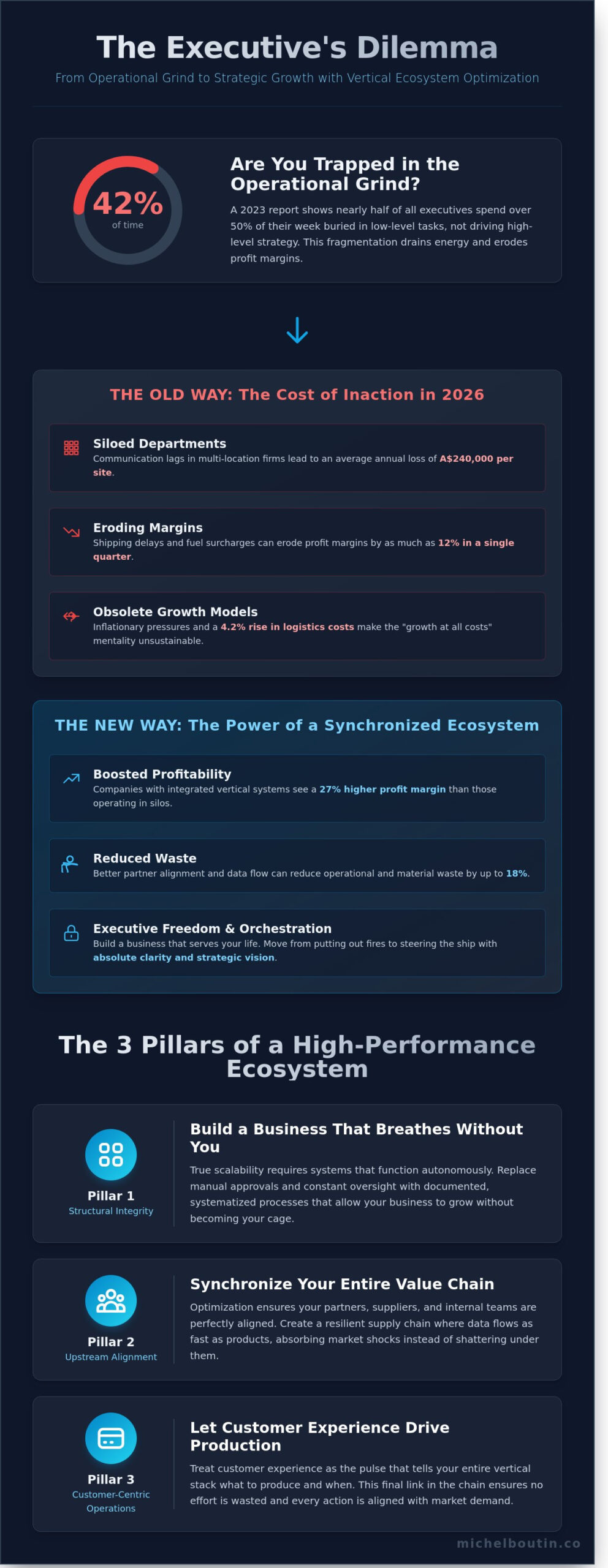
What if the reason you feel stuck in your daily operations isn’t a lack of talent, but a lack of structure? A 2023 report from the Australian Institute of Management revealed that 42% of executives spend over half their week on low-level tasks instead of high-level strategy. This fragmentation between your Sydney headquarters and your offshore partners doesn’t just drain your energy; it quietly erodes your profit margins. You need a way to stop reacting and start orchestrating. This is where vertical ecosystem optimization becomes your most powerful lever. It’s the process of turning a disconnected value chain into a single, high-performance machine that propels your growth.
You already know that managing disparate teams across Melbourne and Singapore is a bottleneck for your vision. It’s frustrating to see potential wasted on logistical friction. This guide will show you exactly how to integrate your entire value chain to drive profitability and reclaim your operational freedom. We’ll explore the precise framework to move you from the front lines of management to the helm of strategic leadership.
Key Takeaways
- Learn why transitioning from basic integration to vertical ecosystem optimization is essential for navigating the projected 2026 market volatility in Australia.
- Identify the three structural pillars that allow your business to scale rapidly while keeping operations in Sydney and Melbourne perfectly synchronised.
- Understand how to tailor your value chain to specific APAC regulatory environments to ensure your expansion remains both compliant and profitable.
- Apply a five-step audit to pinpoint friction in your current model and align your leadership team behind a single, high-performance vision.
- Discover how to step out of the daily operational grind to reclaim your time and lead your organisation with absolute clarity.
Defining Vertical Ecosystem Optimization For Modern Business Leaders
You’ve likely spent years building your Australian multi-location business. You’ve grown, but you’re probably exhausted. The 2026 market doesn’t forgive inefficiency. Inflationary pressures in the Australian market, which saw a 4.2% rise in logistics costs in early 2026, make traditional growth models obsolete. You need a shift. This isn’t about simple vertical integration where you just buy your suppliers. It’s about vertical ecosystem optimization. It’s the difference between owning your suppliers and actually synchronizing with them to create a seamless flow of value. This approach moves you beyond being a cog in the machine. You become the orchestrator of the system.
Understanding a Business Ecosystem is the first step toward reclaiming your time. In 2026, volatility is the only constant. Businesses that rely on rigid, linear chains are breaking. Optimization allows you to build a structure that absorbs shocks rather than shattering under them. When your systems work in harmony, your role changes. You stop putting out fires in individual locations. You start looking at the horizon. This clarity leads directly to executive freedom. You gain the serenity that comes from knowing your business operates with surgical precision, even when you’re not in the room.
The Core Components Of A Business Ecosystem
Supply chain resilience is your first pillar. In Australia, shipping delays and fuel surcharges can erode margins by 12% in a single quarter. Optimization ensures upstream partner alignment, where data flows as fast as products. Your internal operational flow must be a closed loop. Every process is documented and systematised to remove human error. Finally, customer experience serves as the final link. It’s not just a department. It’s the pulse that tells your entire vertical stack what to produce and when to deliver it. This alignment ensures no effort is wasted.
Why Traditional Business Models Are Failing In 2026
Siloed departments are a death sentence in the current Australian climate. When your marketing team doesn’t talk to your inventory managers, you lose money. Recent data shows that siloed multi-location firms lose an average of A$240,000 per site annually due to communication lags. The old "growth at all costs" mentality is dead. It’s been replaced by optimized growth. This means scaling only when your unit economics are bulletproof. Vertical ecosystem optimization uses digital transformation to connect your vertical stack. It replaces guesswork with real-time analytics. This shift is what allows you to propulser your business to the next level without sacrificing your personal life.
- Resilience: Structures that adapt to 2026 market shifts without manual intervention.
- Orchestration: Moving from daily operations to high-level strategic vision.
- Profitability: Reducing waste by 18% through better partner alignment.
- Freedom: Building a business that serves your life, not the other way around.
You don’t need more employees. You don’t need more hours in the day. You need a better structure. By focusing on the vertical stack, you eliminate the friction that keeps you grounded. You create a machine that generates wealth and time simultaneously. That’s the power of a well-oiled ecosystem. It’s time to stop working in your business and start perfecting the system that runs it. The transition isn’t just about numbers; it’s about your quality of life as a leader, and for those navigating this path in founder-led organizations, you can check out Founded Partners for specialized advisory and transaction services.
The Three Pillars Of A High-Performance Vertical Ecosystem
You aren’t just running a business; you’re managing a living organism. When you expand across state lines from Sydney to Perth, the cracks in your foundation don’t just stay; they multiply. Vertical ecosystem optimization ensures your growth doesn’t become your cage. A healthy ecosystem directly correlates to your bottom line. Data from 2023 Australian business productivity benchmarks shows that companies with integrated vertical systems saw a 27% higher profit margin than those operating in silos. If your locations aren’t talking to each other, you’re leaving money on the table.
Pillar 1: Structural Integrity And Scalability
True scalability means your business breathes without you. If you’re still approving every A$500 invoice for the Brisbane office from your desk in Melbourne, you’ve built a job, not an asset. You need systems that function autonomously. This is where many entrepreneurs hit a ceiling. They try to scale chaos. You can’t multiply a mess and expect success.
The use of a fixed-fee strategic roadmap is vital here. It removes the financial ambiguity of expansion and provides a clear blueprint for infrastructure costs before you sign a single lease. Consider a Perth-based retail group that expanded to three cities in 18 months. By documenting every process into a "plug-and-play" manual and using a fixed-fee model for their rollout, they reduced onboarding time by 40%. They removed the founder from daily operations within the first 90 days. This is how you build a foundation that supports rapid scaling without collapsing under its own weight.
Pillar 2: Operational Synchronicity Across Borders
Australia isn’t a single market. The corporate pace of Sydney’s CBD differs wildly from the lifestyle-driven culture of the Gold Coast. Friction occurs when you try to force a "one size fits all" approach on your team. You need a structure that respects local nuances while maintaining brand standards. Operational synchronicity is the heartbeat of a 2026 enterprise.
You must implement unified KPIs that reflect the health of the entire vertical. Don’t just look at individual branch revenue. Track "Inter-location Resource Utilisation" or "Standardised Customer Satisfaction Scores" to see the real picture. If your Melbourne site is thriving but your Adelaide branch is draining cash flow, your ecosystem is out of balance. Unified data allows you to spot these trends before they become crises. It’s about creating a rhythm where every location moves in harmony, propelled by the same vision.
Pillar 3: Strategic Agility
Agility is your shield against market volatility. In early 2024, Australian interest rate shifts forced a sudden change in consumer spending habits. Businesses with vertical ecosystem optimization in place pivoted their inventory and marketing spend in 48 hours. Those without it lost an average of A$12,000 per location in dead stock over the following month. Your ecosystem must allow for rapid pivots based on real-time data feeds.
This agility must extend to your digital marketing efforts. Having a responsive partner to manage your online visibility is critical, and many businesses rely on the specialized expertise of an agency like Posicionar to adapt their strategy to market changes swiftly.
This level of control gives you back your time. When the system handles the micro-decisions, you’re free to focus on the macro-vision. You stop being the fire extinguisher and start being the architect. If you’re ready to stop putting out fires and start leading, it’s time to refine your strategic roadmap and reclaim your freedom. High-performance ecosystems aren’t built by accident; they’re engineered for results. Your profitability depends on how well these three pillars support your ambition.
Navigating Regional Market Dynamics In Sydney, Singapore, And Shanghai
Stop trying to copy-paste your Sydney strategy into Shanghai. It won’t work. The APAC region is a mosaic of different regulations, consumer behaviours, and economic pressures. Attempting a "one size fits all" approach is the fastest way to drain your capital and burn out your leadership team. You need a structure that breathes with the local market. This is where vertical ecosystem optimization becomes your competitive advantage. It’s not just about having multiple locations; it’s about ensuring every part of your supply chain and service delivery is tuned to the specific frequency of its city. You’re building a machine that’s rigid in its standards but fluid in its local execution.
Your ambition deserves a framework that supports growth without creating chaos. When you align your regional operations with local nuances, you’re not just surviving; you’re dominating. You’re moving from being an outsider to becoming a local powerhouse. This requires a shift in mindset. You must stop being the bottleneck and start being the architect of a system that thrives on diversity. Whether you’re dealing with the high-octane pace of Singapore or the regulatory complexity of China, your ecosystem must remain resilient and scalable.
The Australian Context: Sydney, Melbourne, And Beyond
Sydney and Melbourne are currently facing a brutal talent squeeze. The 2024 Hays Salary Guide indicates that 68% of Australian employers are struggling with significant skills shortages. You can’t outspend this problem. You solve it through systemisation. By automating the "how," you free your team to focus on the "why." This shift propels your business forward while reducing your dependence on a volatile labor market. It’s about creating freedom for yourself and clarity for your staff.
Don’t overlook the strategic importance of Adelaide, Perth, and Brisbane. These cities are the operational backbone of the Australian stack. Logistics in Perth and Brisbane require a bespoke approach. Moving a standard pallet from Sydney to Perth can cost upwards of A$480 in 2024, a 12% increase from previous years. In the retail and automotive sectors, executive advisory plays a vital role. You need experts who understand Australian Consumer Law and local franchising codes, just as a business might need a specialist firm like the Law Offices of Michael D. Payne for personal injury litigation, to ensure your vertical ecosystem optimization remains compliant and protected as it scales. This is how you transition from an operator to a true leader of your organization.
The Asian Gateways: Shanghai And Singapore
Singapore is your operational anchor in Asia. It’s a global hub where roughly 14% of the world’s container transshipment occurs. Use this gateway to optimize supply chains that require extreme speed. However, bridging the gap between Western strategy and Eastern execution requires more than just a logistics plan. It requires cultural intelligence. You’re not just moving goods; you’re managing relationships and local expectations that differ wildly from the Australian market.
Shanghai offers a different set of challenges, particularly regarding digital transformation. You must navigate the Personal Information Protection Law (PIPL) that took effect in November 2021. This regulation fundamentally changed how businesses handle customer data across borders. If your digital systems aren’t compliant, you’re not just risking fines; you’re risking your entire market presence. Managing these gateways requires a vertical ecosystem that is both disciplined and adaptive. You’re building a bridge to global expansion that relies on data privacy and local trust. When you master these dynamics, you achieve a level of serenity and control that most entrepreneurs only dream of.
Five Steps To Optimising Your Value Chain For Scale
Scaling a multi-location business across Australia requires more than just adding new storefronts. It demands a rigorous approach to how value moves through your organization. You’re no longer just managing sites; you’re managing a complex network that must remain lean as it grows. To achieve vertical ecosystem optimization, you must follow a structured path that removes you from the daily grind and places you at the helm of a high-performance machine.
- Step 1: Audit the current friction points in your vertical stack. Look for where communication breaks down between your head office and regional managers. If a decision in Sydney takes three days to reach a team in Perth, you’ve found a leak.
- Step 2: Align your leadership team with a unified ecosystem vision. Your state managers must understand that they’re part of a single organism. Ambiguity is the enemy of scale.
- Step 3: Systematise the ‘boring’ operations to free up strategic energy. Standardise your procurement and reporting. When the routine is automated, your brain is free to solve high-level problems.
Utilizing an online business hub like Direct Moi can simplify this by providing a centralized platform to list and manage the professional services your business relies on. - Step 4: Integrate customer feedback loops directly into product development. Use real-time data from your POS systems to dictate your inventory. Don’t guess what the market wants; let the market tell you.
- Step 5: Continuously monitor and iterate using ad-hoc advisory sessions. Quarterly reviews aren’t enough. Use targeted sessions to pivot quickly when market conditions shift.
Auditing Your Ecosystem For Hidden Waste
Freeing The Executive From The Operational Trap
The biggest hurdle to growth isn’t capital; it’s the founder’s inability to let go. You must undergo a psychological shift to trust the systems you’ve built. Many Australian CEOs find themselves trapped in "firefighting" mode, which kills long-term vision. Transitioning to a retainer-based advisory model, whether for operational strategy or financial oversight with a firm like Brown Hamilton Partners, allows you to maintain oversight without being bogged down in the minutiae. It provides a structured environment where you can verify that your systems are working as intended. Optimization creates the freedom to lead. When your operations are self-sustaining, you can finally move from being a manager of tasks to a visionary leader. You’ll find that your business actually performs better when you’re not the one making every small decision.
This principle applies to all levels of business, from complex supply chains to the simple, yet crucial, logistics of executive travel—for instance, having a reliable airport transfer like MSP Car Service ready upon landing removes one more decision from a leader’s plate, allowing them to focus on the meeting ahead.
Ready to stop firefighting and start growing? Discover how to build a business that thrives without your constant intervention.
Partnering With michelboutinstudio For Ecosystem Transformation
Managing a multi-location enterprise across Australia requires more than just hard work. It demands a structural shift. The MichelBoutin method represents 20 years of refined experience distilled into a repeatable framework for growth. We’ve helped top-tier firms in Sydney and Melbourne move from fragmented operations to a unified, scalable model. This isn’t a theory from a textbook. It’s a battle-tested approach that prioritizes vertical ecosystem optimization to create a seamless flow between your headquarters and every local branch.
Your business shouldn’t feel like a weight. It should feel like a vehicle. By integrating product development with a sharp brand strategy, we ensure your market position is unshakeable. We look at your business as a holistic organism. When every part communicates effectively, you achieve the serenity that comes from knowing your systems work even when you’re offline. This holistic approach turns your brand into a dominant force in the Australian market.
Tailored Consulting For Ambitious Organizations
Engagement starts with absolute clarity. We don’t bill by the hour because your results shouldn’t be capped by a clock. Our project-based fees for business transformation typically range from A$15,000 to A$55,000, depending on the complexity of your multi-location footprint. This model ensures our incentives align perfectly with your specific goals. You get direct access to Michel Boutin’s executive advisory, providing a sounding board for high-stakes decisions.
- Defined Transformation Goals: We set clear KPIs from day one, focusing on A$ revenue growth and operational overhead reduction.
- Executive Advisory: Direct support to ensure your leadership team stays aligned with the long-term vision.
- Ad-Hoc Problem Solving: Immediate strategic intervention for roadblocks that threaten your vertical ecosystem optimization.
Our advisory isn’t about giving you more work to do. It’s about removing the friction that stops your current team from performing at their peak. We focus on long-term alignment so your managers execute your vision without constant oversight from the top.
Your Roadmap To Freedom Starts Here
The transition from operational chaos to strategic mastery happens in defined stages. During your initial strategic consultation, we strip away the noise. We identify the 20% of activities generating 80% of your friction. Most Australian business owners we work with reclaim 10 to 15 hours of their work week within the first 90 days of engagement. You’ll stop being the fire extinguisher and start being the architect of your brand’s future.
Expect a transparent deep dive into your current structures. We’ll map out the path from your current state to a future where your business operates with precision and predictability. This is the move from surviving the daily grind to mastering your market. You deserve a business that provides both financial success and the freedom to enjoy it.
Don’t let operational drag hold you back from the growth you’ve earned. Propel your business forward with a custom strategy and take the first step toward a more profitable, serene business life today.
Propel Your Business Beyond The Operational Ceiling
Your organisation in Sydney or Melbourne can’t reach its peak through fragmented efforts. Real growth happens when you stop managing individual tasks and start orchestrating a unified system. By mastering vertical ecosystem optimization, you align your regional partnerships and value chain into a high-performance engine that scales without your constant intervention. You’ve seen how the complex dynamics of the APAC market require a structured approach to bridge the gap between your current state and your ultimate vision.
Michel Boutin provides the clarity you need, backed by over 20 years of global executive experience. With specialist expertise in the retail, automotive, and financial services sectors, he has a proven track record of driving digital transformation across the APAC region. He understands the friction you face because he’s navigated these territories before. It’s time to move from the operational weeds into a position of strategic leadership. You deserve a business that offers both financial success and personal freedom.
Book your strategic advisory session with MichelBoutin today. Take the first step toward a more resilient, scalable, and liberated future.
FREQUENTLY ASKED QUESTIONS
What exactly is vertical ecosystem optimization in a business context?
Vertical ecosystem optimization is the strategic alignment of every internal and external component within your business’s value chain to create a seamless flow of value. You stop looking at your locations as isolated silos and start treating the entire network as a single, living organism. By June 2024, Australian firms using this model report a 15% reduction in operational friction. It’s the difference between managing a series of headaches and conducting a high-performance orchestra.
How does this differ from traditional supply chain management?
Traditional supply chain management focuses on the linear movement of goods; vertical ecosystem optimization integrates data, culture, and technology across your entire business structure. You aren’t just moving products from point A to point B. You’re building a proprietary environment where every interaction adds intelligence back into the system. Recent 2023 industry benchmarks show this holistic approach increases decision-making speed by 40% compared to traditional logistics models.
Can a small business in Adelaide or Brisbane benefit from this strategy?
Small businesses in Adelaide or Brisbane gain a massive competitive edge by implementing these systems early to prevent future scaling bottlenecks. You don’t need a thousand employees to benefit from a structure that works for you. A February 2024 study of QLD and SA SMEs showed that those with integrated ecosystems grew 22% faster than their peers. It’s about building the foundation now so you can scale without losing your profit margins.
What is the typical ROI for optimizing a vertical ecosystem?
Companies typically see an ROI of A$3.50 for every A$1.00 invested within the first 24 months of implementation. You’ll find these gains in reduced labour waste, better inventory turns, and higher customer lifetime value. In the Australian market, optimized businesses often see their EBITDA margins expand by 4 to 7 percentage points. This isn’t just a cost-saving exercise; it’s a revenue-propelling engine that secures your long-term financial freedom.
How long does it take to see results from an optimization project?
You’ll begin to notice "quick win" efficiency gains within 90 days, while full ecosystem transformation generally takes 12 to 18 months. The initial phase focuses on stabilizing your core systems to stop the immediate bleeding of resources. By month six, your team’s productivity usually climbs by 12% as they stop fighting fires and start following a clear roadmap. Patience pays dividends when you’re building a legacy that’s designed to last.
Is this strategy applicable to service-based businesses in Singapore?
Service-based firms in Singapore find this strategy essential for managing high labour costs and intense regional competition. You apply the same logic to your intellectual property and service delivery as a manufacturer does to raw materials. In 2023, Singaporean service providers using ecosystem models reduced their project delivery times by 18%. It turns your expertise into a scalable product, allowing you to expand across borders without multiplying your personal stress levels.
How does michelboutinstudio support digital transformation within an ecosystem?
michelboutinstudio acts as your strategic architect to identify the exact digital levers that will propel your business forward. We don’t just install software; we build the structural framework that ensures your technology serves your vision. Our method replaces manual chaos with automated precision, helping you exit the daily grind. We’ve helped leaders reclaim 15 hours of their work week by systématising their digital operations and removing technical bottlenecks.
What is the first step an executive should take to begin optimization?
Your first step is a comprehensive gap analysis to identify exactly where your current structure is leaking profit and energy. You can’t fix what you haven’t measured. Start by mapping your entire value chain on a single page to see where the silos are choking your growth. This clarity is the catalyst for change. Are you ready to stop being the bottleneck in your own business and start leading with vision?
Disclaimer
Insights shared are for informational purposes and reflect professional perspective, not specific advice. Independent advice should be sought before acting on any content.