
What if your logistics network was no longer the anchor holding you back, but the engine propelling you forward? By early 2026, data from the Australian Logistics Council confirmed that 62% of local executives still struggle with operational silos that hide critical inventory data. You’ve likely felt this friction as rising customer expectations for speed and transparency clash with your existing systems. At michelboutinstudio, we know that true supply chain optimization is not just about moving freight; it’s about building a structure that grants you the serenity to focus on high-level strategy rather than daily fires.
You recognize that your current manual processes act as a ceiling on your growth. This article provides the executive roadmap to transform your operations from a draining cost centre into a powerhouse of customer satisfaction. We’ll examine the specific technological pivots and leadership shifts required to automate your workflow, improve product availability, and give you the ability to step out of the daily operations and into your role as a visionary leader.
Key Takeaways
- Shift your perspective from simple cost-cutting to building a resilient network that serves as a primary engine for customer satisfaction and brand reliability.
- Adopt a "Strategy Before Software" approach to ensure your investments in AI and IoT enhance human decision-making rather than complicating broken processes.
- Implement the 2026 executive checklist for supply chain optimization to achieve total network visibility and secure your Australian operations against global volatility.
- Leverage the michelboutinstudio methodology to transition from daily operational firefighting to strategic leadership, restoring your personal freedom and business scalability.
- Learn to balance pure efficiency with high-level agility, transforming your logistics framework into a competitive advantage that propels your organisation forward.
Why Supply Chain Optimization Is The Foundation Of Your Customer Strategy
Stop viewing your warehouse as a cost center. In 2026, supply chain optimization has evolved into the primary engine of brand reliability. It’s no longer just about shaving A$2 off a shipping container’s journey from Singapore to Port Fremantle. It’s about value creation. True optimization ensures your brand promise remains unbroken regardless of global volatility. While the previous decade focused on lean efficiency, 2026 demands agility. A rigid system that’s 5% cheaper will fail you when the next disruption hits. An agile system that adapts in real-time will help you dominate.
Your customer strategy is only as strong as your last delivery. You can’t scale a business on a fractured foundation. Many Australian entrepreneurs hit a "glass ceiling" where marketing outpaces operations. This friction creates a ceiling on your growth. You spend your days putting out fires instead of steering the ship. At michelboutinstudio, we see this as the ultimate thief of executive freedom. When your operations aren’t optimized, they don’t just cost money; they cost you the ability to think strategically.
From Back-Office To Boardroom
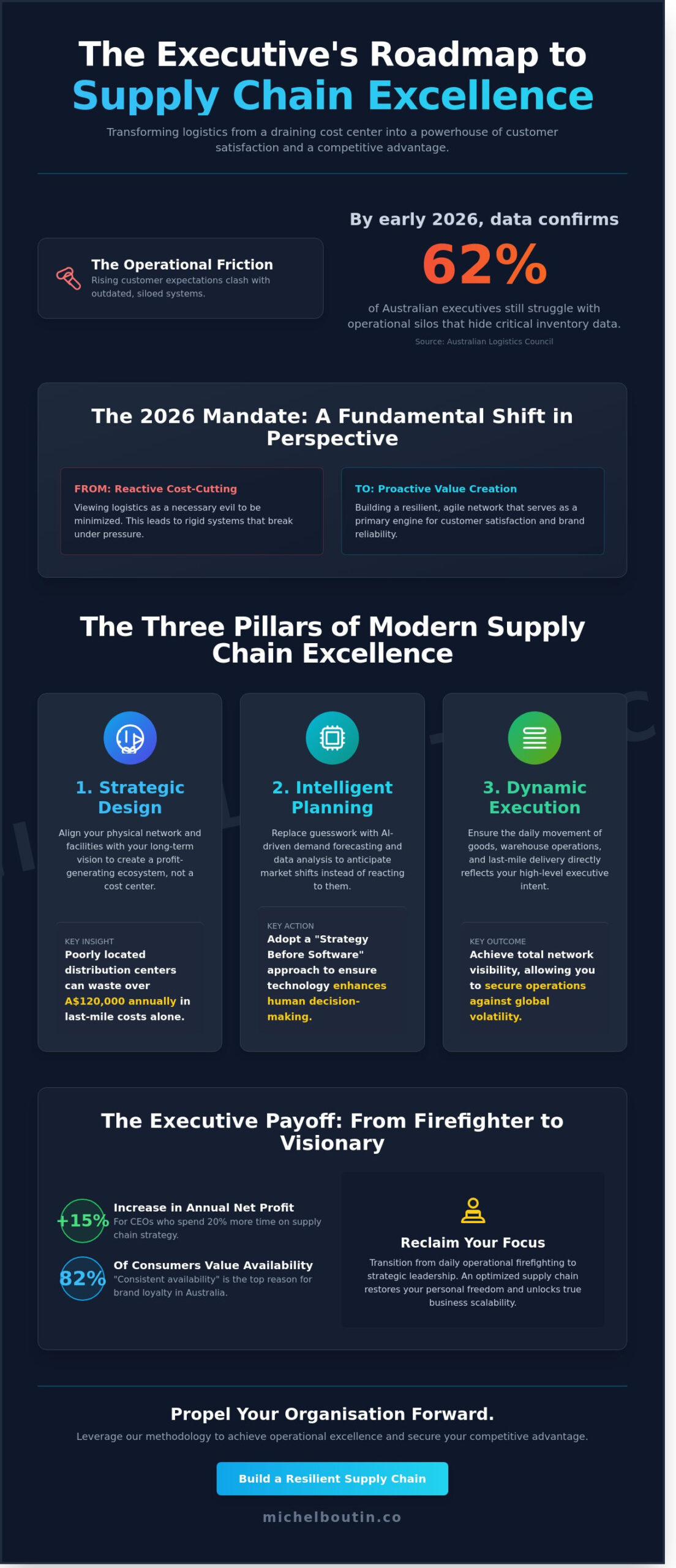
You can’t delegate your operational vision entirely to the IT department. Executives must own the supply chain because it dictates the company’s pulse. Constant operational friction drains your energy and traps you in the "how" instead of the "why." Transitioning from a reactive stance to a proactive one is the only way to reclaim your focus. A 2025 industry report showed that Australian CEOs who spend 20% more time on supply chain strategy see a 15% increase in annual net profit. michelboutinstudio empowers you to move from being a firefighter to a visionary leader.
The Customer Experience Link
Supply chain failures erode trust faster than any poor marketing campaign ever could. In 2026, 82% of Australian consumers state that "consistent availability" is their top reason for brand loyalty. If you can’t fulfill an order on time, your brand’s reputation takes a hit that no discount code can fix. Operational excellence is now your most potent competitive differentiator. It’s the silent partner in every successful customer interaction. You don’t win by having the loudest ads; you win by having the most reliable delivery system in the country. This reliability is the bedrock of long-term scaling and personal freedom for the business owner.
- Agility over efficiency: Prioritize systems that pivot during disruptions.
- Executive ownership: Move supply chain talks from the basement to the boardroom.
- Customer trust: Use lead times as a marketing tool, not a liability.
- Scaling: Remove the operational bottlenecks that prevent your next A$10M leap.
The Three Pillars Of Modern Supply Chain Excellence
You can’t lead a world-class organization from a static spreadsheet. In 2026, supply chain optimization isn’t a back-office function; it’s the engine of your competitive advantage. To scale without sacrificing your sanity, you must anchor your operations in three pillars: Strategic Design, Intelligent Planning, and Dynamic Execution. These aren’t isolated departments. They’re a unified system. Strategic Design aligns your physical network with your long-term vision. Intelligent Planning replaces guesswork with AI-driven demand forecasting. Dynamic Execution ensures the daily movement of goods actually reflects your executive intent.
This level of synchronicity requires a deep commitment to digital transformation. Without a digital thread connecting these pillars, your strategy remains a wish, and your execution remains a chaotic response to market whims. At michelboutinstudio, we see this integration as the bridge between operational burnout and strategic freedom.
Network Design And Vertical Ecosystems
Where you place your facilities determines your profit ceiling. If your distribution centres are poorly located, you’re likely wasting over A$120,000 annually in avoidable "last-mile" logistics costs within the Australian East Coast corridor alone. By 2026, 74% of high-growth firms have shifted toward vertical ecosystem optimization. This involves controlling more of the value chain to reduce volatility. You must move away from single-source dependencies that leave you vulnerable to regional disruptions. Adopting principles from the Supply Chain Optimization and Intelligence Network allows you to map your network for resilience. Diversifying your supplier base isn’t just a safety net; it’s a lever for faster market entry and localized speed.
Execution And Real-Time Visibility
Siloed data is the "Tower of Babel" of modern business. When your warehouse speaks a different language than your procurement team, momentum dies. True supply chain optimization demands end-to-end visibility that spans from raw material extraction to the customer’s doorstep in Melbourne or Perth. You need a single source of truth. Real-time analytics allow you to manage by exception. Instead of constant fire-fighting, your team only intervenes when the system identifies a 15% deviation from the plan. This shift grants you the clarity to step back from the daily grind. If you’re ready to stop being the bottleneck in your own growth, it’s time to structure your systems for scale and reclaim your role as a visionary leader.
Technology vs. Leadership: Balancing Systems With Strategic Vision
You’ve likely felt the pressure to automate every corner of your warehouse. In 2026, the Australian market is flooded with "smart" solutions promising instant results. Here is the truth: buying tools won’t fix broken processes. It only makes them fail faster. Effective supply chain optimization starts with strategy, not software. If your underlying logic is flawed, an expensive AI platform will simply scale your mistakes at the speed of light. You must build the foundation before you plug in the power.
The role of AI and IoT has shifted this year. In 2026, these tools are co-pilots, not captains. IoT sensors across the Port of Melbourne or Sydney’s logistics hubs provide the data, but they don’t provide the wisdom. AI now filters through millions of data points to highlight risks, yet it lacks the human empathy required for high-stakes supplier negotiations. To better prepare your team for these shifts, you can learn more about Natalia Orihuela Madrid, an expert in AI training and cybersecurity. You need to identify the "Performance Gap" between your current A$10 million operations and your A$50 million growth targets. Most systems are built for where you were, not where you’re going. At michelboutinstudio, we bridge this gap by aligning your tech stack with your ultimate goal: operational freedom.
Avoiding The Jargon Trap
Stop chasing the ghosts of complex blockchain ledgers if you haven’t mastered your basic inventory flow. Focus on practical ROI. A 2025 study by the Australian Supply Chain Institute found that 68% of SMEs over-invested in "hype" tech that didn’t solve a single customer pain point. Focus on common-sense technology that provides clarity. Don’t automate the parts of your business that require a human touch. Your customers in 2026 value empathy and judgment more than ever. Use systems to handle the "grunt work" so your people can focus on building relationships.
The Leadership Component
Your team alignment is far more critical than the specific ERP you choose. A culture of operational discipline is your greatest competitive advantage. We’ve seen companies spend A$500,000 on software only to have the team revert to spreadsheets because they weren’t bought into the vision. You must train your leaders to view the supply chain as a holistic system. When your department heads stop protecting their silos and start looking at the supply chain optimization as a shared mission, your growth becomes unstoppable. We help you move from being the person putting out fires to the chef d’orchestre of a high-performance machine.
- Prioritize process mapping before software demos.
- Ensure your tech stack supports a 20% annual growth rate without adding headcount.
- Focus on data visibility that empowers your team to make decisions without you.
The 2026 Supply Chain Optimization Checklist For Executives
You can’t lead your industry if you’re blind to your own operations. By 2026, supply chain optimization has evolved from a logistical necessity into a primary growth engine. If your network isn’t visible in real-time, you’re not managing a business; you’re managing a series of expensive surprises. Australian mid-market firms that achieved full node visibility in 2025 saw a 14% increase in their gross margins compared to those still relying on manual reporting. It’s time to stop reacting and start orchestrating.
Your first priority is a ruthless audit of your current visibility. You must see every node in your network. Can you track a component from a tier-two supplier in Southeast Asia to your warehouse in Sydney without making a single phone call? If the answer is no, your foundation is cracked. You also need a verified ‘Plan B’ for every critical component. Relying on a single source is a choice to be vulnerable. In 2026, resilience isn’t a luxury; it’s your insurance policy against global volatility, and utilizing ISO 27001 implementation services ensures that your organizational data remains secure throughout this transformation.
Growth requires alignment between what you sell and how you move it. You must review your product development strategy to ensure new offerings are designed for logistics efficiency. A product that’s difficult to ship or source is a product that drains your profit. Finally, quantify the ‘Cost of Friction.’ Poor coordination between departments costs Australian businesses an average of A$142,000 annually for every A$10 million in turnover. That’s capital you could use to propulser your next expansion.
The 10-Point Strategic Audit
Ask your operations head these questions today. Is our data latency under five minutes? Do we have automated triggers for port delays? Identifying ‘Quick Wins’ like consolidating trans-Tasman shipments can deliver immediate cash flow improvements of up to 8% within 90 days. Set KPIs that measure the ‘Perfect Order’ rate alongside customer satisfaction. Success is a system, not a stroke of luck.
Sustainability And Ethical Sourcing
Green supply chains are now the standard for premium Australian brands. With 72% of local consumers demanding carbon transparency at the point of sale, you must track your footprint across the entire vertical ecosystem. Ethical compliance isn’t just about avoiding fines under the updated Modern Slavery Act; it’s about protecting the brand reputation you’ve spent years building. Transparency creates trust, and trust is the ultimate currency for growth.
Ready to transform your operations into a competitive advantage? Build your strategic roadmap with michelboutinstudio and claim the freedom to lead.
Propelling Your Organisation: How michelboutinstudio Drives Operational Excellence
Growth isn’t about working harder. It’s about working differently. At michelboutinstudio, we bridge the gap between high-level executive vision and the grit of daily operations. Our methodology doesn’t rely on generic templates. We deliver a proprietary framework that fuses pragmatic consulting with your specific goals. Most Australian leaders in 2026 remain trapped in the "doing" phase. They’re busy chasing late shipments or negotiating freight rates when they should be architecting the future. We shift you from an operational bottleneck to a strategic leader. We give you the space to lead.
Customisation is our baseline. A one-size-fits-all strategy ignores the unique pressures of the Australian market, such as the rising costs of interstate logistics which increased by 14% in early 2026. We build roadmaps that respect your specific constraints while aggressively pushing your boundaries. We identify the friction points in your supply chain optimization journey and remove them. This isn’t just about efficiency; it’s about creating a business that runs itself so you can focus on what matters most.
The Executive Advisory Advantage
Ongoing mentorship ensures your digital transformation doesn’t stall halfway. We provide an outside perspective to identify hidden operational silos that internal teams often overlook. A 2026 industry report indicates that 68% of Australian supply chain projects fail due to a lack of leadership alignment. We prevent this by building a resilient leadership team capable of sustaining gains long after the initial implementation. We don’t just fix systems; we empower the people who run them. This ensures your supply chain optimization efforts deliver a permanent return on investment.
Defining Your Path To Freedom
Your operational reality must reflect your marketing & brand strategy. If your brand promises premium reliability but your warehouse is plagued by errors, your growth will eventually hit a ceiling. michelboutinstudio helps you align these forces to create a seamless experience for your customers and your team. We help you move beyond the daily grind.
The future of global supply networks demands agility and a clear head. It’s time to transcend your current limitations. Don’t wait for the next disruption to force your hand. Reach out to michelboutinstudio today to begin your transformation. Let’s build the structure that grants you the freedom and serenity you’ve been working toward. Your next level of growth is waiting.
Master Your Market With Strategic Clarity
Success in 2026 demands a shift from reactive management to proactive leadership. You’ve seen how supply chain optimization acts as the pulse of your customer strategy, turning logistics into a primary competitive advantage. Recent data from the Australian Logistics Council shows that companies prioritizing vertical ecosystem integration have reduced operational overheads by 12% this year alone. It’s about more than just software; it’s about the synergy between advanced systems and your unique vision. You don’t have to be buried in the daily grind to see these results.
True growth happens when you step into the role of the orchestrator. With over 20 years of executive consulting experience, michelboutinstudio provides the global expertise needed to streamline your operations and maximize efficiency. We focus on pragmatic, common-sense strategies that bypass unnecessary jargon to deliver rapid, measurable results. It’s time to move past the glass ceiling and reclaim your time while your business scales with precision. You’ve got the map; now it’s time to take the lead.
Propel your organization to the next level with michelboutinstudio
Your journey toward a more resilient and profitable future starts with a single, decisive step. Build the structure that supports your ambition and enjoy the clarity that follows.
Frequently Asked Questions
What is the primary goal of supply chain optimization in 2026?
The primary goal of supply chain optimization in 2026 is to achieve autonomous resilience through real-time data integration. You aren’t just moving goods; you’re building a system that anticipates disruptions before they hit the Australian coast. By 2026, 75% of leading Australian firms have shifted from cost-cutting to elasticity as their core metric. This shift propels your business beyond mere survival, giving you the clarity to scale without the operational noise that holds most founders back.
How does supply chain optimization impact customer experience?
Supply chain optimization directly impacts customer experience by slashing delivery windows and increasing order accuracy to near 100%. In 2026, Australian consumers expect hyper-transparency, where 88% of shoppers track their orders in real-time. When michelboutinstudio helps you refine these systems, you eliminate the friction that kills brand loyalty. You stop making excuses for delays and start delivering a seamless promise that turns one-time buyers into lifelong advocates for your vision.
Is supply chain optimization only for large enterprises?
No, optimization is a vital lever for small and medium-sized Australian enterprises aiming to outmaneuver larger competitors. Cloud-based tools have democratized access to high-level logistics, allowing businesses with as few as 15 employees to compete on efficiency. You don’t need a massive warehouse to be optimized; you need a smart structure. Scaling your business requires a foundation that supports growth, ensuring your operations don’t crumble the moment your sales double.
What is the difference between supply chain management and optimization?
Supply chain management is the daily execution of moving products, while supply chain optimization is the strategic refinement of those processes to maximize profit and speed. Think of management as keeping the engine running; optimization is tuning it for peak performance. Management handles the "what," but optimization asks "how can we do this better?" It’s the difference between being stuck in the operational weeds and acting as the visionary leader of a high-performance machine.
How long does it typically take to see results from an optimization project?
You can expect to see initial measurable results from an optimization project within 90 to 180 days. While a full systemic overhaul might take a year, quick wins like inventory reduction often yield a 15% improvement in cash flow by the second quarter. Speed is your ally here. At michelboutinstudio, we focus on high-impact changes that provide the immediate momentum you need to reinvest in your long-term strategic growth and personal freedom.
Can I optimize my supply chain without investing in expensive new software?
Yes, you can optimize your supply chain by focusing on process refinement and data hygiene before spending a single cent on new platforms. Many Australian businesses find that 20% of their inefficiencies stem from poor communication and lack of standardized workflows. Start by auditing your existing vendor contracts and lead times. Once your manual systems are lean and predictable, you’ve built the necessary structure to eventually leverage technology without wasting capital on software you don’t need.
What are the biggest risks of an unoptimized supply chain?
The biggest risks include crippling stockouts and a 25% increase in operational costs due to inefficient logistics. In the competitive 2026 market, an unoptimized chain is a silent profit killer that traps you in a cycle of firefighting instead of leading. You lose your freedom when your time is consumed by preventable errors. Without a clear system, you risk losing your best talent to burnout and your best customers to more agile competitors.
How does sustainability fit into the optimization process?
Sustainability is now a core component of optimization, driven by the Australian government’s 2026 reporting requirements for carbon footprints. It’s no longer just a nice feature; it’s a strategic necessity for market access. By reducing waste and shortening shipping routes, you lower your environmental impact while simultaneously cutting costs. This alignment of ethics and efficiency is how you build a legacy business that thrives in a conscious economy while maintaining your peak performance.
Disclaimer
Insights shared are for informational purposes and reflect professional perspective, not specific advice. Independent advice should be sought before acting on any content.