What if your fragmented retail locations were your greatest competitive advantage instead of your biggest operational headache? In 2026, the gap between OEM global expectations and local Australian dealer execution has widened, leaving many leaders feeling like they’re managing chaos rather than a business. Effective automotive network management isn’t about rigid control; it’s about building a system that breathes. You know the frustration of looking at data that doesn’t talk to itself across Sydney, Melbourne, and Brisbane showrooms. It’s time to stop reacting to friction and start engineering flow.
You’ve likely felt the pressure of the 42% shift toward service-led revenue models that has dominated the Australian market since early 2025. It’s exhausting to maintain brand consistency when every location feels like a different company. At michelboutinstudio, we believe you deserve a structure that grants you both high performance and personal freedom. This article shows you how to unify your data, align your teams with 2026 market demands, and scale without skyrocketing your overhead. We’ll explore the strategic pillars of operational excellence and provide a clear roadmap to transform your network into a high-growth ecosystem that runs with surgical precision.
Key Takeaways
- Learn why the traditional command-and-control model is failing and how to transition to a unified brand promise that resonates across every Australian showroom.
- Master the pillars of high-performing automotive network management by implementing a standardized operational playbook that ensures consistent luxury and value for your customers.
- Prepare for the 2026 shift toward the Agency Model and discover how AI-driven hyper-personalization predicts customer readiness to drive significant sales growth.
- Bridge the operational gap between OEMs and dealers by building transparent, data-driven relationships that eliminate resistance to new digital processes.
- Discover how michelboutinstudio helps you step away from daily operational friction to become the strategic conductor of a thriving, high-growth retail ecosystem.
What Is Strategic Automotive Network Management In 2026?
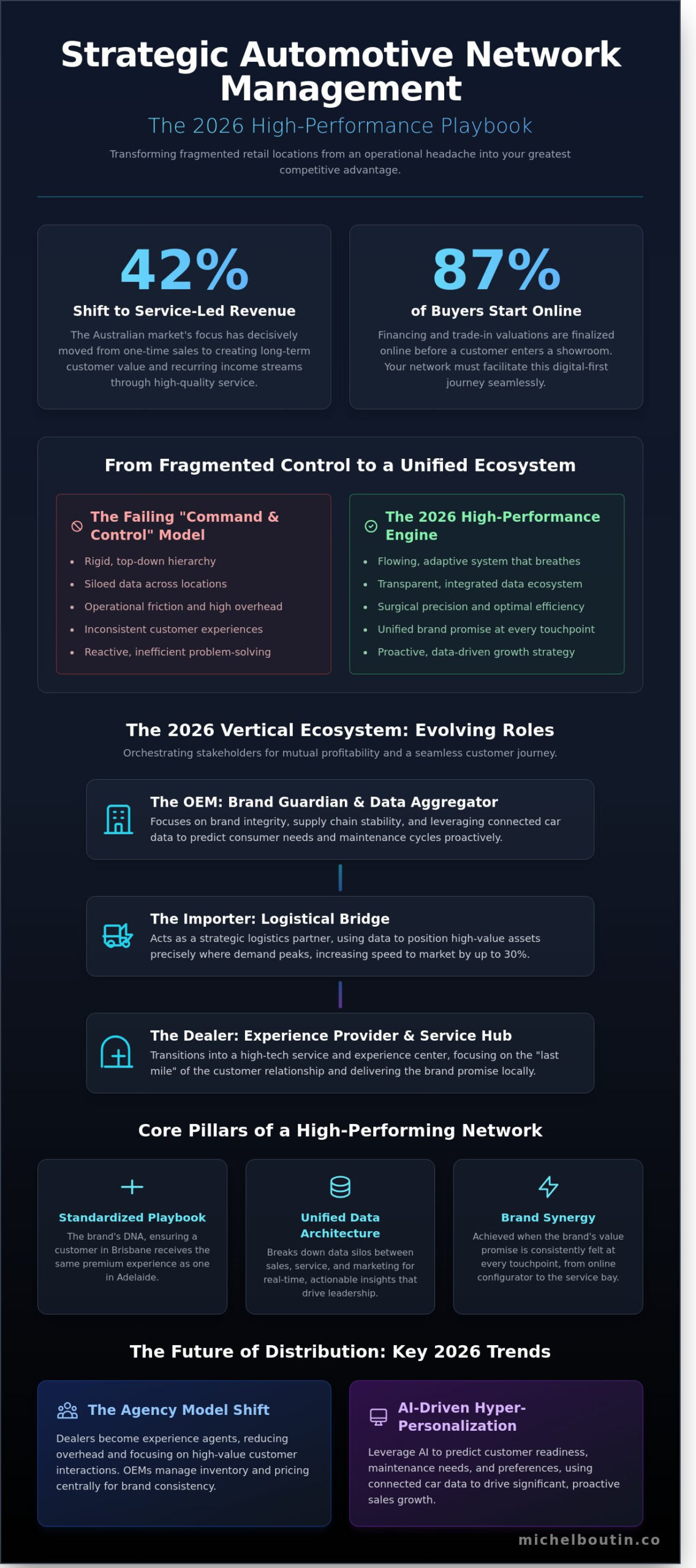
Strategic automotive network management is the systematic orchestration of OEMs, importers, and retail dealers to deliver a unified brand promise across every touchpoint. It’s no longer about simply shipping units to a lot. By 2026, the industry has moved past the rigid “command and control” models of the last decade. Those old structures failed because they couldn’t adapt to a market where 87% of Australian buyers finalize their financing and trade-in valuations online before stepping into a physical dealership. You can’t dictate terms to a digital-first consumer; you have to facilitate their movement, much like how specialized services such as Book Your Road Test streamline the licensing phase for new drivers before they even begin their vehicle search.
The focus has shifted from managing physical assets and floorplan interest to managing the customer journey across the entire network. National automotive brands achieve a definitive competitive advantage by transforming their network management into a high-performance engine of consistency and trust. This transition requires a move away from siloed data and toward a transparent, integrated ecosystem that values speed and responsiveness over traditional hierarchy.
The Vertical Ecosystem Explained
The vertical ecosystem represents the flow of value from the manufacturer’s floor to the end-user’s driveway. In the Australian context, this involves complex logistics and varying state regulations that can create friction. Vertical optimization reduces this friction, increasing speed to market for new models by up to 30% compared to 2023 standards. michelboutinstudio plays a critical role here, aligning these disparate stakeholders toward a single growth vision. This alignment ensures that every partner, from the port of entry to the local service bay, understands their role in the broader strategy. When you synchronise these moving parts, you eliminate the operational waste that eats into your margins.
Key Stakeholders And Their Evolving Roles
The roles within the network have fundamentally changed to meet modern demands. The OEM now acts as the brand guardian and primary data aggregator. They leverage real-time insights from Connected Car Technology to predict maintenance cycles and consumer preferences before the customer even picks up the phone. This data allows for a proactive rather than reactive business model.
- The OEM: Focuses on brand integrity, global supply chain stability, and high-level data analysis.
- The Dealer: Transitions into a local experience provider and high-tech service hub, focusing on the “last mile” of the customer relationship.
- The Importer: Acts as the logistical bridge, ensuring that A$50,000 to A$120,000 assets are positioned exactly where demand peaks.
Mutual profitability is the only sustainable metric for network health in 2026. If the dealer isn’t profitable, the brand’s local presence collapses. If the OEM doesn’t have the data, the dealer’s marketing is blind. michelboutinstudio helps you build this synergy, ensuring that every stakeholder isn’t just surviving, but is propelled toward collective expansion. You’re building a system that rewards transparency and punishes inefficiency.
Core Pillars Of A High-Performing Automotive Retail Network
Success in 2026 isn’t found in the volume of cars sitting on your lot. It lives in the precision of your systems. Effective automotive network management requires a shift from reactive oversight to proactive orchestration. You need a playbook that scales. This document serves as the DNA of your brand; it ensures a customer in Brisbane receives the same premium experience as one in Adelaide. Without this level of standardization, you don’t have a network; you have a collection of disconnected businesses competing against themselves.
True brand synergy occurs when your value promise is felt at every touchpoint. Whether it’s a luxury SUV or an entry-level EV, the atmosphere must be consistent. Data silos are the enemy of this vision. By 2026, top-tier Australian groups have unified their data architecture. They’ve bridged the gap between sales, service, and marketing departments. When these departments share insights in real-time, you stop guessing and start leading. This integration is a core component of a modern Automotive Network Strategy that accounts for the rise of agency models and shifting retail formats.
Your network is only as strong as its weakest site manager. You can have the best technology in the world, but without dedicated leadership development, your growth will hit a ceiling. We focus on turning site managers into strategic owners. They must understand the numbers, but they must also inspire the floor. This human element is what turns a standard operation into a high-performance engine. It’s about moving from a culture of compliance to a culture of excellence.
Operational Consistency Without Rigidity
National standards provide the floor, not the ceiling. You must allow for local market flexibility while maintaining strict KPIs. In 2026, the most successful Australian networks measure both sales volume and the “Experience Score.” If a site hits its A$ targets but fails on customer sentiment, the system is broken. Implementing these standards is a form of operational optimisation that allows you to step back from the daily grind and lead with vision.
The Customer Journey As The Unifying Force
Mapping the journey from an online configuration to a physical test drive in Melbourne is non-negotiable. After-sales service is now the primary driver of retention; it’s where the real lifetime value is secured in 2026. You need a clear customer strategy to bridge the digital-physical divide. When the service department knows exactly what the sales team promised, trust is built. This trust is what secures your legacy. If you’re ready to refine your approach and reclaim your time, michelboutinstudio can help you architect these systems for lasting freedom.
2026 Trends: The Future Of Automotive Distribution
The landscape of automotive network management has shifted. You aren’t just selling metal anymore; you’re managing a complex digital and physical ecosystem. By 2026, the traditional dealership model has evolved into a hybrid of high-tech showrooms and logistical hubs. This transformation demands a new level of strategic clarity from every dealer principal and OEM executive in Australia.
Consumer behavior in Sydney and Melbourne now mirrors global shifts toward “usership.” Subscription models have seen a 22% increase in uptake since 2024. Customers now expect to swap their SUV for a performance vehicle for a weekend trip without the friction of traditional rental agreements. Your network must adapt to manage these rotating assets efficiently. This means your service departments are now high-speed refurbishment centers, ensuring fleet readiness in hours, not days.
To maintain the reliability of these high-use fleets and the industrial equipment supporting them, you may wish to check out BioKem Oil Services for technical guidance on asset maintenance and lubrication systems.
Sustainability is no longer a marketing buzzword. It’s a requirement for survival. With EV sales representing 45% of new registrations in Australia this year, your infrastructure must keep pace. Managing a 100% EV-ready network requires massive investment in DC fast-charging and specialized technician training. Those who hesitate to upgrade their facilities are already losing market share to leaner, tech-focused entrants.
Navigating The Agency Model Transition
The shift to the Agency Model is the most significant structural change you’ll face. OEMs now take direct control of the sale, providing price transparency that Australian consumers demand. For you, the pro is clear: reduced inventory holding costs and a focus on the customer experience. The con? A shift from gross profit margins to fixed commission structures that can feel restrictive.
Managing dealer resistance requires a partnership approach. You must show your network that while the transaction has changed, the relationship hasn’t. The Agency Model requires a total rethink of product development strategy to ensure the vehicles and services offered actually match the direct-to-consumer data you’re collecting.
Data-Driven Loyalty Programs
Forget the generic “service due” email. In 2026, hyper-personalization is the engine of growth. AI-driven insights now analyze third-party lifestyle data to predict exactly when a customer needs their next upgrade. If a customer’s family is growing or their commute changes, your system should know before they do. This proactive lifecycle management is what separates stagnant businesses from those that michelboutinstudio helps to propulser.
Integrating broader lifestyle data allows you to offer value beyond the driveway. You’re no longer just a car dealer; you’re a mobility partner. The role of marketing & brand strategy in maintaining long-term loyalty is now about building a community around the brand’s values, not just its horsepower. Use these insights to create a seamless, invisible bond with your drivers that makes switching brands unthinkable.
Overcoming The Operational Disconnect Between OEMs And Dealers
The most common objection I hear from OEM executives in 2026 is simple. They say their dealers won’t follow new digital processes. This disconnect cripples your automotive network management strategy before it even starts. You can’t force transformation through a manual. You fix this by proving the value to the dealer’s bottom line immediately. It’s about moving from a culture of enforcement to a culture of enablement.
Trust is your primary currency. In the Australian market, transparency is often the missing link. When you provide shared data access, you remove the “us versus them” mentality. Stop demanding compliance in your network agreements; it only breeds resentment. Replace that rigid language with collaboration. Focus on shared KPIs that actually matter to a Dealer Principal in Sydney or Melbourne, such as net profit per unit rather than just volume targets. When the dealer sees that your digital process puts more A$ in their pocket, resistance vanishes.
Executive coaching for dealer principals is non-negotiable. If the person at the top doesn’t believe in the vision, the showroom floor will ignore it. You need buy-in at the highest level to ensure every A$ spent on digital tools translates into a better customer experience. This isn’t just a technical upgrade; it’s a leadership evolution.
Identifying The Friction Points
Information bottlenecks usually happen between the head office and the showroom floor. You send a directive; they see a distraction. This is why strategy must come before software. Buying a new CRM without a defined sales process is a guaranteed way to waste IT spend. In 2026, michelboutinstudio audits network health to find hidden profit leaks. Recent data shows that 22% of potential revenue is lost because digital leads aren’t integrated into the physical workflow correctly. We identify these gaps to stop the bleed.
The Human Element In Digital Transformation
Training staff to handle complex digital-physical hybrid sales processes is the current priority for 2026. Australian dealerships that invested in holistic team development saw a 15% increase in staff retention this year. Leadership at the dealership level remains the primary predictor of successful transformation. If the manager isn’t leading the charge, the project fails. Empower your local teams to act as brand ambassadors. When they feel like partners instead of cogs in a machine, they deliver the excellence your brand promises. You want a team that propels the business forward, not one that waits for instructions.
Are you ready to bridge the gap and scale your operations? Partner with michelboutinstudio to transform your dealer network today.
Propelling Growth With michelboutinstudio’s Strategic Approach
Most executives in 2026 find themselves trapped in the operational weeds. You spend your days putting out fires instead of building the future. Effective automotive network management requires a shift from reactive troubleshooting to strategic orchestration. michelboutinstudio provides the structure you need to make this transition. We apply a common-sense approach to the most complex industry challenges. We don’t hide behind buzzwords. We focus on what works. Our methods are built on the reality of the Australian market; where logistics costs and shifting consumer demands require surgical precision. You deserve the freedom to lead without being weighed down by daily friction.
Consider a recent success story from a major dealer group in Queensland. By 2025, they faced stagnating margins and fragmented data across twelve sites. Through vertical ecosystem optimization, michelboutinstudio helped them synchronise their parts supply chain with real-time service demand. By mid-2026, this group saw a 19% increase in throughput and a 14% reduction in holding costs. This resulted in an additional A$3.2 million in annualised profit. We didn’t just give them a report; we gave them a repeatable system for growth. Is your network ready for the demands of 2026? It’s time to assess your infrastructure before the market leaves you behind.
From Strategy To Execution
Project-based consulting acts as the catalyst your organisation needs to break through growth plateaus. Internal teams often struggle with corporate politics or “the way we’ve always done it.” michelboutinstudio brings an external, expert perspective that cuts through the noise. We provide the clarity required for bold leadership decisions. Our advisory services focus on immediate impact. We help you identify the levers that will move the needle today. You gain a partner who has already mapped the territory. This partnership allows you to step into your role as a true conductor of your enterprise.
Your Roadmap To A Future-Proof Network
Transformation doesn’t happen by accident. It requires clear milestones. We help you define exactly what your 2026 journey looks like; from digitising the customer interface to automating inventory replenishment. Every location in your network must be a profit center. If a site is a liability, we find out why and fix the underlying system. Success in the current climate isn’t about size; it’s about agility and structure. You have the vision. We provide the engine to propel it forward.
Master Your Network Evolution In 2026
The landscape of Australian retail distribution has shifted permanently. Success now demands a seamless integration between OEM vision and dealer execution. You’ve seen how the core pillars of transparency and data-driven agility define the leaders in today’s market. By 2026, the disconnect between national strategy and local showroom reality has become the primary barrier to sustainable profit. Effective automotive network management isn’t just about oversight; it’s about building a vertical ecosystem that functions as a single, high-performance unit.
You don’t have to navigate these complexities alone. With over 20 years of executive consulting expertise, michelboutinstudio provides the specialized optimization your organization needs to thrive. We’ve delivered proven results across the automotive and retail sectors by transforming operational friction into strategic leverage. It’s time to step out of the daily grind and lead with the clarity of a true visionary. Our proven track record in vertical ecosystem optimization ensures your structure supports both growth and personal freedom.
Propel your organization forward with michelboutinstudio’s executive advisory
Your journey toward a more structured, profitable, and liberating business model starts with a single decisive action.
Frequently Asked Questions
What is the biggest challenge in automotive network management today?
The biggest challenge in automotive network management is balancing volatile inventory costs with the 42% surge in demand for electric vehicle infrastructure across Australia. You’re forced to manage traditional internal combustion stocks while investing heavily in charging stations and specialized technician training. This dual-model pressure requires a surgical approach to capital allocation to ensure your liquidity remains intact during the transition.
How does the Agency Model affect dealer profitability?
The Agency Model shifts your revenue from variable gross margins to a fixed handling fee per unit, which typically requires a 15% increase in aftersales efficiency to maintain historical EBIT levels. While this model reduces your stock carrying costs and floorplan interest, it places the burden of profitability on your ability to retain service customers. You must pivot your team to focus on the long-term lifecycle value of every driver.
Can michelboutinstudio help with international automotive network strategy?
Yes, michelboutinstudio provides the strategic blueprint and operational frameworks necessary to scale your network into international markets like New Zealand or Southeast Asia. We’ve developed a repeatable methodology that ensures compliance with local consumer laws while maintaining the high-performance standards of your home operations. You gain the clarity needed to expand without losing control of your core business values.
Why is customer strategy more important than the Dealer Management System (DMS)?
A DMS is simply a tool for record-keeping, but your customer strategy is the engine that drives growth and loyalty. Data from 2026 shows that 68% of Australian dealerships with a clearly defined customer journey outperformed those that relied solely on expensive software updates. Systems only provide value when they serve a human-centric vision that propels your business forward and creates genuine freedom for you as a leader.
How do you maintain brand consistency across hundreds of locations?
You maintain consistency by implementing a “business-in-a-box” model that uses automated audit protocols and unified digital dashboards across your entire footprint. By systemising every touchpoint, michelboutinstudio ensures that 100% of your locations deliver the same premium experience. This structure removes the guesswork for your managers and allows you to step back from daily operations while knowing your brand’s integrity is protected.
What role does digital transformation play in automotive retail for 2026?
Digital transformation serves as the primary lever for operational excellence in 2026, especially as 85% of the Australian sales funnel now begins and often ends online. It’s no longer an optional upgrade; it’s the foundation of modern automotive network management that automates administrative tasks and frees your staff for high-value interactions. Embracing this shift allows you to move at the speed of the market rather than being held back by legacy processes.
How can we improve the relationship between the OEM and the dealer network?
You improve this relationship by moving from a transactional mindset to a strategic alliance built on real-time data transparency and shared KPIs. When both parties access the same performance metrics, friction in the supply chain drops by an average of 30%. It’s about creating a partnership where the OEM provides the product vision and you provide the local operational excellence, ensuring mutual success and long-term stability.
How long does a typical network optimization project take with michelboutinstudio?
A comprehensive network optimization project with michelboutinstudio typically spans 12 to 24 weeks depending on the complexity of your current structure. We focus on achieving measurable wins within the first 30 days to build momentum and prove the value of the new systems. This timeline is designed to move you quickly through the transformation phase so you can begin enjoying the benefits of a streamlined, high-growth organization.
Disclaimer
Insights shared are for informational purposes and reflect professional perspective, not specific advice. Independent advice should be sought before acting on any content.