

What if the problem isn’t a lack of customer feedback, but a lack of clear decisions after you hear it? Customer insight creates value when it connects to growth priorities and guides what teams do each day. If you’re looking for a customer strategy consultant in Australia, choose someone who can bridge that gap rather than add another disconnected initiative.
You may already know where customers experience friction. The harder part is deciding which challenge matters most, aligning teams around it and turning insight into practical action. The right consulting fit should reflect your organisation’s needs and connect customer priorities with product, marketing, operational and digital decisions.
This article will help you identify the customer strategy challenge with the greatest impact, assess the type of engagement that suits your organisation and build a practical path from insight to sustained action. At michelboutinstudio, customer strategy combines an executive-level perspective with a common-sense focus on decisions your teams can put into practice.
Key Takeaways
- Spot when customer initiatives are multiplying without changing key business decisions, and define the challenge that needs attention first.
- Use a customer strategy consultant engagement to clarify the decisions leaders need to make, not simply gather more customer feedback.
- Assess consulting fit by looking at understanding of the problem, relevant experience, decision focus and how insight will translate into action.
- Prepare by describing the challenge, sharing relevant context, identifying stakeholders and clarifying which decisions are in scope.
- Choose a project-based, retainer-based or hourly engagement that aligns with your organisation’s needs and the work to be done.
When Should You Engage a Customer Strategy Consultant in Australia?
Customer initiatives can multiply without changing the business decisions that matter. A new feedback programme, a service improvement project and a marketing campaign may each have a clear purpose, yet still pull teams in different directions. The signal to pause is not simply that customers have concerns. It’s that your organisation is struggling to decide which concerns should shape priorities, investment or the way work gets done.
A customer strategy challenge may be emerging when you notice patterns such as:
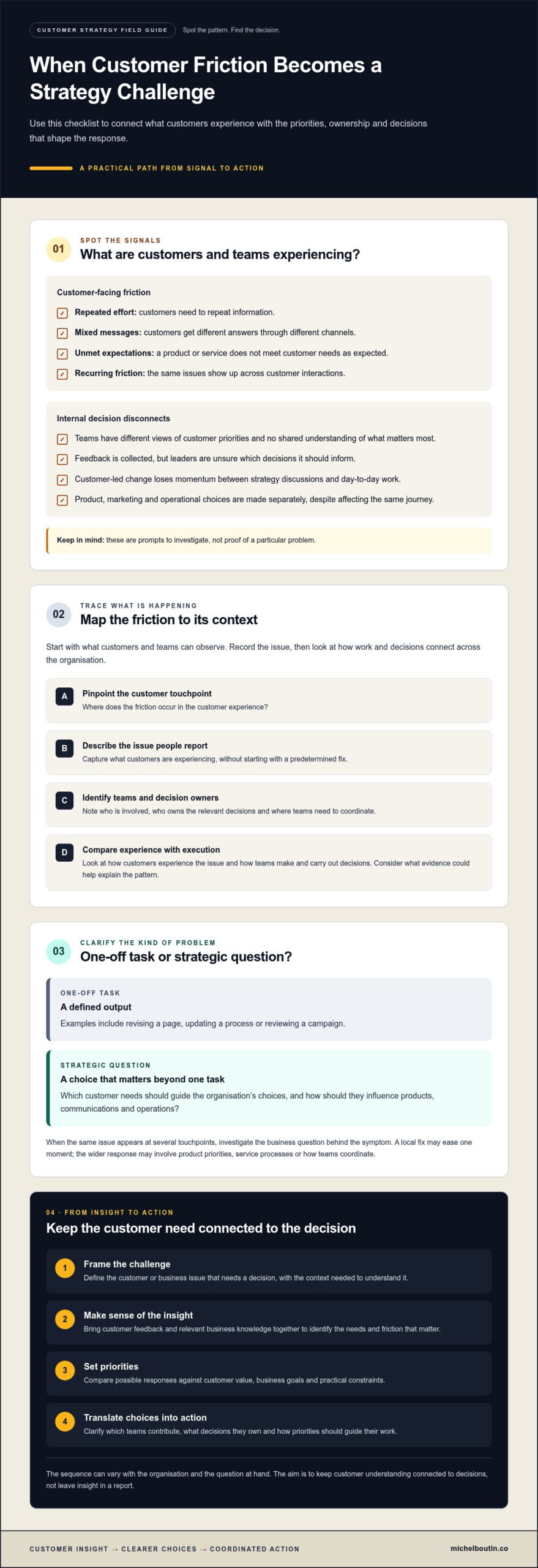
- Teams have different views of customer priorities, with no shared understanding of what matters most.
- Feedback is collected, but leaders aren’t sure which decisions it should inform.
- Customer-led change loses momentum between strategy discussions and day-to-day work.
- Product, marketing and operational choices are made separately, even when they affect the same customer journey.
- The same points of friction keep recurring across customer interactions.
These are prompts for investigation, not proof of a particular problem. Pinpoint where the pattern occurs, who owns the relevant decisions and what evidence could help explain it. For example, note the customer touchpoint, the issue people report and the teams involved. A broader customer strategy executive guide can provide useful foundations for that reflection; here, the focus is recognising when a challenge needs joined-up attention.
Recognise the signals behind a customer strategy challenge
Start with what customers and teams can observe. Customers may need to repeat information, get different answers through different channels or find that a product or service doesn’t meet their needs as expected. Internally, staff may work around unclear processes, while product teams respond to requests without a shared view of which needs should take priority.
Recurring friction can point to gaps in priorities, ownership or decision-making, but the cause depends on the context. Compare what customers experience with how teams make and carry out decisions. If the pattern crosses functions, investigate the underlying strategy rather than adding another isolated fix. Mapping the issue from the customer’s point of view through to the teams and decisions involved can help reveal where the disconnect occurs.
Separate a strategic question from a one-off fix
A one-off task has a defined output: revise a page, update a process or review a campaign. A strategic question remains relevant beyond that task: which customer needs should guide the organisation’s choices, and how should those needs influence products, communications and operations? A customer strategy consultant can help leaders frame that wider question and clarify the decisions it calls for.
Customer strategy consulting addresses the gap between what customers need and the business choices required to respond consistently. That distinction matters when the same issue appears at several touchpoints. Fixing one hand-off may ease a specific moment, but customer needs can also shape product priorities, service processes and how teams coordinate. For a general overview of the consultant’s role in business decisions, see What is Strategy Consulting?
Consider recurring complaints about unclear information. A single campaign could improve one message. A strategic review asks whether the information itself, the product offer, staff guidance or ownership of customer communications needs attention. Start with the business question behind the symptom, not a predetermined solution.
What Does a Customer Strategy Consultant Help Your Organisation Decide?
A customer strategy consultant helps leaders connect what customers need with the choices the organisation makes. That means going beyond collecting feedback. The work is to understand what insight means for business priorities, then clarify which decisions should change, who needs to act and how teams can move forward.
A customer strategy consultant can help leaders work through a practical sequence:
- Frame the challenge. Define the customer or business issue that needs a decision, along with the context needed to understand it.
- Make sense of the insight. Bring customer feedback and relevant business knowledge together to identify the needs and friction that matter to the challenge.
- Set priorities. Compare possible responses against customer value, business goals and practical constraints.
- Translate choices into action. Clarify which teams need to contribute, what decisions they own and how priorities should guide their work.
The sequence can vary with the organisation and the question at hand. Its purpose is consistent: keep customer understanding connected to decisions instead of leaving insight in a report. Customer insight becomes useful when it changes the choices an organisation makes and gives teams a clear direction for action.
Connect customer experience to business priorities
Customer experience is one part of broader customer strategy. It concerns how customers experience interactions, while strategy also asks how those needs should influence the organisation’s wider choices. For example, a difficult renewal process might affect customer loyalty, but addressing it could involve service steps, product options and operational responsibilities, not just a message or interface. A dedicated customer experience strategy guide can help if your focus is specifically on shaping those interactions.
Experience choices can also affect growth. Leaders might weigh whether to improve an existing journey, change the offer or redirect team effort. In digital channels, turning strategic retention goals into ongoing customer engagement often relies on specialised CRM management, where teams like verticalbrands.co focus on aligning email marketing with customer lifecycle stages. A consultant helps make those trade-offs explicit, so customer needs inform business priorities without assuming every request should become a new initiative.
Turn strategic direction into practical work
Clear priorities give teams a reference point, not a rigid formula. If customers value a simpler product choice, for instance, that priority may inform product development, brand communication and the support teams need to explain the offer. When aligning commercial teams around those priorities, agencies like Stratagon focus on building customer-centric campaigns to drive revenue growth. A product development strategy guide is useful for exploring product decisions in more depth, while customer strategy keeps those decisions connected to customer needs and organisational direction.
From there, leaders can decide what to progress, what to pause and where teams need to coordinate. The right actions depend on the challenge, evidence and operating context. The goal is not to prescribe the same process for every organisation, but to give people enough clarity to act with purpose and review whether their choices still serve customers and the business.
To explore how a customer challenge connects to business decisions, learn more about customer strategy at michelboutinstudio.
How to Assess Customer Strategy Consultant Fit
The right fit starts with your challenge, not a polished presentation. A customer strategy consultant should make the problem clearer, connect it to decisions leaders can influence and show how the work can fit your organisation’s day-to-day operations.
Use these four dimensions to assess whether the proposed approach matches what your organisation needs:
| Dimension | What a strong fit looks like | What to look for in the work |
|---|---|---|
| Problem fit | The work addresses the customer challenge your organisation is actually facing. | A clear framing of the issue, its context and the questions the engagement will help resolve. |
| Relevant experience | Experience brings useful perspective without assuming every sector or customer is the same. | Examples and thinking that connect to your circumstances, not just familiar industry labels. |
| Decision focus | The work is designed to inform choices leaders need to make. | Specific priorities and trade-offs, rather than insight presented without a decision attached. |
| Implementation orientation | Recommendations account for how your teams and operations work. | Clear links between direction, ownership and the next practical actions. |
Assess strategic and sector relevance
Sector experience can help a consultant recognise familiar pressures and ask sharper questions. michelboutinstudio brings experience across retail, automotive and financial services, alongside Michel Boutin’s over 20 years of industry experience. That background offers useful context, not a template to apply unchanged.
Customer expectations, buying decisions and operating conditions differ between organisations, even within one sector. The important test is whether the proposed work takes your customers and business context seriously. A useful discussion connects relevant experience to your challenge, then adapts the focus to the decisions your leaders need to make.
Look for a clear path from insight to action
A useful strategic discussion makes the choices visible. You should be able to see what needs prioritising, which decisions sit with leaders or teams, and how recommendations relate to existing operations. Broad statements about improving customer focus may sound promising, but without a connection to real choices, they’re difficult to act on.
Notice whether the consultant clarifies what progress means for your organisation, rather than assuming a standard outcome. Strong direction respects constraints and identifies where teams need to coordinate. It also leaves room to refine the approach as the challenge becomes clearer.
michelboutinstudio brings an executive-level, practical perspective to customer and business decisions. When assessing fit, describe the customer issue, the decisions at stake and the progress you want your organisation to make.
How to Prepare for a Customer Strategy Consulting Engagement
You don’t need a perfect brief or complete agreement across the organisation before starting. Preparation is about making the first conversation more useful: what’s happening, what you know so far and which decisions need attention. A focused starting point gives a customer strategy consultant room to explore the challenge without locking everyone into a solution too early.
Use this short sequence to organise your thinking:
- Define the challenge. Describe the customer or business issue you want to understand. Keep it specific enough to discuss, but open enough to explore its causes.
- Gather relevant context. Bring together available customer feedback, product information and operational details related to the issue.
- Align the people involved. Identify leaders and teams who own or influence the decisions in scope. They don’t need identical views, but they should understand why the discussion is happening.
- Clarify the decisions. Note what the work may need to inform, such as where to focus effort, what to investigate further or which trade-offs leaders need to consider.
This preparation doesn’t predetermine an outcome. It creates a shared starting point for asking better questions and shaping the work around your organisation’s needs.
Frame the customer challenge and decisions
Write a short problem statement that names the issue without prescribing its answer. For example: “Customers find it difficult to compare our options, and we need to understand what is driving that.” Then list the decisions the work should inform, such as whether to review the offer, how information is presented or where further investigation is needed.
Separate evidence from assumptions. Customer comments or observed process issues are evidence to consider; beliefs about why they happen are hypotheses to test. This distinction helps leaders stay curious, especially when teams have different interpretations. Keep the statement practical: what do you need to understand, and what choices could that understanding help clarify?
Bring the right context and people into the conversation
Share useful material where available, not every document the organisation has. Relevant customer feedback, product details, existing priorities and descriptions of how work currently happens can help establish context. Include stakeholders who influence the decisions, such as people responsible for customer-facing work, products or operations.
Also note constraints and dependencies. A proposed change may rely on another team, an existing commitment or a decision leaders haven’t made yet. Naming these factors early helps keep the discussion grounded. You don’t need full internal consensus; you need enough openness to surface differing views and understand what each team can influence.
If the customer challenge sits within a broader organisational transformation, include that context so the scope reflects the wider decisions involved. For a focused customer strategy discussion, read about customer strategy consulting with michelboutinstudio.
Work With michelboutinstudio on Customer Strategy
Customer strategy is most useful when it helps leaders make practical choices, not when it sits apart from the decisions shaping the business. michelboutinstudio brings an executive perspective to customer and business challenges, connecting customer priorities with areas such as marketing and brand strategy, product development and operational optimisation.
There’s no single engagement shape for every organisation. The right approach depends on the question you need to address, the decisions involved and the support that will help your team make progress. For organisations looking for a customer strategy consultant in Australia, michelboutinstudio offers project-based, retainer-based and hourly professional services, shaped around the work rather than a fixed template.
Match the engagement model to the work
A project-based engagement can suit a defined piece of strategic work. For example, leaders may want to explore customer loyalty priorities or develop a brand strategy. The scope can focus on the question and decisions at hand while reflecting the organisation’s context.
Retainer-based support provides ongoing executive and strategic input as priorities develop. It can suit leaders who want a consistent partner to help consider customer implications across decisions over time. Hourly professional services can suit targeted advisory, a workshop or a focused problem-solving discussion. The format shapes the support; it doesn’t mean every challenge follows the same path.
Start by considering what your organisation needs now. Is there a defined question to work through, a continuing need for strategic input or a specific issue where focused advice would help? Starting with the work itself makes it easier to choose an engagement that fits.
Start a focused conversation with michelboutinstudio
You don’t need to arrive with a complete plan. Bring a concise description of the customer challenge, the decisions you’re trying to make and the organisational context that may shape the work. It’s also useful to note what you already understand, where views differ and what you want to clarify.
That gives the discussion a practical starting point. Together, you can explore the scope and the kind of support that best fits your needs, without assuming the answer before the challenge is understood. michelboutinstudio works across customer strategy and related growth, product and operational challenges, bringing relevant areas together where they connect to your priorities.
Ready to move forward? Discuss your customer strategy challenge with michelboutinstudio and outline the decisions you want to progress.
Turn Your Next Customer Decision Into Momentum
The next step doesn’t need to be a sweeping transformation. Choose one customer-related decision that feels unclear, then ask what your organisation needs to understand before it can move forward. That question can help focus attention, bring the right people into the conversation and avoid adding activity without direction.
A customer strategy consultant can help turn that uncertainty into a clearer path, grounded in your priorities and operating reality. The aim isn’t to hand over ownership of customer decisions. It’s to build the clarity and alignment your teams need to make them with purpose.
michelboutinstudio works with organisations to connect customer needs with practical business choices. Start with the challenge as you see it today. You can explore the context, the decisions involved and a suitable next step without needing every answer in advance.
Discuss your customer strategy challenge with michelboutinstudio and identify one clear decision to move forward.
Frequently Asked Questions
What does a customer strategy consultant do?
A customer strategy consultant helps leaders weigh customer needs alongside business realities. For example, a request for more product options may need to be considered against the organisation’s priorities, capabilities and existing offer. The consultant helps make those trade-offs clear so decision-makers can see what needs further investigation and what choices are in front of them. The focus is on useful judgement, not activity for its own sake.
When should a business hire a customer strategy consultant?
Consider bringing in a consultant before a decision with customer consequences becomes difficult to reverse. This could be a planned change to a product range, service model or brand direction. Early advice can help leaders test their assumptions and consider possible customer implications before resources and teams are committed. You don’t need to wait for a crisis; a consequential choice with unresolved customer questions can be a useful starting point.
How do you choose a customer strategy consultant in Australia?
Look for someone who can discuss your specific business question in plain language and distinguish what’s known from what still needs exploring. A customer strategy consultant in Australia should consider your organisation’s context without treating experience in another sector as a ready-made answer. In an initial discussion, notice whether the conversation helps sharpen the question and identify the decisions that matter.
How much does a customer strategy consultant cost?
There’s no single price that applies to every customer strategy engagement. The cost depends on factors such as the scope of work, expertise required and level of support involved. Before agreeing to an engagement, clarify what work is included, what decisions it will inform and what assumptions shape the proposed scope. This gives you a more useful basis for assessing the investment than comparing fees without context.
Can a customer strategy consultant help improve customer experience?
Yes. A consultant can help leaders consider what to change and how to judge whether the change addresses the intended customer need. For example, teams might review customer feedback alongside relevant operational signals after a process change. Choose measures that fit the issue being addressed. This keeps attention on whether the experience is improving in a meaningful way, rather than simply counting completed activities.
What should we prepare before speaking with a customer strategy consultant?
Bring one live decision your organisation is working through and explain what makes it difficult. It can also help to note any commitments or deadlines that shape the timing, and which parts of the decision remain open. You don’t need to create new research for an initial discussion. Share relevant context and use your existing understanding to make the conversation specific.
How is customer strategy different from customer experience strategy?
The distinction is often the scope of the decision. If you’re refining how customers move through a particular service journey, customer experience strategy may be the closer focus. If the question also involves which customer needs to prioritise or how the organisation should shape its offer, the scope is broader. The two can inform each other, but the starting question helps clarify where to focus.
Disclaimer
Insights shared are for informational purposes and reflect professional perspective, not specific advice. Independent advice should be sought before acting on any content.