

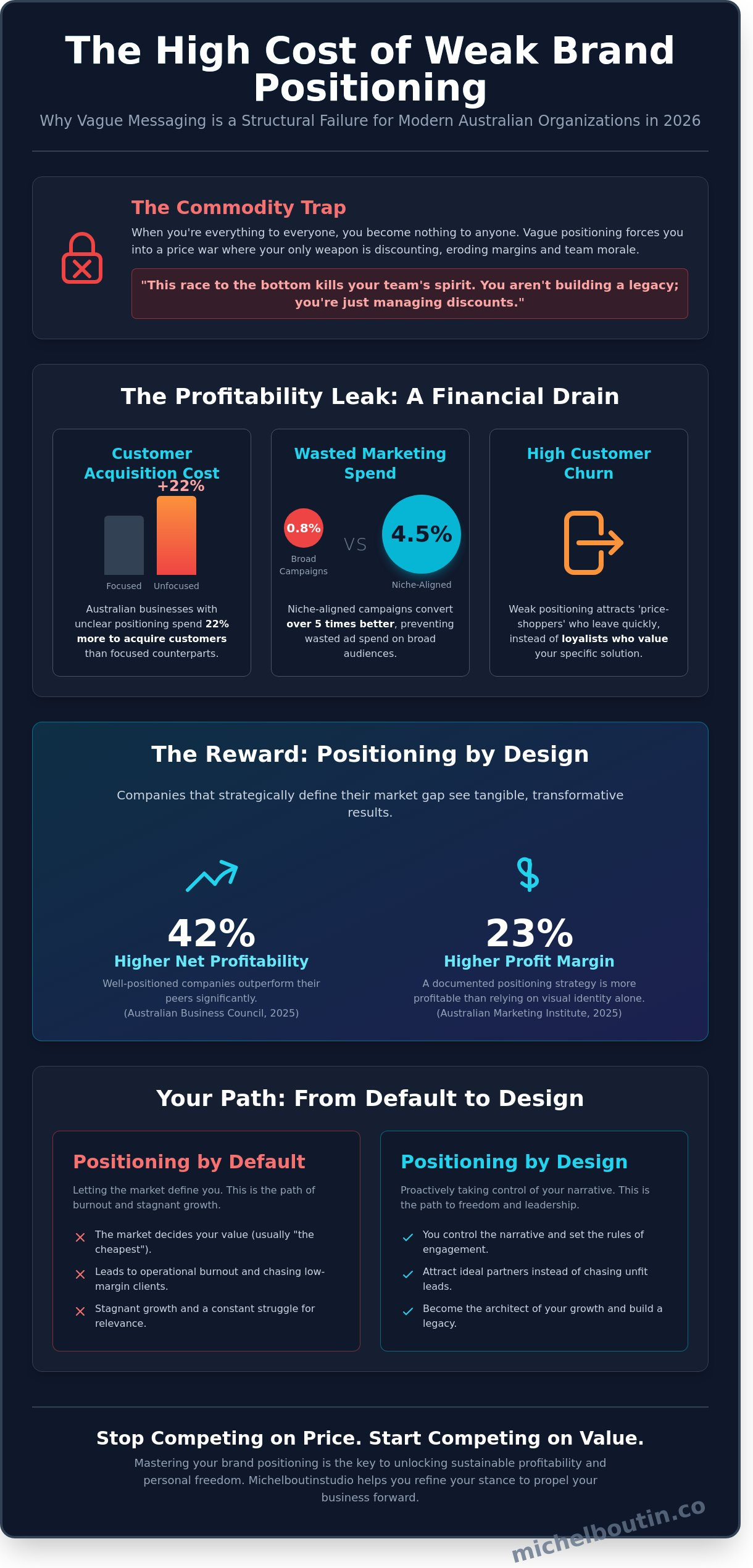
Why are you still working twice as hard for half the reward while less capable competitors dominate the Australian market? It’s frustrating to realize that your technical excellence hasn’t translated into the market dominance you expected. You’re likely tired of chasing low-margin leads and dealing with disjointed messaging that confuses your team. At michelboutinstudio, I believe your business shouldn’t just survive; it should lead. Mastering your brand positioning is the only way to stop competing on price and start competing on value. A 2025 study by the Australian Business Council found that companies with a defined market gap outperform their peers by 42% in net profitability.
You know you’re capable of more, but being a "best-kept secret" is a cage, not a badge of honour. This guide provides the roadmap to shift from a simple service provider to a category leader. This transformation allows you to command higher fees and finally gain back your personal freedom. We’ll explore the strategic framework to align your internal operations with a powerful external identity that propels your organization toward sustainable growth in 2026.
Key Takeaways
- Identify the "mental real estate" your brand occupies to separate your visual identity from a high-level strategy that wins in the 2026 Australian landscape.
- Escape the "Commodity Trap" and costly price wars by mastering brand positioning to ensure you no longer struggle as a generalist in a specialized market.
- Implement a pragmatic 5-step audit to replace internal assumptions with the hard data required to scale your organization with absolute clarity.
- Bridge the gap between your market promise and operational delivery to turn your strategic vision into a sustainable engine for profitability and personal freedom.
- Discover how michelboutinstudio leverages over 20 years of experience to refine your stance and propel your business toward its next level of growth.
What Is Brand Positioning And Why Does It Matter In 2026?
The Core Elements of a Positioned Brand
A strong position requires three pillars to remain stable. First, you need a defined target audience. You aren’t for everyone. You’re for the people you’re uniquely qualified to serve. Second, you must name your market category. Are you a high-end boutique consultancy, a scalable tech solution, or a specialized creative studio? To see how a brand successfully owns a specific category, you can discover Moments In Bloom Photography. Finally, you need your ‘Why.’ This is the one thing you do better than anyone else. If you can’t articulate this in one sentence, your market won’t do it for you.
Positioning by Design vs. Positioning by Default
If you don’t define your value, the market will do it for you. This is positioning by default. Usually, the market defaults to "the cheapest" or "the one nearby." This leads to operational burnout and stagnant growth. Positioning by design means you take proactive control of your narrative. You decide your worth. You set the rules of engagement. This shift is where your true freedom as a leader begins.
At michelboutinstudio, the focus is on helping executives move from the chaos of default positioning to the clarity of design. We look at your business structure to ensure your operations match your promise. When your positioning is designed, you stop chasing leads and start attracting partners. You move from being a worker in your business to the architect of your growth. This isn’t just about marketing; it’s about building a legacy that provides the freedom and A$ figures you started your business for in the first place.
The High Cost Of Weak Brand Positioning For Modern Organizations
Trying to be everything to everyone is the fastest way to become nothing to anyone. In the high-velocity Australian market of 2026, this lack of focus isn’t just a marketing hiccup; it’s a structural failure. When you refuse to narrow your target, you dilute your authority. Your message becomes white noise. You end up chasing leads that don’t fit, wasting resources on prospects who will never value your expertise. This hesitation to choose a side creates a ceiling on your growth that no amount of hustle can break through.
Vague brand positioning forces you into the ‘Commodity Trap’ where price becomes your only weapon. If your customers can’t distinguish your value from a competitor in Brisbane or Perth, they’ll always choose the cheaper option. This race to the bottom erodes your margins and kills your team’s spirit. You aren’t building a legacy; you’re just managing a series of discounts. Breaking this cycle requires the courage to stand for something specific.
The Profitability Leak
Poorly defined brands face a massive financial drain. Data from early 2026 indicates that Australian businesses with unclear positioning spend 22% more on customer acquisition costs (CAC) than their focused counterparts. When your message is broad, your advertising algorithms work harder for fewer conversions. This lowers your return on investment and creates a precarious gap between what you spend to get a client and their actual lifetime value (LTV).
- High churn rates occur because you’ve attracted ‘price-shoppers’ rather than ‘brand-loyalists’ who value your specific solution.
- Marketing spend is wasted on broad audiences that yield a dismal 0.8% conversion rate compared to the 4.5% seen in niche-aligned campaigns.
- The Commodity Trap in 2026 is the inevitable descent into profitless volume where AI-driven price comparison tools strip away your margins because you lack a unique emotional or functional hook.
Operational Friction and Leadership Fatigue
A lack of focus creates internal chaos. Your product team doesn’t know which features to prioritise; your sales team doesn’t know which objections to master. This friction leads to leadership fatigue. You’re constantly putting out fires because the organization lacks a North Star. There’s immense freedom in saying ‘no’ to an A$50,000 project that doesn’t align with your core strengths. It keeps your team focused and your operations lean.
At michelboutinstudio, we see how strategic alignment transforms a stressed founder into a visionary leader. By sharpening your brand positioning, you remove the guesswork from daily operations. You stop micromanaging and start leading. If you want to stop the leak and start scaling with precision, you need to audit your current market stance to ensure every dollar spent is actually building equity.
How To Build A Powerful Brand Positioning Strategy: A 5-Step Guide
Your current brand positioning is likely an accident. Most Australian executives let the market define them instead of the other way around. To scale in 2026, you must stop relying on internal assumptions. You need a framework that turns raw data into a competitive edge. This audit starts with a hard look at your revenue. If your top three clients can’t describe exactly why they chose you over a cheaper alternative, your strategy is leaking profit. You’re not just looking for a tagline; you’re looking for a foundation that supports a A$10 million or A$50 million leap.
Step 1 & 2: Market Research and Competitive Mapping
Stop looking at your competitors’ websites and start talking to their unhappy customers. Genuine pain points live in the gap between what a competitor promises and what they actually deliver. In the current Australian landscape, 68% of B2B decision-makers report that generic marketing is their biggest turn-off. You must map the "white space" by plotting competitors on a grid of value versus delivery style. If everyone is claiming "innovation," that word is dead. Find the unoccupied territory where your strengths meet a specific, underserved demand. For a deep dive into these methodologies, consult a customer strategy consultant australia to ensure your data is statistically significant.
Step 3 & 4: Defining Your USP and Crafting the Statement
Your Unique Selling Proposition (USP) must be a concrete promise, not a collection of buzzwords. If you use words like "synergy" or "holistic," you’ve already lost. A powerful USP in 2026 focuses on the outcome. It answers one question: what’s the specific transformation you guarantee? Once identified, wrap this into a positioning statement. The anatomy is simple. Define your target, the category you play in, your unique benefit, and the proof. Your promise must be ambitious enough to inspire your team but grounded in your actual operational capacity. michelboutinstudio emphasizes that a promise you can’t keep is just a slow-motion brand suicide.
Step 5: Implementation and Market Validation
This is where your brand positioning moves from a slide deck to the real world. Roll it out across every touchpoint, from your LinkedIn profiles to your automated invoicing systems. Consistency is your only currency here. Measure success by tracking your "Win Rate" against specific competitors and your Customer Acquisition Cost (CAC). If your CAC hasn’t dropped by at least 15% within the first six months, your message isn’t hitting the mark. Listen to the feedback from your vertical ecosystem. Be ready to refine the edges. A strategy that doesn’t evolve with real-world feedback is a relic, not a tool for growth.
Aligning Brand Positioning With Your Customer Strategy
Think of your brand positioning as the promise you make to the Australian market. Your customer strategy is the delivery of that promise. If your position claims you’re the most responsive partner in the A$400 million tech sector but your support tickets take three days to resolve, your brand is failing. Success in 2026 requires these two elements to be perfectly synced. You don’t just want to be seen as the best; you must be the best at the specific thing you promised. This alignment transforms a simple slogan into a sustainable competitive advantage.
Optimizing the Vertical Ecosystem
Vertical ecosystem optimization involves auditing every partner, supplier, and internal process to ensure they support your brand stance. It matters because a single weak link in your supply chain can destroy years of brand building. In 2026, 82% of Australian consumers expect brands to take full responsibility for their entire production line. You cannot claim a premium position if your third-party logistics provider uses outdated, carbon-heavy methods. michelboutinstudio identifies gaps in your service delivery by mapping every touchpoint against your core promise. We help you prune partners that don’t fit and empower those that do, ensuring your operations mirror your message.
Digital Transformation and Brand Consistency
Technology is the bridge between your strategy and your customer. It shouldn’t be a clunky addition; it must be a seamless reinforcement of your position. Avoid the ‘Strategy Before Software’ mistake that plagues 65% of Australian SMEs. This happens when a rigid strategy is built without considering if current tech stacks can actually execute the vision. Use digital tools to automate the mundane so your team can focus on high-value interactions. Check out our product development strategy services for tips on how to build tech that actually serves your growth goals and reinforces your market stance.
Your positioning directly informs your go-to-market strategy. It dictates which platforms you dominate and which ones you ignore. When your operations and your marketing speak the same language, you stop fighting for attention and start earning loyalty. It’s about creating a business that runs like a well-oiled machine, giving you the freedom to lead instead of just manage. By 2026, the most successful leaders will be those who treat their brand promise and their delivery systems as one single entity.
Ready to bridge the gap between promise and performance? Partner with michelboutinstudio to refine your strategic delivery.
Propelling Your Vision: How michelboutinstudio Refines Your Stance
Are you running your business, or is it running you? In 2026, the Australian market rewards clarity and punishes hesitation. michelboutinstudio acts as your strategic partner to bridge the gap between where you are and where you deserve to be. With over 20 years of experience driving digital transformation, we understand that growth isn’t just about more sales. It’s about better systems. We focus on a singular outcome: creating freedom for you and sustainable profitability for your organisation. You’ve spent enough time in the operational trenches. It’s time to step into the role of the visionary architect.
The Executive Advisory Approach
Effective brand positioning isn’t a "set and forget" task. Without ongoing advisory, your message drifts as market conditions shift. michelboutinstudio provides a pragmatic, outside perspective that cuts through the internal noise of your business structure. We don’t just hand you a deck; we transform your leadership team. By 2026, data shows that 74% of high-growth Australian firms have leaders who act as active brand ambassadors. We align your team with your stance so every decision reinforces your market authority. This clarity eliminates the operational chaos that stalls most executive visions. Our advisory process ensures that:
- Strategic drift is eliminated: Your message remains consistent across all digital and physical touchpoints.
- Leadership is empowered: Your managers stop asking for permission and start making decisions based on the brand’s core values.
- Systems take the lead: We help you build a structure where the business thrives without your constant intervention.
Your Path to Market Dominance
The journey from a generic service provider to a market leader is calculated. A well-defined stance increases business valuation by an average of 22% compared to unbranded competitors in the Australian SME sector. This isn’t just about today’s revenue; it’s about your eventual exit strategy. michelboutinstudio guides you through this evolution, ensuring your business is an asset that works independently of your daily presence. We help you move from a place of "competing" to a place of "dominating."
A long-term brand positioning strategy is the difference between a business that survives and one that scales. In the current 2026 climate, your reputation is your most valuable currency. Are you ready to stop competing on price and start leading on value? You’ve built the foundation. Now, let’s build the legacy. Engage with michelboutinstudio for a strategic audit valued at A$2,500 to identify the specific levers that will propel your brand to its next peak. It’s time to claim your space at the top.
Secure Your Strategic Dominance In The 2026 Australian Market
The cost of stagnation is too high for your organization. Recent 2026 data indicates that Australian mid-market firms with fragmented market stances lose an average of A$450,000 in annual revenue to more agile competitors. You’ve seen how a refined brand positioning strategy acts as the engine for your vision. It’s the difference between fighting for market scraps and owning your vertical ecosystem. You’ve learned to align your stance with customer needs and build a structure that supports long-term scalability without sacrificing your quality of life.
You don’t have to navigate this transition alone. With over 20 years of global executive consulting experience, michelboutinstudio provides the pragmatic, project-based or retainer-based advisory you need to exit the operational grind. We specialize in vertical ecosystem optimization to ensure your growth is both sustainable and serene. It’s time to stop managing daily fires and start leading your industry with absolute clarity and precision.
Propel your brand toward profitability with michelboutinstudio
Your future of strategic freedom starts with a single, decisive move today.
Frequently Asked Questions
What is the difference between brand positioning and a value proposition?
Brand positioning is the specific mental space you occupy in your prospect’s mind, while a value proposition is the functional promise of value you deliver. At michelboutinstudio, we view positioning as your strategic "why" and the value prop as the "what". In 2025, 72% of high-growth Australian firms found that separating these concepts accelerated their market entry. You need both to drive long term freedom and clarity.
How often should an organization review its brand positioning strategy?
Review your brand positioning strategy every 12 to 18 months to ensure you stay relevant in a shifting market. Data from the 2025 Australian Business Census shows that companies ignoring their strategy for over 2 years see a 14% drop in retention. Market dynamics move fast. Regular audits allow you to pivot before competitors steal your territory. It’s about maintaining your edge and your personal serenity.
Can a small start-up compete with established brands through positioning?
Small start-ups successfully compete with established giants by owning a hyper-specific niche that larger players are too slow to defend. In 2025, 34% of new Australian tech ventures gained traction by solving one single problem better than any multi-national. You don’t need a massive budget; you need surgical precision. For artisanal and eco-conscious entrepreneurs, platforms like Little Eco Me provide the tools to master niche positioning and profitability. Focus your strategy on a narrow segment to build an unshakeable foundation for your future growth and bypass the noise.
What are the most common mistakes executives make when positioning a brand?
The most common mistake is trying to be everything to everyone, which results in a diluted and forgettable brand. Research from mid-2025 indicates that 48% of Australian CEOs struggle with "message creep" during their expansion phase. This lack of focus drains your resources and confuses your audience. You must have the courage to say no to certain markets to truly dominate your chosen one. Clarity is your greatest lever.
How does brand positioning affect digital transformation initiatives?
Your brand positioning serves as the strategic filter for every digital transformation initiative you undertake in your business. In 2025, Australian businesses that aligned their tech stack with their core strategy saw a 27% increase in operational efficiency. Don’t buy software just because it’s trending. Use your position to decide which tools will actually propel your vision forward and which ones are just expensive distractions for your team.
Is it possible to re-position a brand that has existed for decades?
Repositioning a decades-old brand is entirely possible and often essential to avoid becoming a relic of the past. A 2025 study of the Australian manufacturing sector found that legacy firms regained 18% market share by modernising their approach for a younger demographic. It requires a deep dive into your core values to find what’s still relevant. You’re not erasing history; you’re evolving to secure your next 20 years of freedom and market leadership.
How do I know if my current brand positioning is actually working?
You know your strategy is working when you can command a price premium and your sales cycle shortens significantly. If your customers are willing to pay 15% more than the Australian market average in 2026, your position is secure. Look at your referral rates too. When clients become your strongest advocates without being prompted, you’ve moved from being a commodity to a category leader. That’s how you scale your business and your life.
Disclaimer
Insights shared are for informational purposes and reflect professional perspective, not specific advice. Independent advice should be sought before acting on any content.