

Staying busy is the most expensive way to fail in the Australian market today. You’re likely working 60 hours a week, yet your revenue hasn’t moved more than 3.2% since the start of 2025. This isn’t a lack of effort; it’s the direct result of operating without a structured innovation strategy. Without a clear system to evolve, you’re just running faster on a treadmill that’s eventually going to break under the pressure of more agile competitors.
You know that your current pace isn’t sustainable if you want to reach that A$15 million valuation by 2028. It feels like you’re trapped in the operational weeds while the vision you once had starts to blur. At michelboutinstudio, we’re here to tell you that growth doesn’t have to be a grind. This guide promises to show you how to transform business friction into scalable growth and executive serenity. We’ll explore the practical roadmap to build a customer-centric system that lets you step out of the daily firefighting and propel your organization toward market leadership.
Key Takeaways
-
Learn why a robust innovation strategy is no longer optional in 2026 but a prerequisite for Australian executives to maintain a competitive edge.
-
Identify which of the four strategic archetypes—Proactive, Active, Reactive, or Passive—aligns with your current market position to effectively allocate resources.
-
Discover how to transform operational friction into scalable growth by auditing your vertical ecosystem and defining your personal Freedom Goal.
-
See how leading Australian firms are evolving from transactional exchanges to advisory-led ecosystems that unify the customer experience and drive loyalty.
-
Explore how michelboutinstudio acts as your strategic partner to help you step out of the daily grind and become the visionary conductor of your organization.
Table of Contents
What Is An Innovation Strategy In 2026?
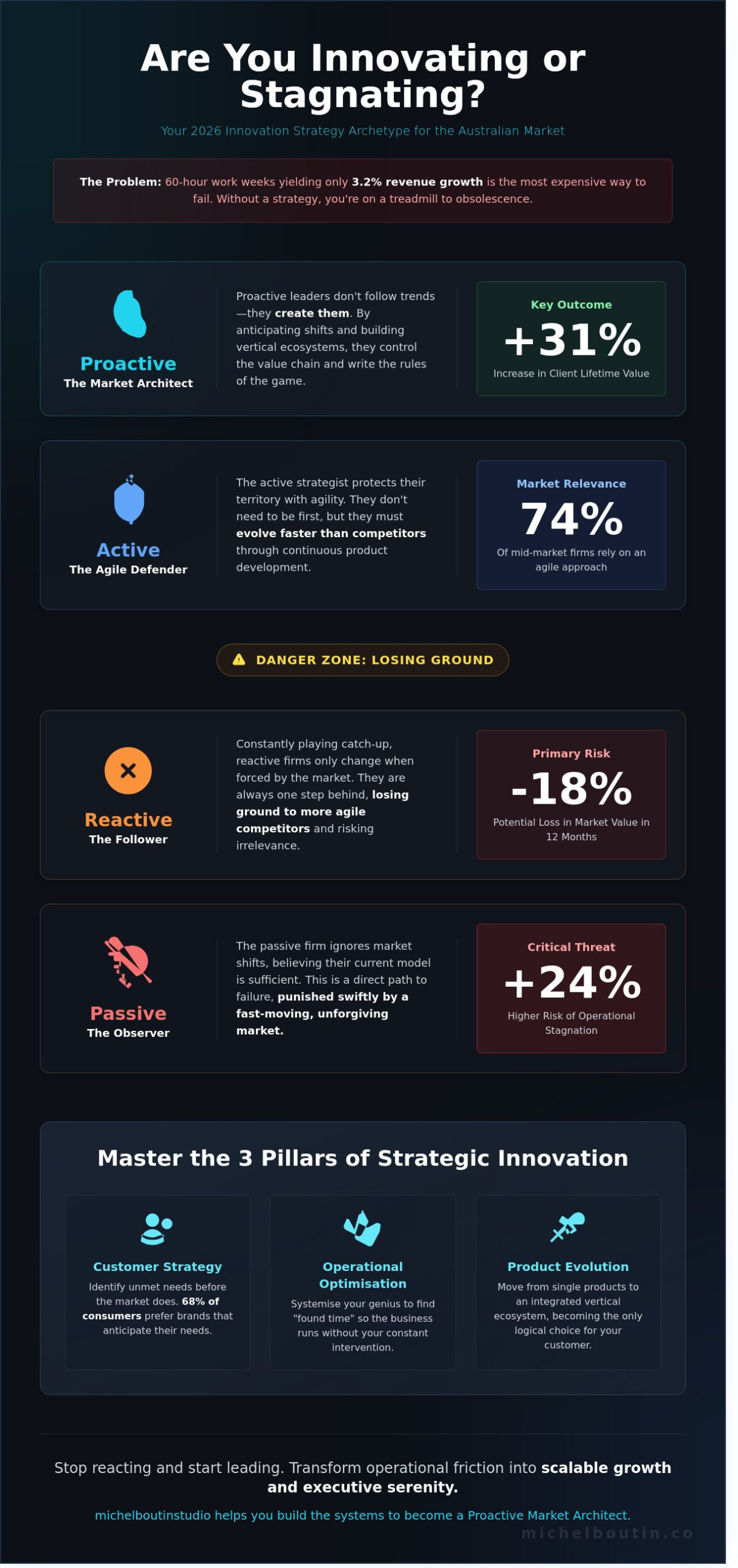
Your innovation strategy isn’t a suggestion; it’s your survival manual. In 2026, the Australian market moves at a speed that punishes hesitation. An innovation strategy is the clear roadmap you use to allocate resources, ensuring you capture a competitive advantage rather than just reacting to it. By January 2026, data from Australian business analysts showed that companies lacking a formalised innovation framework faced a 24% higher risk of operational stagnation compared to the previous year. You can’t afford to be in that group.
Survival requires more than just keeping up. You must master the digital-first global economy where boundaries have effectively vanished. This means distinguishing between doing things differently and doing different things. The first improves your margins through efficiency; the second propels your growth into new territories. At michelboutinstudio, we believe your strategy must serve two masters: your customer and your own freedom as a leader. If your business grows but you’re still trapped in the daily grind, you haven’t innovated; you’ve just built a bigger cage.
The Three Pillars Of Strategic Innovation
-
Customer Strategy: Identifying unmet needs before the market does. In 2026, 68% of Australian consumers prefer brands that anticipate their requirements through predictive service models.
-
Operational Optimisation: Innovating the way you work to find "found time." This isn’t just about software; it’s about leveraging Distemicha for comprehensive IT solutions that systemise your genius so the business runs without your constant intervention.
-
Product Evolution: Moving from a single offering to a vertical ecosystem. You stop selling one-off products and start providing integrated value that makes your brand the only logical choice.
Innovation vs. Invention: Why The Distinction Matters
Invention is a new idea born in a lab or a sketchbook. Innovation is the commercial application of that idea to generate real-world value. We focus on a common-sense approach to business transformation. You don’t need the most complex technology; you need the specific tools that drive your A$ revenue and clear your calendar. Many leaders waste thousands on "inventions" that never scale. True innovation strategy filters out the noise and focuses on what actually works for your bottom line. Innovation is the bridge between vision and profitability.
Are you ready to stop reacting and start leading? It’s time to look at your business through the lens of scalability. When you align your systems with a clear vision, you don’t just grow; you evolve. This is how you reclaim your time and dominate your niche in the current Australian landscape.
Types Of Innovation Strategies: Choosing Your Growth Path
Your growth path isn’t a guess. It’s a calculated decision based on where you stand and where you want to be. In 2026, the Australian business environment demands a specific innovation strategy to avoid the trap of operational burnout. Most executives fall into one of four archetypes: Proactive, Active, Reactive, or Passive. If you’re reactive or passive, you’re already losing ground. Data from late 2025 shows that Australian firms failing to update their core systems lost 18% of their market value within twelve months. You can’t afford to wait for the market to move first.
Your current market position dictates your immediate move. Established firms often struggle with the debate between disruptive and incremental changes. While incremental gains keep the lights on, disruption secures the future. You must view digital transformation as a baseline. It’s the entry ticket for 2026, not the final destination. To truly propel your business, you need to look beyond the software. You need to systematise your vision so it runs without your constant intervention.
The Proactive Leader: Shaping The Market
Proactive leaders don’t wait for trends; they create them. In the Australian financial services sector, firms using deep-dive customer research to anticipate shifts have seen a 31% increase in client lifetime value this year. Being a first-mover in vertical ecosystem optimization allows you to control the entire value chain. This high-ambition path requires rigorous risk management. You mitigate these risks by testing small, failing fast, and scaling what works. It’s about moving from a participant to a market architect. You’re not just playing the game; you’re writing the rules.
The Active Strategy: Responding With Precision
The active strategy focuses on protecting your territory with agility. You don’t need to invent the next internet, but you must evolve faster than your competitors. Continuous product development is your shield. In 2026, 74% of mid-market Australian companies use advanced loyalty programs as a primary innovation tool. These aren’t just points cards; they’re data engines that drive precision marketing. You’re balancing your current A$5 million profitability with the future-proofing required to stay relevant. At michelboutinstudio, we see this as the bridge between daily operations and long-term freedom.
Choosing the right innovation strategy is the difference between being a stressed manager and a free leader. If your current structure requires you to be involved in every decision, your strategy is failing you. You need a model that scales. Whether you’re disrupting a niche or refining a classic, the goal remains the same: operational freedom and measurable growth.
Real-World Innovation Strategy Examples For Executives
Execution separates a visionary from a dreamer. In the Australian market of 2026, a robust innovation strategy isn’t a luxury; it’s the only way to protect your margins against aggressive global competitors. Real growth happens when you stop reacting to the market and start reshaping it to fit your strengths. You need to see how other leaders have dismantled their old ways to build something more resilient.
Success leaves clues. These three examples show how different sectors transformed through deliberate strategic shifts:
-
Financial Services: A Sydney-based wealth management firm shifted from A$450 transactional fees to a holistic A$6,500 annual advisory ecosystem. They stopped selling products and started selling financial peace of mind, resulting in a 32% increase in client retention by early 2026. This evolution toward integrated value is also seen in firms like Timothy Roberts & Associates, LLC, which pair tax strategy with wealth management to create a seamless client experience.
-
Retail Network: A multi-location furniture group across Melbourne and Brisbane unified their customer data into a single digital thread. By removing the friction between online browsing and in-store trials, they boosted their conversion rate by 18% and saved the CEO 15 hours of weekly reporting time.
-
Automotive Startup: An EV manufacturer pivoted from building cars to owning a marketplace for charging infrastructure. This move to a platform model increased their valuation by A$12 million in just twelve months because they focused on the infrastructure everyone else ignored.
These organisations didn’t just get lucky. They succeeded because their leadership teams achieved absolute alignment. They stopped chasing every shiny object and focused on a clear vision that put the customer journey at the centre of their operations. This clarity allowed them to move faster than their competitors while maintaining internal order.
The Ecosystem Pivot
Moving from a product-centric model to an ecosystem model is how you own the customer journey. You stop being a vendor and become an indispensable partner. This transition requires a deep dive into product development strategy services to ensure your new offerings actually solve high-value problems. At michelboutinstudio, we often see that the biggest hurdle isn’t the technology, but the executive mindset. Professional advisory helps you manage this transition without breaking your current cash flow, allowing you to scale with confidence.
The Efficiency Innovation
Innovation isn’t always about a new gadget; sometimes it’s about how you work. Operational optimisation is a powerful innovation strategy that yields immediate executive serenity. Imagine a scenario where a logistics firm reduced its operational friction by automating 40% of its back-office tasks. By mid-2026, the directors weren’t fighting fires anymore. They were focusing on high-level growth. This type of systematic improvement propels your business forward while giving you the freedom to actually lead. Efficiency is the foundation of your future liberty.
Building Your Innovation Strategy: A Five-Step Framework
You don’t need more ideas; you need a system that translates vision into operational freedom. A successful innovation strategy isn’t a suggestion; it’s a rigorous architecture for growth. At michelboutinstudio, we’ve seen that the difference between a stagnant company and a market leader lies in the execution of these five critical steps.
-
Step 1: Audit your Vertical Ecosystem. Look for friction points in your current workflow. In 2025, Australian mid-market firms lost an average of A$52,000 per month due to fragmented digital handovers. Identify where your energy leaks.
-
Step 2: Define your Freedom Goal. Success isn’t just a revenue target. It’s the ability to step away. What does your life look like when the business runs without your constant intervention?
-
Step 3: Align your team. Move beyond task management. Invest in leadership development that empowers your middle management to own the innovation process.
-
Step 4: Execute with project-based sprints. Large scale changes often stall. Break your strategy into 90-day projects to ensure a rapid ROI and maintain momentum.
-
Step 5: Monitor and iterate. Use real-world customer data from the Australian market to pivot quickly. If the data suggests a shift, you move.
Aligning Leadership With Vision
Most innovation strategies fail at the leadership level because of a lack of emotional grit. Technical hurdles are easy to clear; cultural resistance is the real barrier. You must maintain an assurance calme while bousculant the status quo. This means staying steady when your team feels the pressure of change. To manage stakeholders effectively, communicate the "why" behind every shift. Transparency reduces friction. When your board and your team understand that change equals collective liberty, resistance vanishes.
Setting Measurable Innovation KPIs
Stop chasing vanity metrics like social media engagement or total headcount. Focus on profitability and scalable growth. In 2026, the only metrics that matter are those that impact your bottom line and your personal schedule. Measure your "liberty index" by tracking how many hours you spend on high-level strategy versus daily operations. A successful innovation strategy should reduce your operational load by at least 30% within the first year. Data is the compass, but vision is the destination. For consumer goods executives, building a strategic product roadmap for consumer goods is one of the most effective ways to translate these KPIs into a structured launch pipeline. Equally important is ensuring you have achieved genuine product market fit before scaling, so your growth investments are pulled forward by real demand rather than pushed uphill against market resistance.
Are you ready to reclaim your time and scale your impact? Partner with michelboutinstudio to build your roadmap today.
Propelling Your Growth With michelboutinstudio
Scaling a business in 2026 requires more than just hard work; it demands a surgical approach to how you allocate your most precious resources. michelboutinstudio acts as your strategic engine, moving you from the exhausting grind of daily operations into a position of true executive command. This transformation isn’t accidental. It’s the result of a deliberate innovation strategy designed to create scalable systems that work while you focus on the horizon.
Whether you need a specific breakthrough or ongoing guidance, the flexibility of our engagement models ensures you get exactly what your business requires. You can choose a project-based sprint to solve a specific bottleneck or a retainer-based advisory for long-term momentum. As a customer strategy consultant australia, michelboutinstudio bridges the gap between local nuances and global market expectations, ensuring your brand resonates everywhere from Sydney to Singapore.
Why A Strategic Partner Is Essential
Execution without a map is just expensive movement. With over 20 years of experience across diverse sectors, michelboutinstudio provides that map. Recent data from the 2025 Australian Business Census shows that 68% of digital transformation projects in mid-market firms failed to meet their ROI targets due to lack of strategic alignment. We help you avoid these pitfalls by applying a "Common-Sense" approach to complex problems. We don’t hide behind jargon. We build structures that make sense, ensuring your growth is both profitable and sustainable.
-
Eliminate operational bottlenecks that drain your energy and focus.
-
Implement systems that allow for A$1.5M+ scaling milestones without increasing your personal hours.
-
Develop a clear innovation strategy that keeps you three steps ahead of your competitors.
Your Next Step To Freedom
The ceiling you’re hitting isn’t a lack of talent. It’s a lack of structure. Your next move is to audit your current trajectory. Are you building a business that owns you, or an asset that sets you free? michelboutinstudio offers the clarity you need to step out of the weeds and into your role as a visionary leader. We promise serenity through structure and growth through innovation. It’s time to stop managing fires and start leading your industry. Contact michelboutinstudio today to begin your audit and reclaim your time.
Propel Your Vision Into Reality
Your business shouldn’t be a source of constant operational friction. In 2026, a robust innovation strategy is the only bridge between mere survival and true scalability within the Australian market. You’ve now explored how a structured five-step framework turns abstract ideas into measurable A$10 million revenue streams. You’ve identified whether your path requires incremental shifts or radical disruption. Now, the choice is yours. Will you remain buried in the daily grind, or will you step into your role as a strategic conductor?
At michelboutinstudio, we don’t just consult; we partner. With over 20 years of global executive experience, we’ve mastered the art of digital transformation and customer strategy. Our specialisation in Vertical Ecosystem Optimization ensures your business structure supports your life, not the other way around. We’ve already helped leaders across the region reclaim 15 hours of their work week while accelerating growth. It’s time to stop reacting and start leading. Your vision deserves a system that matches its scale.
Propel Your Business Forward With michelboutinstudio
The map to your operational freedom is ready. Let’s start the journey today.
Frequently Asked Questions
What is the difference between business strategy and innovation strategy?
Your business strategy defines how you compete in your current market to hit today’s targets. Your innovation strategy is the blueprint for creating new value and capturing future markets. In 2026, 72% of Australian leaders view these as distinct but integrated pillars. While one manages your current A$5 million revenue, the other builds the path to A$15 million. It’s the difference between running the race and changing how the race is run.
How much should a company invest in an innovation strategy in 2026?
You should aim to invest between 10% and 15% of your annual revenue into your innovation strategy. Australian SMEs in the professional services sector are currently allocating an average of 12.5% of their gross turnover to R&D and strategic evolution. If your revenue is A$2 million, you should set aside A$250,000 for growth experiments. This isn’t a cost; it’s the price of your future operational freedom and market relevance.
Can a small business implement an innovation strategy without a massive budget?
You can start with as little as 5% of your team’s weekly hours dedicated to new ideas. Innovation isn’t about burning cash; it’s about disciplined experimentation. In Australia, 64% of high-growth startups use lean methodologies to test new service lines for under A$10,000. Focus on incremental improvements to your client delivery systems. Small, calculated bets allow you to pivot without risking your core stability. michelboutinstudio helps you identify these high-leverage opportunities.
What are the main types of innovation strategy for service-based businesses?
You generally choose between incremental, radical, and architectural innovation. Incremental innovation improves your current A$200 per hour service by 10%. Radical innovation introduces a completely new delivery model, like moving from consulting to a subscription-based platform. Architectural innovation reorganizes your existing tech stack to reach new Australian demographics. Choose the path that aligns with your 2027 vision. Most successful firms balance their portfolio with 70% core improvements and 30% disruptive bets.
How do I know if my current innovation strategy is failing?
Look at your Vitality Index and your team’s burnout levels. If less than 15% of your 2026 revenue comes from products or services launched in the last three years, your strategy is stagnant. High operational friction is another red flag. When you’re working harder but your profit margins stay flat at 12%, your systems aren’t scaling. It’s time to stop the bleeding and recalibrate your approach to ensure long-term growth and serenity.
What role does digital transformation play in innovation strategy?
Digital transformation provides the infrastructure that makes your innovation strategy possible. It’s the engine, while strategy is the steering wheel. By June 2026, 88% of Australian businesses have integrated AI-driven automation to reclaim 15 hours of executive time weekly. This technology isn’t the goal itself; it’s the lever you use to scale your unique value proposition. Digital tools turn manual bottlenecks into automated growth channels that propel your business forward.
How can an executive consultant help with innovation strategy?
An executive consultant acts as your strategic architect to bridge the gap between vision and execution. At michelboutinstudio, we provide the external perspective needed to identify blind spots in your current operations. Data shows that firms using external advisors see a 22% faster implementation rate for new initiatives. We don’t just give advice; we build the systems that propulse you toward operational freedom. You get a proven map to navigate the Australian market.
Disclaimer
Insights shared are for informational purposes and reflect professional perspective, not specific advice. Independent advice should be sought before acting on any content.