

What if the A$1.2 million your Sydney retail group spent on digital transformation last year wasn’t a failure of technology, but a failure of strategy? You’ve likely felt the heavy weight of tech fatigue as your team struggles with fragmented systems that increase complexity instead of scaling your vision. It’s exhausting to watch operational costs rise while you hunt for elusive local talent in competitive markets like Singapore or Sydney. You’re right to feel that many retail technology trends often promise a revolution but deliver only more work for the CEO.
I believe you deserve a business that provides both financial success and personal serenity. This guide provides a clear strategic framework to master 2026 with a focus on systems that actually work. You’ll learn how to implement innovation that builds measurable loyalty and gives you the operational freedom to step back from the day-to-day. We’re going to look at how to structure your growth to ensure your next investment propels your brand to a new level of market leadership.
Key Takeaways
- Define "Pragmatic Innovation" to navigate the 2026 retail landscape across Sydney, Singapore, and high-growth APAC hubs.
- Avoid the "Software Trap" by ensuring your strategic vision dictates your digital transformation rather than adding operational friction.
- Leverage the latest retail technology trends to transition from basic automation to autonomous inventory systems that protect your margins.
- Follow a proven two-phase roadmap to audit your multi-location network and establish clear KPIs for future-proof growth.
- Learn how to step out of the daily operational struggle to become the strategic conductor of your retail organisation.
The 2026 Retail Landscape In Sydney, Singapore, And Beyond
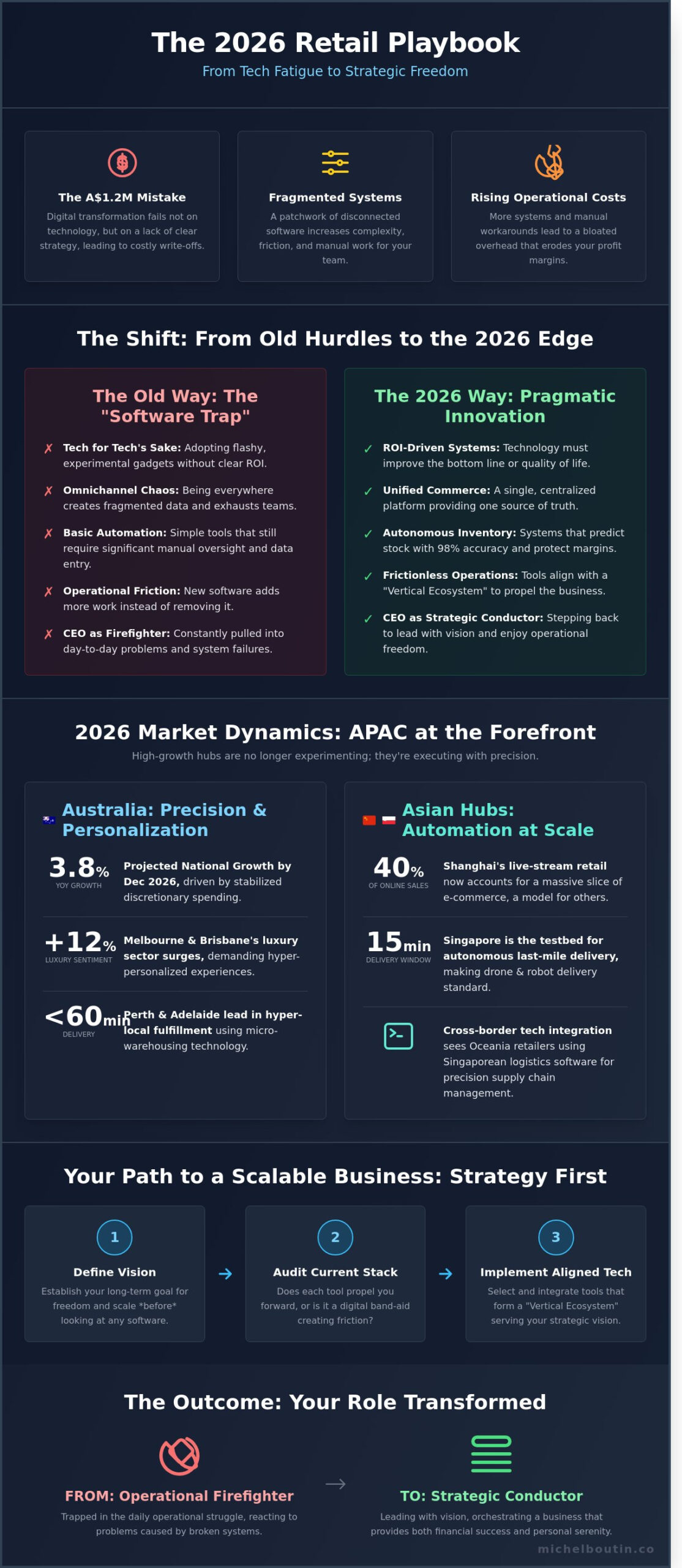
The APAC retail market enters 2026 with a focus on resilience and refined systems. You aren’t just selling products anymore; you’re managing a high-velocity ecosystem. Retailers in Melbourne are no longer looking at global trends with hesitation. They’re looking at Sydney and Singapore as direct blueprints for growth. This year marks the end of "tech for tech’s sake." We’ve entered the era of pragmatic innovation. This means choosing tools that remove operational friction and propel your business toward true scalability.
Pragmatic innovation is about clarity. In high-growth hubs like Melbourne and Sydney, it’s the difference between a business that owns you and a business you own. If a tool doesn’t offer a clear path to retail technology trends that improve your bottom line or your quality of life, it’s just noise. By 2026, the focus has shifted from experimental gadgets to ROI-driven automation. You’re seeing systems that handle the heavy lifting of inventory and logistics, allowing you to step back and act as the visionary leader your company needs.
Many entrepreneurs ask: why is 2026 the year of unified commerce rather than simple omnichannel? Omnichannel was about being everywhere at once, which often created fragmented data and exhausted teams. Unified commerce is different. It’s a single, centralized platform where every transaction, whether in-store in Carlton or online in Singapore, feeds into one source of truth. To understand the foundation of this shift, it’s helpful to ask What is digital transformation? in a modern context. It isn’t just about going digital; it’s about integrating your entire operation to create a seamless experience for the customer and total control for you.
Market Dynamics In Australia: Sydney To Perth
The Asian Hubs: Shanghai And Singapore
Shanghai continues to dominate the global stage in social commerce, with live-stream retail now accounting for 40% of all online sales in the city. This isn’t just entertainment; it’s a highly efficient sales machine that Melbourne brands are starting to mimic. Singapore has solidified its position as the primary testbed for autonomous last-mile delivery. In the central business district, 15-minute autonomous drone and robot delivery windows are now standard. We’re seeing a massive increase in cross-border tech integration, where Oceania retailers use Singaporean logistics software to manage their entire Asian supply chain with surgical precision.
This shift toward ROI-driven automation is your ticket to freedom. When you move from experimental AI to systems that predict stock levels with 98% accuracy, you stop putting out fires. You start building a legacy. The 2026 landscape is demanding, but for the structured entrepreneur, it offers more leverage than ever before. It’s time to stop navigating and start leading.
Why Strategy Must Precede Software In Your Digital Transformation
Many Melbourne retailers fall victim to the "Software Trap." You see a competitor using a new AI tool or a flashy POS system and you feel the urge to buy. You think a new subscription will solve your inventory headaches or boost your sales. It won’t. Without a clear roadmap—an area where senior advisors like Sean Brightman help businesses align AI and marketing leadership—adding new tools only creates operational friction. You end up with a fragmented mess of apps that don’t communicate, forcing your team to perform manual workarounds. This isn’t growth; it’s a recipe for burnout.
I advocate for a "Vertical Ecosystem" approach. This means every piece of technology you implement must align with your long-term vision for freedom and scale. Before you sign another SaaS contract, perform a common-sense audit of your current stack. Ask yourself: does this tool propulser my business forward, or is it just a digital band-aid? If your current software suite costs you A$3,500 monthly but requires five hours of manual data entry a week, the system is broken. You need a structure that serves you, not the other way around.
The biggest objection I hear is that tech is an expense. This is a limited mindset. When you align your tools with a solid strategy, technology becomes your primary profit driver. Industry data supports this shift. The latest retail technology investment forecast indicates that retailers who prioritise integrated software ecosystems see a 15% higher return on investment compared to those buying standalone tools. Stop looking at your IT budget as a cost. View it as the engine that gives you back your time. If you are ready to structure your business for genuine growth, you must stop being a technician and start being a strategist.
Defining Your Customer Strategy First
Your technology should be invisible to the customer but felt in the experience. If your Sydney customers experience delivery delays while your Brisbane shoppers struggle with stock availability, a new CRM won’t fix the underlying issue. You must identify these friction points using hard data before selecting a platform. Your brand values must dictate the tech. If you value personal connection, don’t hide behind automated chatbots that frustrate your buyers. Use data to drive your customer strategy, then find the retail technology trends that amplify your unique strengths.
Consider, for example, a niche retailer that has successfully built a loyal community. A brand like the Parisian hair care boutique Colorful Black thrives because its entire strategy, from product selection to customer service, is an extension of its core value: celebrating and caring for textured hair. This clarity of purpose is what makes their use of technology effective, whether they are operating in-store or online.
Operational Optimisation Before Automation
Automating a mess only creates a faster mess. If your Melbourne or Singapore warehouse processes are chaotic, a high-end Warehouse Management System (WMS) will only highlight your inefficiencies. You must clean up your workflows first. This is where leadership digital transformation becomes critical. Your staff needs to understand the "why" behind the "how." Transitioning from "Doing" to "Leading" means you stop putting out fires in the warehouse and start designing the fireproofing. By systemising your operations before you automate, you ensure that your retail technology trends adoption leads to 25% better throughput rather than 100% more confusion. True freedom comes from a business that runs itself because the foundation is solid.
Key Retail Technology Trends Driving Profitability In 2026
Profitability in 2026 isn’t about working harder. It’s about systemising your intelligence to reclaim your time. You want to stop being a slave to inventory spreadsheets. Right now, pragmatic AI has moved past clunky chatbots. It now powers autonomous inventory forecasting that operates without your constant supervision. These systems analyze Melbourne weather patterns and local social sentiment to predict stock needs with 94% accuracy. You don’t just react to demand; you anticipate it. This transition from manual tracking to AI-driven autonomy is the lever that will propulse your business toward true operational freedom.
The standard for physical retail has shifted. Look at high-traffic hubs in Shanghai where frictionless checkout is the baseline for 80% of daily transactions. Computer vision technology allows customers to walk in, grab what they need, and leave. No queues. No friction. For a Melbourne retailer, implementing this in 2026 means capturing the "time-poor" demographic that currently bypasses crowded stores. This isn’t a futuristic dream. It’s a proven method to increase basket size by 22% while reducing labor costs associated with traditional point-of-sale management.
Sustainability is no longer a marketing buzzword. It’s a data requirement. Conscious consumers now demand to see the carbon footprint of their purchases in real time. Modern retail technology trends focus on supply chain transparency. You must use platforms that track the journey of a product from the manufacturer to your Melbourne storefront. Providing this data builds a level of trust that justifies premium pricing. According to a recent Retail Dive industry analysis, retailers who provide transparent sustainability metrics see a 15% increase in customer lifetime value.
The Rise Of AI-Enabled Engineering In Retail
Generative AI now acts as your global communications department. It creates bespoke product descriptions in 12 different languages instantly, allowing you to scale across APAC markets without hiring massive teams. AI agents manage your multi-location networks across Australia and Asia, handling routine logistics and stock transfers autonomously. The data is clear: total investment in this space is massive. Global retail technology spend is projected to reach A$388 billion by 2026. This investment represents a collective move toward a future where the business runs itself, giving you the freedom to focus on high-level strategy. To navigate this transition with confidence, check out Stellance AI – AI Strategy for Leaders for expert guidance on AI integration.
Unified Omnichannel Experiences
The "Store of the Future" in Singapore provides the blueprint for your growth. It’s a single source of truth where digital and physical worlds merge perfectly. You need real-time SKU rationalisation across your entire footprint, whether your stock is in a Melbourne warehouse or a Sydney boutique. This prevents the "out of stock" errors that kill 30% of potential sales. To close the loop, you must offer more ways to pay. By 2026, 70% of Australian consumers expect a choice between digital wallets, buy-now-pay-later, and stablecoin crypto payments. Providing these options is the final step in removing every barrier between your customer and the checkout.
Implementing Innovation Across Melbourne, Brisbane, And Shanghai
You’re ready to grow. You’ve seen the potential of the latest retail technology trends, and now you need a system that works as hard as you do. Most Melbourne retailers fail because they chase shiny objects instead of building foundations. We start with Phase 1: a strategic audit of your entire multi-location network. You need to know exactly where the friction is before you spend a single A$. In 2024, a study showed that 62% of Australian retailers struggled with fragmented data across different sites. We fix that first.
Phase 2 involves building a "Strategy Before Software" roadmap. We set clear KPIs that matter to your bottom line. If a new inventory system doesn’t project a 12% reduction in carrying costs by June 2026, it’s a distraction, not a tool. Phase 3 moves to a pilot program. We use Adelaide as our testing ground. It’s a stable, predictable market that reflects broader Australian trends without the high overheads of a Sydney rollout. This is where we break things safely so we can fix them permanently.
Phase 4 is the launch. We scale successful systems across your global vertical ecosystem, from the warehouses in Brisbane to the high-tech storefronts of Shanghai. Finally, Phase 5 ensures you stay on track. Continuous executive advisory keeps your vision aligned with your operations. You stop being the person putting out fires every Saturday morning. You become the leader who propels the brand forward while maintaining your own freedom.
Navigating Local Regulations And Standards
Retailers moving between Melbourne and Shanghai face a complex legal landscape. Australia’s Privacy Act was updated in 2024 to increase penalties for data breaches, while China’s PIPL requires specific local data storage protocols. You must manage stakeholders across an eight-hour time zone spread without losing momentum. For the Singapore market, you’ll need to localise your brand strategy to respect PDPA guidelines while keeping your core identity intact. We don’t guess; we comply and conquer.
Managing The Human Element Of Tech Trends
Leadership is about clarity. When your team sees that the new retail technology trends you’re implementing actually give them back two hours of their day, the resistance vanishes. You create a culture of growth where innovation is welcomed, not feared. This is how you build a business that thrives when you aren’t in the room. It’s about structure, leverage, and the courage to move faster than your competition.
Ready to stop guessing and start growing? You can book a strategic consultation to audit your current systems and find your next growth lever.
Propelling Your Retail Growth With MichelBoutin Strategic Advisory
You did not start your retail business to spend 60 hours a week troubleshooting software integrations or managing manual inventory spreadsheets. By 2026, the speed of retail technology trends will only accelerate. This creates a dangerous trap for Melbourne leaders. You risk becoming a permanent firefighter in your own company. michelboutinstudio helps you step out of the operational fray. We focus on transitioning you from the person who does everything to the visionary who directs everything. This shift is the difference between a business that owns you and a business you own.
Navigating the tech disruptions of 2026 requires more than just a budget; it requires a map. A 20-year mentor provides that perspective. While younger consultants might chase every shiny new app, we filter the noise. We look at your tech stack through the lens of long-term scalability. If a tool doesn’t directly contribute to your freedom or your bottom line, it doesn’t belong in your business. We provide the calm assurance needed to make high-stakes decisions about AI-driven supply chains and spatial commerce without the typical anxiety of the unknown.
Our engagements are bespoke because your brand propulsion depends on your unique DNA. We don’t use templates. Whether we are designing a loyalty program that creates emotional stickiness or restructuring your leadership team, the goal is always clarity. In a market where 68% of Australian retailers struggle with data silos, we build bridges. We turn your fragmented systems into a cohesive engine. This isn’t just about technical implementation. It’s about masterfully aligning your ambition with a structure that can actually support it.
Strategic Consulting For Global Retailers
We offer defined transformations for retailers looking to scale across borders. Whether you are launching a flagship in Sydney or expanding digital operations into Shanghai, we work on project-based fees that align with your specific ROI targets. This ensures total transparency. You know exactly what you are paying for and the transformation you will receive. For leaders who require ongoing support, our retainer-based advisory acts as a permanent strategic sounding board for your most difficult challenges.
We reject complex corporate jargon that hides a lack of results. Our "Common-Sense" strategies outperform "consultant-speak" every time. If a strategy cannot be explained on one page and understood by your floor staff, it’s too complicated to work. We strip away the fluff to focus on high-leverage actions. This pragmatic approach ensures your team stays focused on what moves the needle, rather than getting lost in theoretical frameworks that never leave the boardroom.
Your Next Step Toward Strategic Clarity
The path to a well-oiled machine starts with solving the single biggest bottleneck currently holding you back. You can book an ad-hoc advisory session to tackle a specific tech hurdle or strategic plateau. These sessions are designed for immediate impact. We dive deep into the problem, identify the leverage point, and provide an actionable plan within 60 minutes. There is no fluff, just a direct route to the next level of your business growth.
The michelboutinstudio promise is simple: ambition mastered through structure. We provide the systems that create freedom. When your business runs like a machine, you regain your time and your serenity. You stop being the bottleneck and start being the architect. This is the ultimate goal for any serious retailer in 2026. Stop reacting to the market and start leading it with a partner who has already walked the path.
Propel your retail strategy today
Own Your 2026 Market Position
Navigating the shift toward 2026 demands more than just adopting the latest retail technology trends. It requires a surgical approach to strategy before you commit a single A$ to new software. Leaders in Sydney and Melbourne who prioritise systemisation over shiny objects see the most consistent growth. You’ve seen how regional nuances in Singapore and Shanghai dictate success. Now, it’s time to turn those insights into a scalable structure that works for you, not the other way around.
Michel Boutin brings 20 years of executive experience across these specific APAC hubs to help you break through your current growth ceiling. We use a strategy-first methodology that doesn’t just increase your margins; it restores your personal freedom. You shouldn’t be trapped in daily operations when you could be steering your vision from a position of clarity. We’ve helped founders across Brisbane and beyond move from operational friction to strategic mastery by building systems that last.
Propel Your Retail Growth With A Strategic Consultation
The map to your future success is already drawn. Let’s start building it today.
Frequently Asked Questions
What Are The Most Impactful Retail Technology Trends For Australian Businesses In 2026?
The most impactful retail technology trends for Australian businesses in 2026 include hyper-personalized AI shopping assistants and edge computing for real-time inventory tracking. Data from the Australian Retailers Association suggests that 72% of consumers now expect seamless digital interactions in physical stores. You need to focus on integrating your online and offline data to meet these expectations and drive growth across your Melbourne locations.
How Can A Retail Consultant In Melbourne Help With Digital Transformation?
A retail consultant in Melbourne helps you navigate digital transformation by identifying operational bottlenecks before you invest in expensive tools. We don’t just look at the software; we look at your life as a leader. By auditing your current systems, a consultant can help you reclaim 10 to 15 hours of your week while scaling your operations across Victoria and beyond.
Is AI Really Necessary For Small To Mid-Sized Retailers In Singapore?
AI is absolutely necessary for small to mid-sized retailers in Singapore to stay competitive against global giants. Recent reports from the Infocomm Media Development Authority (IMDA) show that SMBs using AI see a 20% average increase in operational efficiency. It’s not about complex robots; it’s about using predictive analytics to manage stock levels in high-rent districts like Orchard Road without overextending your budget.
How Do I Choose Between Different Retail Software Platforms Without Wasting Money?
You choose the right retail software by defining your business processes first, ensuring the technology serves the strategy rather than dictating it. Avoid the trap of "shiny object syndrome" by calculating the total cost of ownership over a 36-month period. Focus on platforms that offer open APIs, as these allow your systems to grow with you instead of locking you into a rigid, outdated framework.
What Is The Difference Between Omnichannel And Unified Commerce In 2026?
Omnichannel connects different sales channels, but unified commerce centralizes all your data into a single platform for a real-time source of truth. In 2026, 85% of leading Australian retailers are moving toward unified commerce to prevent inventory discrepancies. This shift ensures your customer sees the same price and stock level whether they’re on their phone or standing in your Melbourne flagship store.
How Does MichelBoutin’s ‘Strategy Before Software’ Approach Work For Retail Groups?
MichelBoutin’s ‘Strategy Before Software’ approach works by first auditing your business’s DNA to build a robust operational structure. We identify the levers that will propulse your growth before we even look at a line of code. This method ensures you aren’t just buying software; you’re investing in a system that grants you the freedom to lead your retail group with clarity and confidence.
Can I Implement These Technology Trends If I Have Multiple Locations Across APAC?
You can implement these retail technology trends across multiple APAC locations by using cloud-native architectures that allow for local adaptations. Whether you have stores in Sydney, Tokyo, or Bangkok, a centralized management system provides the visibility you need. This structure allows you to maintain brand consistency while catering to specific local regulations and payment preferences like WeChat Pay or Afterpay without duplicating your workload.
What Is The Expected ROI For Retail Automation In The Shanghai Market?
The expected ROI for retail automation in the Shanghai market typically ranges from 25% to 40% within the first 18 months of implementation. High labor costs and a tech-savvy consumer base make automation a high-leverage move for retailers in mainland China. By automating warehouse sorting and last-mile delivery tracking, businesses can reduce fulfillment errors by 30%, directly impacting the bottom line and freeing up capital for further expansion.
Disclaimer
Insights shared are for informational purposes and reflect professional perspective, not specific advice. Independent advice should be sought before acting on any content.