

Did you know that 70% of Australian businesses fail to see a positive return on investment within their first 24 months of APAC expansion due to fragmented execution? Scaling into Sydney or Singapore requires more than just ambition; it demands a surgical go-to-market strategy that prioritises structure over sheer effort. You’ve probably felt that heavy operational friction where you’re the one solving every local bottleneck. It’s frustrating to watch your vision get lost in translation while costs climb toward that A$500,000 mark for a single failed market entry. You know that growth shouldn’t come at the expense of your sanity or your bottom line.
You deserve to lead your company as a conductor, not a firefighter. This guide promises to help you master the art of market entry with a pragmatic, executive-led framework designed for the 2026 landscape. We’ll examine the specific steps to verify market-product fit in new cities, reduce your personal operational burden, and provide the clear roadmap you need to propel your business toward true strategic freedom and regional dominance.
Key Takeaways
-
Master a pragmatic go-to-market strategy that transforms your expansion from a general plan into a surgical, high-impact roadmap for growth.
-
Identify the four pillars of a scalable framework to ensure your product solves verified local pain points in Sydney and across the APAC region.
-
Navigate the distinct regulatory landscapes and business pulses of Singapore and Shanghai to avoid the "one-size-fits-all" trap.
-
Build a cross-functional team and define clear "North Star" metrics to operationalise your plan effectively within the first 90 days.
-
Learn why bespoke strategic mentorship is the ultimate lever to propel your brand past generic templates and toward long-term operational freedom.
Table of Contents
-
WHAT IS A GO-TO-MARKET STRATEGY FOR MODERN APAC ORGANIZATIONS?
-
NAVIGATING REGIONAL NUANCE: GTM STRATEGY IN SYDNEY, SINGAPORE, AND SHANGHAI
-
HOW TO OPERATIONALISE YOUR GTM PLAN WITHOUT GETTING STUCK IN THE WEEDS
-
PROPELLING YOUR BRAND: WHY BESPOKE STRATEGIC ADVISORY IS YOUR COMPETITIVE EDGE
WHAT IS A GO-TO-MARKET STRATEGY FOR MODERN APAC ORGANIZATIONS?
You’re building something significant in Melbourne. You’ve secured the talent, and perhaps you’ve even secured your first round of seed funding. But without a clear direction, you’re just burning through A$50,000 a month in operational costs without a path to victory. A go-to-market strategy isn’t just a buzzword for your next board meeting. It’s a pragmatic roadmap designed to deliver your unique value proposition to a specific, high-intent market. It’s the difference between hope and a calculated strike.
In the 2026 business environment, the APAC region is more interconnected yet more fragmented than ever. Success requires total alignment between your product’s features, your customer strategy, and your local operations. Most founders fail because they’re stuck in the "firefighting" phase. They react to the market instead of leading it. What is a go-to-market strategy? It’s your blueprint to move from daily chaos to strategic market leadership. It ensures every dollar spent on your launch yields a measurable return.
THE DIFFERENCE BETWEEN GTM AND TRADITIONAL MARKETING
Marketing is a marathon; it’s the ongoing process of brand building and awareness. Your go-to-market strategy is a tactical strike. It focuses on a single launch, a new feature, or an expansion into a new territory like Sydney or Singapore. While marketing manages the "who" and the "what," GTM tackles the "how" of market entry. This includes your specific pricing models, distribution channels, and sales enablement tools.
Confusing these two leads to wasted capital. In competitive hubs like Melbourne, where prime office rents can exceed A$1,000 per square metre, you can’t afford to be vague. Data from 2025 suggests that 42% of startups fail because there’s no market need for their product. A GTM strategy prevents this. It forces you to validate your assumptions before you sign that expensive lease or hire a ten-person sales team. It turns your entry into a surgical operation rather than a messy experiment.
WHY EXECUTIVES MUST LEAD THE GTM VISION
Strategy fails when it’s siloed in the marketing department. If you’re the CEO, you can’t just delegate your GTM. You must own the vision. Your leadership sets the ambition. The GTM framework provides the structure. When you lead this vision, you create a culture of accountability. Every team member knows exactly which lever to pull to drive growth. It’s about moving from a "doing" mindset to a "scaling" mindset.
A clear strategy actually gives you more freedom. It allows you to step back from the daily grind. When the system is well-oiled, you don’t need to be in every meeting. You become the conductor of the orchestra rather than the person playing every instrument. This level of clarity reduces stress and prevents the burnout that claims so many Melbourne founders. It’s about building a business that serves your life, not a life that serves your business. You gain the serenity that comes from knowing your market entry is backed by data and discipline.
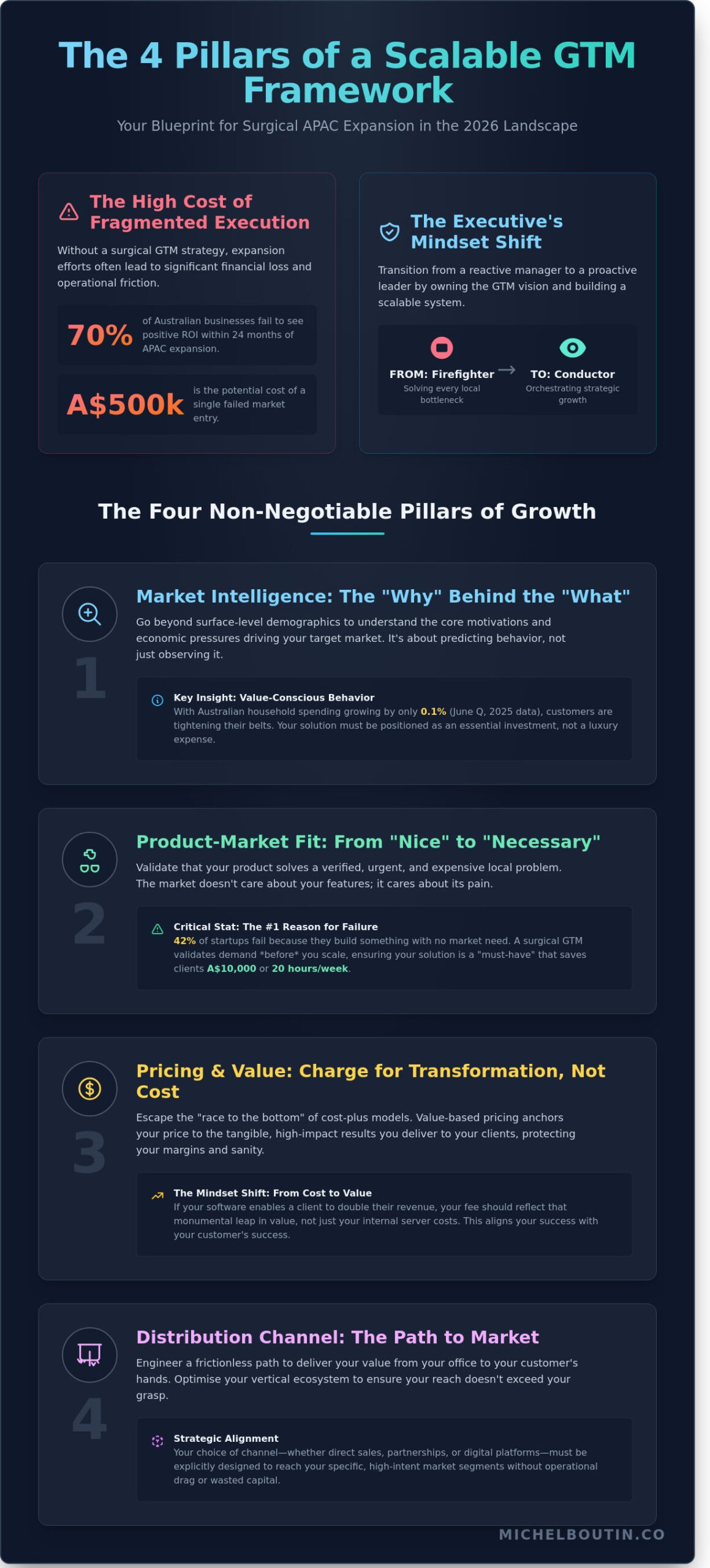
THE 4 PILLARS OF A SCALABLE GTM FRAMEWORK
Building a business without a clear go-to-market strategy is like trying to pilot a plane while still assembling the wings. You might get off the ground, but the crash is inevitable. To scale your Melbourne startup, you need a framework that transforms raw ambition into a precision instrument. This isn’t about guesswork; it’s about building a structure that grants you the freedom to lead instead of just managing fires. A robust strategy relies on four non-negotiable pillars that anchor your growth in reality.
Market intelligence is your first pillar. It goes beyond surface-level demographics. You must understand the "why" behind local consumer shifts. In 2025, Australian household spending grew by only 0.1 percent in the June quarter, signaling a massive shift toward value-conscious behavior. If you don’t know why your Melbourne customers are tightening their belts, you can’t position your solution as a necessity. You’re looking for the data that predicts behavior before it becomes a trend.
Consulting firms like Human Instinct specialize in providing these deep, data-driven insights, helping businesses uncover new audiences and understand the core motivations driving customer behavior.
Product-market fit is the second pillar. It’s the difference between a "nice-to-have" and a "must-have." Many founders fall in love with their features, but the market only cares about its pain. Your offering must solve a verified local problem. If your solution doesn’t save a Melbourne business A$10,000 in operational waste or 20 hours of manual labor per week, you haven’t found your fit yet. You’re seeking a surgical alignment between your product and the friction points of your city.
Pricing and value form the third pillar. Stop using cost-plus models. They trap you in a race to the bottom that erodes your margins and your sanity. Value-based pricing allows you to charge based on the transformation you deliver. If your software propels a client to double their revenue, your price should reflect that massive leap, not just your server costs. This shift in mindset is what separates struggling consultants from scalable enterprises.
The fourth pillar is your distribution channel. You must optimise your vertical ecosystem to ensure your reach doesn’t exceed your grasp. It’s about how you move your value from your office to the customer’s hands without friction. Whether you use direct sales or a partner network, the goal is a seamless flow. You want to become the conductor of a well-oiled machine, ensuring every touchpoint reinforces your brand promise. To start building this level of operational clarity, you can explore how to systemise your growth.
PILLAR 1: CUSTOMER STRATEGY AND MARKET INTELLIGENCE
Researching a buyer in Sydney requires a different lens than one in Shanghai. Cultural nuances, local regulations, and purchasing habits vary wildly. Navigating regional nuance is essential when defining your Ideal Customer Profile (ICP) for a 2026-27 expansion. By 2027, data-driven startups will use predictive analytics to anticipate client needs six months in advance. This foresight allows you to occupy the space before your competition even sees the opportunity.
PILLAR 2: OPTIMISING YOUR VERTICAL ECOSYSTEM
Managing multi-location networks across Victoria requires absolute brand consistency. Your supply chain must deliver on the promises your marketing team makes. Digital transformation isn’t just a buzzword; it’s the tool that enhances physical customer experiences. When you integrate your inventory systems with your CRM, you create a frictionless journey. This alignment allows you to step out of the daily operations and focus on the high-level vision that truly drives your go-to-market strategy forward.
NAVIGATING REGIONAL NUANCE: GTM STRATEGY IN SYDNEY, SINGAPORE, AND SHANGHAI
Every city has a unique business pulse. If you assume your Melbourne success will automatically translate to Sydney or Singapore, you are setting yourself up for a costly lesson. A one-size-fits-all approach is a recipe for failure. You must adapt. You must refine. Your go-to-market strategy acts as the bridge between your product and these distinct regional realities.
Regulation and compliance are your first hurdles when looking North. In Singapore, the Accounting and Corporate Regulatory Authority (ACRA) allows you to register a business in approximately 15 minutes. It is a frictionless gateway. Shanghai requires a different level of stamina. Establishing a Wholly Foreign-Owned Enterprise (WFOE) can take between 90 to 180 days. You need to account for these timelines in your cash flow projections. Ignoring local licensing laws in China can lead to immediate shutdowns. Trust the systems, but verify every step with local counsel.
Cultural nuances in marketing require more than just a translation. It is about resonance. In Australia, we value a straight-talking, "no-nonsense" brand voice. In Shanghai, 95% of digital interactions happen within "super apps" like WeChat. If your brand is not integrated into these ecosystems, you do not exist to the local consumer. You must adapt your delivery without losing your core identity. Keep your "why" consistent, but change your "how" to match the local digital behavior. This is where mastering brand positioning for strategic growth becomes critical to ensure your value proposition resonates across different markets while maintaining consistency.
Finding "white space" is the key to conquering crowded markets like Brisbane or Adelaide. Brisbane is currently experiencing a 2.5% annual population growth, the highest of any Australian capital city in 2024. This influx creates massive gaps in infrastructure and localized services. Adelaide offers a strategic advantage with commercial lease rates roughly 15% lower than Melbourne. Use these data points to position your startup where the competition is thin but the demand is surging.
MARKET COMPARISON: AUSTRALIA VS. ASIA HUBS
Sydney and Melbourne are high-value, service-oriented markets. Consumers here are demanding. They expect premium support and relationship-based sales. Singapore and Shanghai are different beasts. They are rapid-growth, tech-forward environments that reward agile execution over perfect planning. A 2023 study showed Singapore’s digital economy is expanding at 12% annually. You must balance your global vision with an "on-the-ground" reality that moves at twice the speed of home.
To capitalize on this, many businesses partner with a local performance marketing agency Singapore to navigate the competitive digital landscape and drive scalable results.
CASE STUDY: SCALING ACROSS THE OCEANIA REGION
A Melbourne-based retail tech firm expanded to 40 locations across Brisbane and Perth in 2024. Their secret? They avoided the pitfall of "Melbourne-centralization." They empowered local state managers to tweak pricing by 5% based on local logistics costs. This decentralization propelled their regional growth, leading to a 30% increase in installation speed. Local leadership is the engine of any successful national go-to-market strategy. It gives you the freedom to lead while they execute.
Success is not about being everywhere at once. It is about being exactly where your customer needs you, with a structure that supports that presence. Are you ready to step out of your comfort zone? The growth you want is waiting in the nuances you haven’t mastered yet. Propel your business forward by respecting the local soil you plant your seeds in.
HOW TO OPERATIONALISE YOUR GTM PLAN WITHOUT GETTING STUCK IN THE WEEDS
Execution is the bridge between a visionary idea and a profitable reality. Most Melbourne founders fail not because their product is weak, but because their execution is fragmented. To turn your go-to-market strategy into a high-performance engine, you must stop acting like a technician and start behaving like a conductor. You need a structure that supports growth without demanding your presence in every minor decision. This is how you reclaim your freedom while your business scales.
Start by building a cross-functional execution team. This isn’t a standard committee; it’s a lean squad that owns the tactical output. They don’t just report on progress; they own the numbers. In the first 90 days, your focus must remain laser-sharp on "North Star" metrics. If a task doesn’t directly impact your customer acquisition cost (CAC) or your initial revenue targets, it’s a distraction. Ambition requires the discipline to say no to the "weeds" of daily operations that don’t move the needle.
Presenting this team professionally is a critical first step in establishing credibility in a new market. For expansions into New Zealand, for example, securing high-quality corporate headshots Auckland ensures your leadership projects a polished and unified brand image from day one.
STEP 1: ALIGNING SALES, MARKETING, AND PRODUCT
Silos are the silent killers of momentum. When marketing targets one persona while sales pitches another, your brand message dilutes. You must create a "GTM War Room." This is a dedicated space, physical or digital, where data from all three departments converges daily. If your marketing team sees a spike in A$200 leads from LinkedIn that fail to convert in sales, the feedback must be instantaneous. This real-time loop ensures your unique value proposition remains consistent across every touchpoint. Alignment is your greatest lever for efficiency.
STEP 2: MEASURING WHAT MATTERS IN 2026
By 2026, the Australian startup ecosystem will no longer reward "growth at all costs." Investors in the APAC region now demand sustainable profitability. You must move beyond vanity metrics like social media impressions or website traffic. Focus on Time to Value (TTV). If a new customer takes more than 14 days to experience the core benefit of your service, your churn risk skyrockets. Benchmark your performance against the 2025 Australian SaaS Index, where a healthy LTV:CAC ratio is now established at 4:1. Tracking these hard numbers provides the clarté needed to pivot before resources are wasted.
Systemisation is the final step to propulser your venture forward. If a process is repeatable, it must be automated. Use CRM triggers to manage follow-ups and lead scoring without manual intervention. According to the 2024 State of Australian Startup reports, founders who automate 30% of their sales funnel see a 22% increase in operational capacity. This isn’t just about technology; it’s about building a machine that works while you sleep. Structure creates the freedom you entered this journey to find.
A well-oiled go-to-market strategy acts as a roadmap that prevents you from circling back to the same operational headaches. It allows you to step out of the day-to-day grind and into your role as a strategic leader. When your systems are robust, your growth becomes predictable. This is how you move from a struggling startup to a dominant market player in the Melbourne tech scene.
Ready to stop micromanaging and start leading your expansion with precision?
Build your scalable GTM engine today
PROPELLING YOUR BRAND: WHY BESPOKE STRATEGIC ADVISORY IS YOUR COMPETITIVE EDGE
Generic templates are a trap for ambitious founders. They offer a false sense of security while ignoring the specific unit economics of your business. In Melbourne’s high-stakes tech ecosystem, a cookie-cutter approach is a recipe for stagnation. Real growth requires a bespoke go-to-market strategy tailored to your specific niche. You need more than a document; you need a blueprint for execution that accounts for local market volatility and consumer behaviour.
Research indicates that 70% of strategic initiatives fail due to poor alignment or a lack of operational discipline. This is where the value of an external mentor becomes undeniable. You need someone who has walked the path, faced the fires, and emerged with a repeatable system. An expert advisor doesn’t just give advice; they provide a mirror. They force you to confront the bottlenecks in your leadership and the leaks in your conversion funnel. This external perspective is often the difference between a startup that burns through its Series A and one that achieves sustainable profitability.
Many founders are stuck in the operator trap. They spend 80% of their time on A$30 per hour tasks instead of A$1,000 per hour strategic moves. michelboutinstudio helps leaders transition from being the person who plays every instrument to becoming the conductor of the entire orchestra. We focus on building systems that work while you sleep. This shift isn’t just about business growth; it’s about reclaiming your freedom. When your business is systematic, it becomes an asset rather than a job. You gain the clarity needed to make bold moves with confidence. This transformation often requires a fundamental shift in how you position your value in the market, which is why understanding brand positioning for strategic growth becomes essential for commanding premium pricing and attracting ideal clients.
THE michelboutinstudio APPROACH TO GTM
We don’t believe in 100 page reports that gather digital dust. Our Melbourne based studio prioritises rapid, common sense strategies designed to deliver a measurable ROI within 90 days. We integrate customer acquisition tactics with intensive leadership development. This dual focus ensures your team can handle the growth we trigger. Refining your go-to-market strategy is the lever that propels APAC innovators past their competitors. We provide the structure; you provide the vision.
-
Systematisation: We turn chaotic workflows into streamlined, profitable engines.
-
Growth Levers: Identifying the specific 20% of activities that drive 80% of your revenue.
-
Scalability: Preparing your leadership team to manage 10x growth without burning out.
YOUR NEXT MOVE: FROM VISION TO EXECUTION
Indecision is the silent killer of Melbourne startups. A 20 year perspective allows you to see past this week’s market fluctuations. It gives you the necessary distance to build a legacy rather than just a product. Stop overthinking the perfect moment. It doesn’t exist. The only way to achieve business symmetry is to start building the structure today. You can Book a Strategic Advisory Session with michelboutinstudio to begin this transformation and move from operator to conductor. Your brand deserves a strategy that is as unique as your vision.
OWN YOUR APAC EXPANSION BY 2026
The path to regional dominance is paved with data, not guesses. You’ve identified the regional nuances of Sydney and Singapore. You’ve seen how the four pillars provide the skeleton for your growth. Now, it’s about movement. A successful go-to-market strategy demands a shift from daily operations to high-level orchestration. It’s the difference between being a passenger and the pilot of your own growth. I’ve spent over 20 years as an executive navigating these exact waters across the Retail, Automotive, and Financial Services sectors. I don’t believe in open-ended consulting fees that drain your budget. I offer fixed-fee project engagements because your ROI should be as clear as your vision. It’s time to stop managing the weeds and start leading the field. Let’s build the structure that gives you both market share and the personal freedom you’ve worked to earn. Your next level of growth is waiting for a decision.
Propel your business with a bespoke Go-To-Market strategy
Your future in the APAC market starts with the first bold step you take today.
Frequently Asked Questions
How long does it take to develop a Go-To-Market strategy?
You should expect to spend 8 to 12 weeks building a robust go-to-market strategy. This timeframe allows for 4 weeks of deep market research and 4 weeks to define your value proposition and sales channels. Rushing this process leads to expensive pivots later. A structured 90 day plan ensures your Melbourne startup hits the ground with momentum rather than hesitation.
Is a GTM strategy only for new products?
A go-to-market strategy isn’t just for 1.0 launches. You need one whenever you enter a new vertical or release a major update that shifts your value proposition. In 2024, 60% of established SaaS companies use GTM frameworks for expansion into new regions like Southeast Asia. It’s about maintaining your edge and ensuring every move you make is calculated for maximum growth.
What is the most common mistake in APAC market entry?
Treating the diverse APAC region as a single, uniform market is the costliest error you can make. Data from 2023 shows that 45% of Australian startups fail in Asia because they ignore local regulatory nuances and consumer behaviors. You can’t apply a Sydney sales model to Singapore or Jakarta and expect the same results. Success requires a hyper-local approach that respects specific regional pain points.
How much should I budget for a Go-To-Market launch in Sydney?
You’ll need a minimum budget of A$50,000 to A$150,000 for a professional launch in the Sydney market. This investment covers your initial A$15,000 in localized digital advertising and the A$35,000 required for high quality sales collateral and CRM setup. These figures reflect 2024 average costs for competitive B2B sectors. Proper funding gives you the runway to test your assumptions without risking your core business stability.
Can a small business benefit from a formal GTM framework?
Small businesses benefit more than anyone from a formal framework because they have the least room for error. A clear plan helps you allocate your limited A$20,000 marketing spend where it actually converts. Without structure, you’re just guessing. A GTM framework provides the clarity you need to stop doing everything and start doing the 20% of actions that drive 80% of your revenue.
How do I know if my GTM strategy is working?
You’ll know your strategy is working when your Customer Acquisition Cost stays below 30% of your Lifetime Value. Monitor your sales cycle length; if it drops from 6 months to 4 months, your messaging is hitting the mark. These hard numbers don’t lie. They tell you if you’re building a scalable engine or just buying temporary attention that won’t last in the long term.
What is the difference between GTM and a Business Plan?
Your business plan is a static document for investors, while your go-to-market strategy is a tactical roadmap for your team. The business plan covers your 5 year vision and financial projections. In contrast, the GTM focuses on the next 6 to 12 months of execution. Think of the business plan as your destination and the GTM as the high performance engine that actually gets you there.
Should I hire a consultant or build a GTM plan in-house?
Hire a consultant to build the framework if your internal team hasn’t launched in a new market in the last 2 years. External experts bring a fresh perspective that identifies blind spots you’re too close to see. However, your internal team must own the daily execution to ensure the strategy lives within your company culture. This hybrid approach combines specialized expertise with long term operational stability.
Firms with decades of experience, such as the US-based CGT Marketing, often bring battle-tested B2B marketing frameworks that can be adapted to any new market.
Disclaimer
Insights shared are for informational purposes and reflect professional perspective, not specific advice. Independent advice should be sought before acting on any content.