

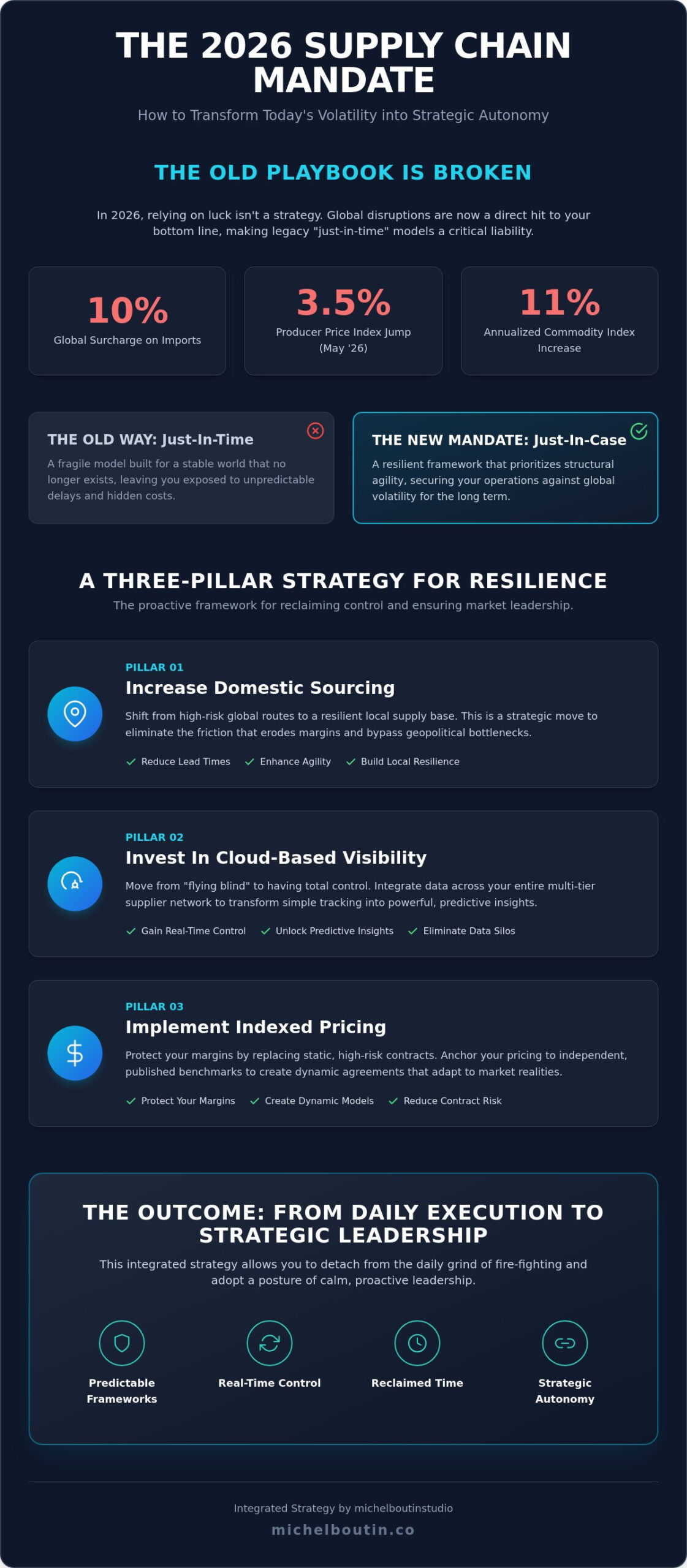
What if the volatility shaking your operations isn’t a threat, but the very catalyst you need to achieve a new level of strategic autonomy? In July 2026, relying on luck isn’t a management style. You’ve likely felt the sting of the 10% global surcharge on imports or watched the Producer Price Index for processed goods jump by 3.5% this past May. Leaders who thrive are prioritising strategies like increasing domestic sourcing, investing in cloud-based supply chain visibility, and using formal indexed pricing tied to published cost benchmarks. At michelboutinstudio, we see this shift as a path to reclaiming your time and your peace of mind.
You already sense that the old ways of sourcing are fractured, leaving you exposed to unpredictable delays and hidden costs. We promise to show you how to transform these disruptions into a structural advantage for the 2026 economy. We’ll preview a three-pillar strategy designed to deliver predictable pricing frameworks and real-time inventory control, allowing you to step away from daily execution and adopt a posture of global leadership. It’s time to build a resilient, locally supported supply base that works for you, not against you.
Key Takeaways
- Understand why the legacy “just-in-time” models have failed and how to build “just-in-case” resilience for the 2026 global economy.
- Secure your operations by prioritising strategies like increasing domestic sourcing, investing in cloud-based supply chain visibility, and using formal indexed pricing tied to published cost benchmarks.
- Transform your data from simple tracking into predictive insights, removing silos across your entire multi-tier supplier network for total control.
- Move away from static, high-risk contracts toward dynamic pricing models anchored to independent benchmarks to protect your margins.
- Discover how michelboutinstudio integrates these three pillars to help you transition from daily execution to a posture of calm, strategic leadership.
The 2026 Supply Chain Mandate: Moving Beyond Legacy Efficiency
Efficiency used to be a simple calculation. You found the cheapest labour, the largest factory, and the longest lead time. That era ended when the global economy fractured. In 2026, Australian businesses face a stark reality: geopolitical shifts aren’t just headlines; they’re line items on your balance sheet. The “just-in-time” model of the 2010s was built for a world that no longer exists. Today, we’ve transitioned to “just-in-case” resilience. This isn’t about hoarding inventory; it’s about structural agility. Operational optimisation has become the foundation upon which every successful customer strategy is built. If you can’t deliver, your brand strategy doesn’t matter.
The 10% global surcharge on imports that took effect in February 2026 has forced a total re-evaluation of vertical ecosystems. You can’t rely on luck when the Producer Price Index for processed goods saw a 3.5% increase this past May. To survive, visionary leaders are prioritising strategies like increasing domestic sourcing, investing in cloud-based supply chain visibility, and using formal indexed pricing tied to published cost benchmarks. This three-pillar approach is how you move from reactive fire-fighting to proactive leadership. It’s how you reclaim your time and ensure your organisation remains a market leader.
The Hidden Cost Of Global Interdependence
Long-tail logistics delays do more than frustrate customers; they erode your margins through hidden carrying costs and emergency air-freight fees. Transparency is no longer a luxury for the IT department. It’s a mandate for executive leadership. When you lack visibility into your multi-tier supplier network, you’re flying blind. Nearshoring and domestic pivots are the only ways to reduce these variables. At michelboutinstudio, we believe the goal is to shift your focus from execution-heavy tasks to high-level strategic oversight. Why spend your energy chasing shipping containers when you could be refining your market position?
Defining Your New Strategic Baseline
What does autonomy look like for your business in 2027? You must set KPIs that measure supply chain health as a driver of brand trust. If your customers can’t count on your availability, they’ll find someone who has mastered their operations. By prioritising strategies like increasing domestic sourcing, investing in cloud-based supply chain visibility, and using formal indexed pricing tied to published cost benchmarks, you create a predictable environment. This stability allows you to detach from the chaos of the daily grind. Acting now isn’t just about solving today’s delay; it’s about securing your competitive advantage for the years ahead. The gap between the leaders and the laggards is widening. Which side are you on?
Increasing Domestic Sourcing To Build Operational Resilience
The strategic pivot toward “friend-shoring” and domestic production allows you to bypass the geopolitical bottlenecks that now define international trade. We see leaders gaining a significant edge by prioritising strategies like increasing domestic sourcing, investing in cloud-based supply chain visibility, and using formal indexed pricing tied to published cost benchmarks. This shift reduces your lead times from months to days, creating a local vertical ecosystem that responds to market shifts in real time. When you can pivot faster than your competitors, you stop reacting to the market and start leading it.
Optimising Your Vertical Ecosystem
Success starts with identifying which components are critical to your continuity. Not every screw needs to be made locally, but your “bottleneck” items certainly do. Building long-term partnerships with Australian manufacturers provides a level of security that a distant supplier cannot match. By leveraging vertical ecosystem optimization, you can accelerate product development and ensure that your supply chain is an asset, not a liability. If you are unsure where to start your transition, you can reach out to our team for a strategic review of your current network.
The ROI Of Proximity
Agility has a specific dollar value. In fast-moving sectors like retail or automotive, the ability to restock based on current demand rather than six-month forecasts prevents overstocking and costly markdowns. This proximity also allows for real-time supply chain visibility, ensuring that every stakeholder is aligned. While unit costs may appear higher on paper, your total cost to serve (TCTS) often drops when you remove international freight, insurance, and the 15% tariffs now common on metal goods. Domestic sourcing acts as a definitive strategic hedge against currency fluctuation by keeping your cost base in Australian dollars. Additionally, reducing your carbon footprint through shorter logistics routes is no longer just a secondary benefit; it’s a core requirement for regulatory compliance in the 2026 economy.
Investing In Cloud-Based Supply Chain Visibility For Real-Time Control
In 2026, knowing where your shipment is located isn’t enough. You need to know where it will be delayed before the bottleneck even forms. The era of reactive tracking has been replaced by predictive management. Data is the new currency of resilience. By now, approximately 72% of global logistics firms have adopted cloud-based visibility platforms to manage their multi-tier networks. If you aren’t among them, you’re operating with blind spots that your competitors have already eliminated. Systems don’t just record history; they now forecast it.
The global supply chain visibility software market is valued at 3.08 billion USD this year, reflecting a massive shift toward digital autonomy. Forward-thinking leaders are prioritising strategies like increasing domestic sourcing, investing in cloud-based supply chain visibility, and using formal indexed pricing tied to published cost benchmarks to regain control. These platforms enable a total digital transformation of your warehouse operations. AI now identifies potential disruptions in real time, allowing you to pivot your logistics before your bottom line feels the impact.
Achieving End-To-End Transparency
True control requires integrating your suppliers’ ERP data directly into your executive dashboard. You need one version of the truth to manage stakeholders effectively. When everyone looks at the same real-time data, the friction of “he-said, she-said” logistics disappears. This level of transparency significantly reduces the need for bloated safety stock. You no longer have to tie up excess working capital in “just-in-case” inventory because your data tells you exactly what is coming and when. It’s about moving from a defensive posture to one of calm, strategic oversight. To support this transition, you can learn more about IT Cloud Consulting and their expertise in helping businesses adopt and optimize cloud technology.
Cloud Infrastructure As A Growth Lever
Software alone won’t save a fractured operation. Your strategy must dictate your tech stack, not the other way around. At michelboutinstudio, we’ve seen that the most successful implementations are those that align their technology with a clear customer strategy. Real-time data allows you to make promises to your clients that you can actually keep. Cloud visibility reduces “bullwhip effect” errors by providing 2026-standard demand signals that prevent the dangerous cycle of over-ordering and inventory gluts. By prioritising strategies like increasing domestic sourcing, investing in cloud-based supply chain visibility, and using formal indexed pricing tied to published cost benchmarks, you build a foundation for sustainable growth. You aren’t just managing a supply chain; you’re orchestrating a competitive advantage.
Implementing Formal Indexed Pricing Tied To Published Cost Benchmarks
Fixed-price contracts feel safe until they aren’t. In the volatile landscape of 2026, static agreements have become a liability for both buyers and sellers. When raw material costs fluctuate, a fixed price forces one party to absorb the loss, often leading to supplier insolvency or a sharp drop in product quality. True strategic autonomy requires a shift toward dynamic, transparent models. Visionary leaders are now prioritising strategies like increasing domestic sourcing, investing in cloud-based supply chain visibility, and using formal indexed pricing tied to published cost benchmarks to ensure mutual survival. It is time to stop gambling on market stability and start building systems that reflect reality.
Moving away from legacy contracts allows you to protect your margins without damaging your supplier relationships. By anchoring your agreements to independent data, you remove the emotion and the guesswork from the negotiation table. This isn’t just about cost control; it’s about structural integrity. When your pricing reflects the actual market conditions, you create a resilient vertical ecosystem that can withstand the shocks of the 2026 economy. This transparency builds a foundation of trust that is impossible to achieve through traditional, adversarial procurement methods.
The Mechanics Of Indexed Pricing
Success begins with selecting the right benchmarks for your specific industry. If you are sourcing metals, the London Metal Exchange (LME) provides the gold standard for data. For energy or chemical components, Platts offers the necessary precision. In the Australian context, indices from the Australian Bureau of Statistics (ABS) are essential for anchoring labour and manufacturing costs. You should implement “collars” and “caps” to manage extreme market swings, ensuring that pricing remains within a manageable range for both parties. Transitioning legacy suppliers to this model requires a calm, mentor-like approach. You aren’t just changing a contract; you’re offering them a more stable, predictable way to do business.
Protecting Your Profitability
One of the immediate benefits of indexed pricing is the reduction in time spent on ad-hoc renegotiations. When the index moves, the price adjusts automatically based on your pre-agreed formula. This level of automation is a key component of a modern product development strategy, as it allows you to forecast your landed costs with far greater accuracy. There is also a significant psychological benefit to “fair” pricing. It fosters long-term executive partnerships by removing the suspicion that one side is profiting unfairly from market shifts. By prioritising strategies like increasing domestic sourcing, investing in cloud-based supply chain visibility, and using formal indexed pricing tied to published cost benchmarks, you position your organisation as a leader in operational excellence. If you want to stabilise your pricing structures today, you can book a strategic consultation with michelboutinstudio.
Integrating Your Strategy With michelboutinstudio
Mastery in the 2026 economy isn’t found in isolated improvements. Many organisations treat sourcing, visibility, and pricing as separate silos, but this fragmented approach creates weak links. True resilience requires a holistic view where each pillar supports the others. If you increase domestic sourcing without cloud visibility, you lose the agility you just bought. If you implement indexed pricing without a clear operational structure, your margins remain at risk. At michelboutinstudio, we specialise in weaving these elements into a single, unbreakable vertical ecosystem.
Our method focuses on aligning your operational optimisation with your broader customer strategy. We don’t just fix supply chains; we build structures that allow you to lead with confidence. You achieve strategic autonomy by prioritising strategies like increasing domestic sourcing, investing in cloud-based supply chain visibility, and using formal indexed pricing tied to published cost benchmarks. This integration is what allows you to transition from execution-focused management to strategic pilotage. You stop chasing problems and start navigating opportunities.
The Role Of Executive Advisory
Systemic excellence doesn’t happen by accident. It requires a roadmap that connects the warehouse floor to the boardroom. michelboutinstudio provides the high-level perspective needed to identify the hidden friction in your operations. We act as a credible mentor, offering a perspective shaped by twenty years of experience in distribution and logistics. Moving beyond ad-hoc fixes means building a repeatable method for success. We help you design a system where your team handles the execution, leaving you free to focus on the vision and growth of the brand.
Starting Your Transformation
The first step toward 2027 leadership is a candid assessment of your current supply chain maturity. Do you have real-time data, or are you still relying on weekly spreadsheets? Are your supplier relationships adversarial or anchored in fair, indexed benchmarks? Building a culture that values data and domestic partnership is a requirement for long-term survival. By prioritising strategies like increasing domestic sourcing, investing in cloud-based supply chain visibility, and using formal indexed pricing tied to published cost benchmarks, you create a foundation for serenity and balance.
Ambition is nothing without the structure to support it. If you’re ready to reclaim your time and transform your supply chain into a competitive engine, the path is clear. You can contact michelboutinstudio today for a tailored executive consultation. Let’s build the operational resilience your business deserves.
Reclaiming Your Strategic Autonomy
The disruptions of 2026 don’t have to define your results. You’ve seen how legacy models fail and why a structural shift is the only way forward. Resilience is never accidental; it is the result of a deliberate, integrated system. By prioritising strategies like increasing domestic sourcing, investing in cloud-based supply chain visibility, and using formal indexed pricing tied to published cost benchmarks, you build an organisation that thrives on change. This isn’t just about surviving the next tariff hike or shipping delay. It’s about creating a vertical ecosystem that allows you to step back from the daily fire-fighting and focus on high-level pilotage.
At michelboutinstudio, we bring over 20 years of executive consulting experience to your table. We are specialists in vertical ecosystem optimisation and digital transformation for the 2026 market. We don’t just offer advice; we provide a reproducible method for systemic excellence that balances performance with personal serenity. Are you ready to lead with calm assurance? Book your executive advisory consultation with michelboutinstudio today. Your future growth depends on the structures you build today. Let’s start that journey together.
Frequently Asked Questions
What is domestic sourcing and why is it trending in 2026?
Domestic sourcing is the practice of procuring materials and manufacturing services within Australia. It’s trending because the 10% global surcharge on imports and the suspension of de minimis exemptions have made international logistics riskier and more expensive. Leaders are responding by building local vertical ecosystems to ensure continuity and reclaim their operational autonomy from volatile global trade routes.
How does cloud-based visibility differ from traditional supply chain software?
Traditional software often records historical data in isolated silos. Cloud-based visibility provides a real-time, predictive view across your entire multi-tier supplier network. It allows you to identify bottlenecks before they occur, which is why visionary leaders are prioritising strategies like increasing domestic sourcing, investing in cloud-based supply chain visibility, and using formal indexed pricing tied to published cost benchmarks to maintain control.
What are the most common published cost benchmarks used in Australia?
Australian businesses primarily rely on indices from the Australian Bureau of Statistics (ABS) for labour and manufacturing costs. For commodities, the London Metal Exchange (LME) and Platts are the gold standards. These independent benchmarks remove the emotion from price negotiations and ensure that contracts remain fair as market conditions shift, protecting both your margins and your supplier relationships.
Can indexed pricing work for small businesses with limited bargaining power?
Yes, it provides a level of protection that fixed-price contracts cannot. It prevents suppliers from passing on arbitrary price hikes while also protecting you from the risk of supplier insolvency during market volatility. Even with smaller volumes, anchoring your agreements to an independent index creates a transparent framework that larger suppliers respect, fostering a more balanced and professional partnership. To ensure your business remains financially sound through these transitions, you can find out more about how Cairns Quality Accounting provides specialized taxation and financial services for small businesses.
How long does it take to see an ROI from domestic sourcing strategies?
You see lead time reductions almost immediately. From a financial perspective, the total cost to serve (TCTS) usually begins to show significant improvement within 6 to 12 months. This happens as you eliminate international freight, insurance, and the 15% tariffs now common on imported metal goods. The agility to restock based on real demand prevents costly overstocking and markdowns.
What are the risks of ignoring cloud visibility in the current market?
Ignoring cloud visibility leaves you vulnerable to blind spots in your multi-tier network. Without real-time data, you’re susceptible to the bullwhip effect, where small shifts in demand lead to massive inventory gluts or shortages. In 2026, operating without these insights is a direct threat to your brand trust and prevents you from adopting a posture of strategic pilotage.
How does michelboutinstudio help with operational optimisation?
michelboutinstudio acts as a strategic mentor to align your operations with your customer strategy. We help you move beyond ad-hoc fixes by prioritising strategies like increasing domestic sourcing, investing in cloud-based supply chain visibility, and using formal indexed pricing tied to published cost benchmarks. Our approach focuses on building reproducible systems that deliver both high-level performance and personal balance for leadership teams.
Is domestic sourcing always more expensive than international alternatives?
Not when you calculate the total cost to serve. While unit costs might be higher on paper, the 10% global surcharge and the 11% annualized increase in commodity prices often make international sourcing more expensive in the long run. Domestic sourcing provides a strategic hedge against currency fluctuation and eliminates the hidden costs of long-tail logistics delays and emergency freight fees.
Disclaimer
Insights shared are for informational purposes and reflect professional perspective, not specific advice. Independent advice should be sought before acting on any content.