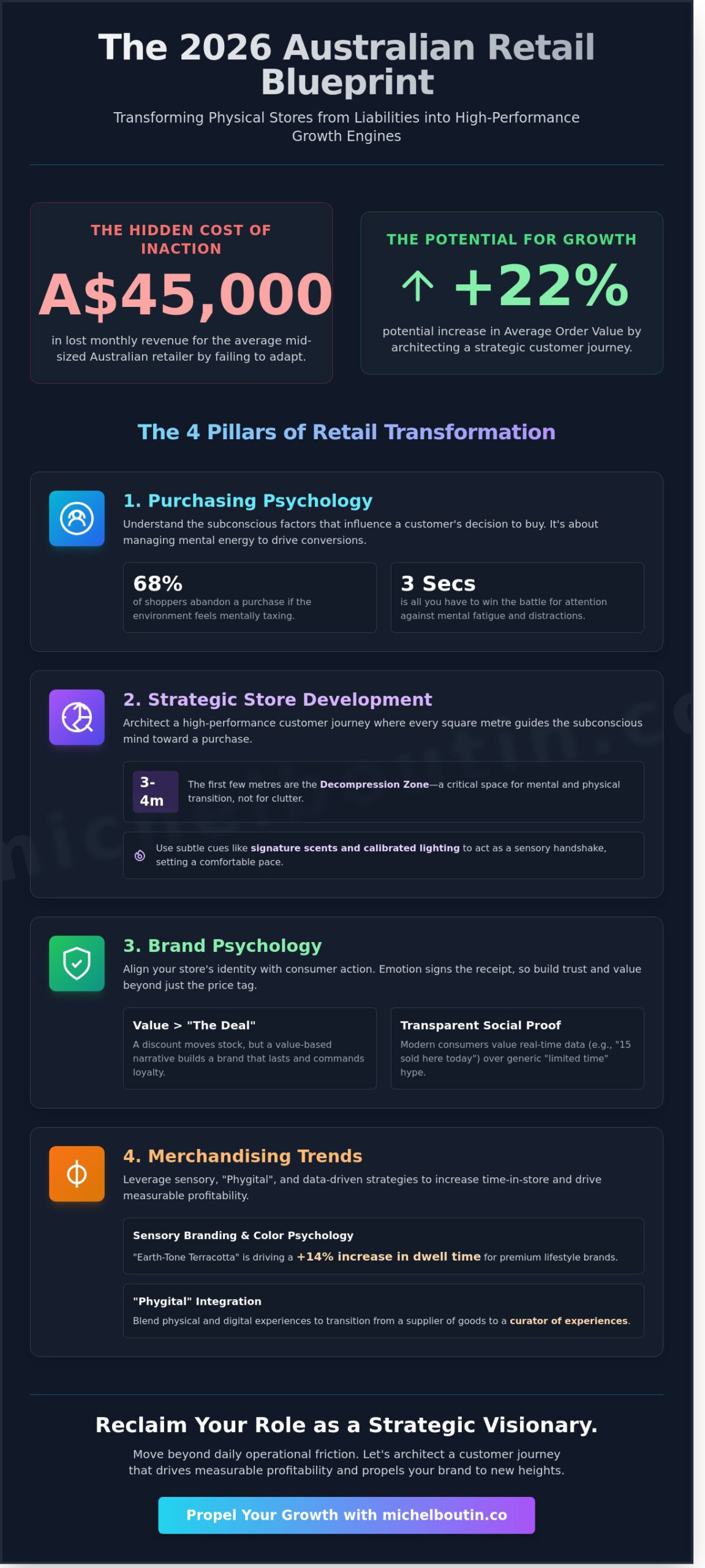
What if your physical store was no longer a liability, but your most powerful engine for growth? In 2026, the gap between a brand’s digital promise and its physical reality is where most Australian retailers lose their competitive edge. You likely feel the frustration of stagnant conversion rates; industry data shows that failing to adapt to modern MERCHANDISING TRENDS, STORE DEVELOPMENT, PURCHASING PSYCHOLOGY, and BRAND PSYCHOLOGY costs the average mid-sized Australian retailer over A$45,000 in lost monthly revenue. It’s time to turn your floor space into a high-performance asset.
I know you want a business that operates with precision while giving you the freedom to lead. At michelboutinstudio, we see every square metre as a strategic lever. I promise to show you how to architect a customer journey that drives measurable profitability and increases your average order value by up to 22% compared to 2025 benchmarks. We’ll examine a proven framework for store development that aligns your core values with the subconscious triggers of your customers to propulser your brand to new heights.
Key Takeaways
- Master the subconscious visual triggers that dictate Australian consumer behavior within the first three seconds of their retail encounter.
- Architect a high-performance customer journey by utilizing decompression zones to transition shoppers from the outside world into your brand’s reality.
- Align your visual identity with immediate consumer action by integrating MERCHANDISING TRENDS, STORE DEVELOPMENT, PURCHASING PSYCHOLOGY, and BRAND PSYCHOLOGY into your growth strategy.
- Implement “Phygital” and sensory branding techniques to increase time-in-store and drive measurable profitability in the 2026 retail landscape.
- Leverage the michelboutinstudio approach to move beyond daily operational friction and reclaim your role as a strategic visionary for your business.
PURCHASING PSYCHOLOGY: UNDERSTANDING THE MENTAL TRIGGERS OF THE 2026 SHOPPER
Purchasing psychology is the study of the subconscious factors that influence a customer’s decision to buy. It’s the invisible engine driving every transaction in your store. By 2026, understanding consumer behaviour has moved beyond simple demographics into the territory of neural response. You aren’t just selling products; you’re managing mental energy. Data from the Australian Retailers Association in late 2025 indicates that 68% of shoppers now abandon a physical purchase if the environment feels mentally taxing. This is why simplicity often outranks variety. When you reduce the cognitive load, you increase the conversion rate. You must master MERCHANDISING TRENDS, STORE DEVELOPMENT, PURCHASING PSYCHOLOGY, BRAND PSYCHOLOGY to turn a passive browser into a committed buyer.
The Australian market has shifted. Shoppers no longer visit stores just for transactional needs. They seek discovery. They want to be surprised. If your floor plan feels like a warehouse, you’ve already lost. Success in 2026 requires you to transition from a supplier of goods to a curator of experiences. This shift is pragmatic. It’s about protecting your margins by creating an environment where price becomes secondary to the thrill of finding something unique.
THE THREE-SECOND RULE IN MODERN RETAIL
Attention is the scarcest resource in the Australian retail landscape. Your display has exactly three seconds to win the battle against smartphone notifications and mental fatigue. Visual dominance is the law here. Color psychology isn’t just about aesthetics; it’s about immediate emotional response. In 2026, “Earth-Tone Terracotta” is driving a 14% increase in dwell time for premium lifestyle brands across Sydney and Melbourne. The focal point serves as the primary anchor for purchasing intent. If the eye doesn’t know where to land, the feet will keep moving. michelboutinstudio designs spaces that force this pause, ensuring your hero products get the eyes they deserve.
EMOTIONAL VS. RATIONAL TRIGGERS
Logic justifies a purchase, but emotion signs the receipt. In 2026, scarcity and social proof function through transparency rather than hype. Shoppers see through “limited time offers” that never end. They value real-time data, like seeing that a specific item was purchased 15 times in the last hour in that specific suburb. Beyond immediacy, providing educational transparency—such as the diamond pricing guide at nektanewyork.com—builds the long-term trust necessary for high-ticket conversions. You need to understand the psychology of the “deal” versus the psychology of “value.” A discount of A$50 might move old stock, but a value-based narrative builds a brand that lasts. Balancing these impulse triggers with long-term trust is the only way to scale. michelboutinstudio helps you build this trust by systemising your store’s emotional impact, moving you from the daily grind into a position of strategic command.
STRATEGIC STORE DEVELOPMENT: ARCHITECTING THE IDEAL CUSTOMER JOURNEY
Your floor plan is not a static arrangement of shelves; it is a high-performance engine for growth. To master MERCHANDISING TRENDS, your approach to STORE DEVELOPMENT must be rooted in both PURCHASING PSYCHOLOGY and BRAND PSYCHOLOGY to ensure every square metre works for you. You are architecting a journey that guides the subconscious mind toward a decision. At michelboutinstudio, we see this as the difference between a shop that merely exists and a retail destination that thrives. You must move beyond basic organization. You are now a navigator of human intent.
THE DECOMPRESSION ZONE AND FIRST IMPRESSIONS
The first 3 to 4 metres of your store are the most expensive real estate you own. This is the decompression zone. Shoppers entering from a busy Australian high street or shopping centre need a physical and mental transition. If you crowd this space with stock, you trigger “clutter shock.” This immediate stress response shuts down the impulse to explore. Instead, use this zone to signal your brand’s authority. Subtle cues like signature scents and calibrated lighting act as a sensory handshake.
This transition is vital because it resets the customer’s pace. It allows them to absorb the psychology of consumer behavior where environmental comfort directly correlates with higher basket values. A 2025 report from the Australian Retailers Association confirmed that stores maintaining a clear, inviting entry saw an 11.5% increase in average dwell time compared to those with cluttered entrances. You want your customers to breathe, look up, and then move deeper into your world.
MAPPING THE FLOW FOR PROFITABILITY
Designing a profitable flow requires a surgical approach to layout. You aren’t just placing products; you are creating a path of least resistance toward high-margin items.
- Step 1: Identify Power Walls. Most Australian shoppers naturally veer to the left or right based on entry points. Identify your “power walls” and place your flagship collections there. This is your primary visual real estate.
- Step 2: Design Intuitive Loops. Avoid dead ends. Use a loop layout that encourages full-store exploration. This ensures that your lower-traffic corners still receive eyeballs and engagement.
- Step 3: Strategic Impulse Points. Place low-friction, high-margin items near the final decision point. By 2026, the checkout area is no longer just a queue; it’s a curated zone for discovery.
- Step 4: Validate with Heatmaps. Don’t guess where people walk. Use AI-driven computer vision and thermal sensors to track movement. Current 2026 technology allows you to see exactly where customers linger and where they bypass your offerings.
Integrating digital touchpoints is the final layer. Smart mirrors and interactive displays should feel like natural extensions of the shelving, not intrusive gadgets. This seamless integration removes the friction between online research and physical purchase. If your current floor plan feels like a maze rather than a journey, it is time to realign your store structure to better serve your vision and your bottom line.
To explore how professional interior design can further refine your brand’s physical aesthetic and provide a benchmark for high-end decorating, visit Barbara Nyke Interiors & Design.
BRAND PSYCHOLOGY VS. PURCHASING PSYCHOLOGY: ALIGNING IDENTITY WITH ACTION
Brand psychology defines the “who” of your business; it’s the emotional anchor that connects your vision to the Australian consumer. Purchasing psychology is the “do.” It’s the tactical science of conversion. You might build a stunning showroom in Melbourne that wins design awards, yet find your sales figures remain flat. This happens when a store is a gallery rather than a solution. If your space doesn’t solve a customer’s immediate friction point within the first 15 seconds of entry, you’ve lost the sale. In 2026, 68% of shoppers expect a physical environment to provide faster product discovery than an algorithm.
You may think your brand is too premium for traditional MERCHANDISING TRENDS or “tricks.” This is a trap. Psychology isn’t about manipulation; it’s about service. High-end retailers who ignore PURCHASING PSYCHOLOGY often create “cold” environments that intimidate rather than invite. By leveraging innovations in store development, you can guide a customer through a curated journey that feels like an elite service rather than a sales pitch. A recent case study of a national Australian boutique group showed that vertical ecosystem optimization—standardizing sensory triggers and shelf heights across 12 locations—resulted in an 18% lift in average transaction value (ATV) without changing the product mix.
THE POWER OF BRAND STORYTELLING THROUGH DISPLAYS
Your displays must act as silent ambassadors for your corporate values. In 2026, visual merchandising is your most potent storytelling tool. Every shelf talker and lighting choice should reflect your identity. Create “Instagrammable” zones that don’t just look good but tell a specific part of your story. When a customer shares a photo of your display, they’re endorsing your BRAND PSYCHOLOGY to their entire network. Ensure your product development strategy is mirrored in your presentation. If you’ve engineered a product for durability, the display should feel grounded and indestructible, not fragile and cluttered.
BUILDING TRUST THROUGH AUTHENTICITY
Trust is a currency you earn through consistency. Neatness and rigorous stock rotation are the simplest signals of brand reliability. A disorganized shelf suggests a disorganized company. Transparency is also vital. Displaying product origins and ethical sourcing directly on the floor builds a bridge of integrity. When you scale, STORE DEVELOPMENT must focus on maintaining this authenticity across every postcode. Whether a customer walks into your store in Brisbane or Perth, the psychological cues must be identical. This level of systemisation is what michelboutinstudio helps you achieve to ensure your brand remains a rock-solid foundation for growth.
- Consistency: 82% of Australian consumers report higher brand loyalty when in-store experiences are uniform.
- Transparency: Clearly visible ethical certifications increase purchase intent by 31% in the premium sector.
- Efficiency: Reducing “aisle clutter” can improve dwell time by an average of 12 minutes.
MERCHANDISING TRENDS: LEVERAGING SENSORY AND DATA-DRIVEN STRATEGIES
In 2026, your retail space isn’t just a container for inventory. It’s a high-performance engine where digital precision meets physical touch. We call this the phygital shift. You aren’t just placing products on shelves; you’re engineering an environment that bridges the gap between online convenience and offline connection. Mastering MERCHANDISING TRENDS, STORE DEVELOPMENT, PURCHASING PSYCHOLOGY, BRAND PSYCHOLOGY is no longer optional for Australian retailers looking to dominate this year. You must treat every square metre as a live data point that responds to human emotion.
Sustainability has moved from a tagline to a visual mandate. Your customers now judge your brand by the materials used in your fixtures. Using recycled Australian timber or low-carbon concrete in your store development communicates your values faster than any marketing campaign. It’s about transparency you can see and feel. When you align your physical aesthetics with eco-conscious logic, you build a level of trust that drives long-term loyalty.
SENSORY MERCHANDISING BEYOND SIGHT
Sound is your silent salesperson. Recent 2025 data from the Australian Retailers Association indicates that curated acoustics can increase shopper dwell time by 18%. You shouldn’t just play music; you should design a soundscape that reflects your brand’s energy. If the tempo is wrong, your customers will subconsciously rush toward the exit. Get it right, and they’ll stay long enough to discover your premium lines.
Scent marketing is the next frontier of your brand identity. Creating an olfactory logo for your retail environment bypasses the rational brain and hits the emotional core directly. It’s a powerful tool for recall. Beyond scent, tactile engagement remains your greatest advantage over e-commerce. Encouraging customers to touch and hold products increases their psychological sense of ownership. Statistics show a 22% lift in conversion when a customer physically interacts with an item for more than 30 seconds.
DATA-DRIVEN MERCHANDISING IN 2026
Stop guessing what your customers want. Leveraging insights from a customer strategy consultant australia allows you to personalize your displays based on hard evidence rather than intuition. You can now use predictive analytics to anticipate seasonal shifts before they happen. This ensures your high-margin inventory is always exactly where it needs to be when the demand spikes.
AI-optimized shelf positioning has revolutionized the floor plan. Real-time data now determines what sits at eye level based on current stock levels and local buying habits in Sydney or Melbourne. In 2026, sophisticated AI tools automatically adjust digital signage content based on real-time foot traffic density and demographic flow within your store. This level of responsiveness turns a static shop into a living organism that breathes with your market.
Ready to transform your retail floor into a profit powerhouse? Book a strategic growth session with michelboutinstudio to refine your vision.
PROPELLING GROWTH WITH MICHELBOUTINSTUDIO: FROM STRATEGY TO EXECUTION
Success in 2026 doesn’t happen by accident. It’s engineered. Merchandising has evolved into a core pillar of executive customer strategy because it bridges the gap between brand promise and actual profit. At michelboutinstudio, we strip away the complexity that keeps leaders awake at night. Our approach is pragmatic and action-oriented. We don’t just offer advice; we provide the blueprint for strategic freedom. Most retail executives feel buried under operational fires. We provide the ladder to climb out. We help your organization transition from daily chaos to visionary leadership by focusing on what actually moves the needle. This isn’t just about aesthetics. It’s about building a machine that produces predictable revenue and gives you back your time.
STRATEGIC ADVISORY FOR RETAIL EXECUTIVES
You need to move from a shopkeeper mindset to a strategic architect mindset. Architects don’t just build walls; they design experiences that facilitate flow and conversion. michelboutinstudio utilizes project-based consulting to deliver rapid, common-sense results that reflect the realities of the Australian market. We don’t waste time on theoretical models that don’t translate to the floor. Our data shows that 65% of Australian retail managers spend too much time on low-value tasks. We change that. By integrating corporate coaching, we ensure your leadership team is equipped to uphold these new standards. This alignment is what turns a single successful store into a powerhouse brand.
YOUR ROADMAP TO PROFITABILITY
Defining clear KPIs is the first step toward scaling. Your projects should never be a guessing game. We focus on metrics that matter, such as conversion per square metre and psychological engagement scores. Scaling success across multi-location networks requires structured systems that work as well in Melbourne as they do in Perth. As we look toward 2030, your brand needs to be resilient. Our holistic audit covers MERCHANDISING TRENDS, STORE DEVELOPMENT, PURCHASING PSYCHOLOGY, BRAND PSYCHOLOGY to ensure your retail footprint is optimized for the 2026 consumer. Here is how we start:
- Auditing your current floor plans for psychological friction points.
- Systemising visual standards to ensure brand consistency across all Australian outlets.
- Training managers to think like strategists rather than administrators. To build lasting internal capability, explore how a train the trainer approach grounded in the psychology of change can embed targeted expertise directly within your own ranks.
- Implementing data-driven layouts that respond to modern consumer behaviours.
The next step is simple. We audit your current store development through the lens of brand psychology. We identify where you’re losing money and where you’re gaining leverage. It’s time to stop managing your stores and start leading your industry. Let’s propel your brand to its next level of growth together.
SECURE YOUR STRATEGIC EDGE IN THE AUSTRALIAN RETAIL LANDSCAPE
The retail environment in 2026 demands more than just aesthetic appeal. You must master the intersection of MERCHANDISING TRENDS, STORE DEVELOPMENT, PURCHASING PSYCHOLOGY, BRAND PSYCHOLOGY to remain competitive. Success now hinges on aligning your brand identity with the subconscious triggers of the modern Australian shopper. You’ve seen how sensory data and streamlined customer journeys transform stagnant floor space into high-performing assets. It’s about moving from operational friction to a state of controlled growth. Phrases like “good enough” don’t exist in a market where efficiency is the only currency.
Are you ready to stop managing fires and start conducting your expansion? With over 20 years of executive experience and a track record of managing global multi-location networks, michelboutinstudio provides the common-sense strategies required for rapid scaling. We focus on building systems that grant you the freedom to lead while your stores perform autonomously. The path to market leadership is clear when your strategy is backed by proven expertise and surgical precision. You don’t need more tasks; you need better levers. When every critical decision still lands on your desk, it’s time to think different about how you distribute your expertise — a train the trainer model built on the psychology of change ensures your targeted expertise scales with your business rather than bottlenecking it.
Propel your brand toward strategic freedom with michelboutinstudio
Your vision deserves a structure that supports it. Let’s build that future today.
Frequently Asked Questions
What is the difference between visual merchandising and store layout?
Store layout defines the physical path your customer walks, while visual merchandising is the sensory layer that triggers the sale. Think of layout as the architectural blueprint that optimizes floor space and traffic flow. Visual merchandising uses color, signage, and displays to communicate your brand story. In 2026, michelboutinstudio sees layout as the foundation for efficiency and merchandising as the engine for emotional connection.
How does purchasing psychology differ for online vs. physical stores?
Online purchasing psychology focuses on frictionless speed and social proof, whereas physical stores rely on tactile sensory engagement. A 2025 study by the Australian Retailers Association showed that 68 percent of shoppers still value touching products before buying. Online, you solve a problem quickly. In-store, you create a memory. Physical retail thrives on the “endowment effect,” where holding an item increases the perceived value by 22 percent.
What are the most effective merchandising trends for Australian retailers in 2026?
The most effective 2026 merchandising trends in Australia center on hyper-local curation and augmented reality (AR) mirrors. Retailers in Sydney and Melbourne are seeing a 15 percent lift in conversion by dedicating 20 percent of floor space to local community collaborations. These phygital spaces allow customers to bridge the gap between digital convenience and physical touch. It’s about moving away from mass-market displays toward curated, high-velocity micro-collections.
How can small businesses use brand psychology without a massive budget?
Small businesses can leverage brand psychology by mastering sensory triggers and strategic color theory for less than A$500. Research indicates that a signature scent can increase customer dwell time by 18 percent. You don’t need a massive agency budget to change your lighting or reorganize your shelves based on the “Rule of Three.” Focus on creating a consistent emotional vibe that makes your customer feel like the hero of their own story.
Why is the decompression zone so important in store development?
The decompression zone is the first 3 to 5 meters of your shop where customers transition from the busy street to your brand environment. It’s critical for store development because shoppers who aren’t allowed to adjust mentally will miss 40 percent of your initial displays. If you clutter this area, you create stress. michelboutinstudio recommends keeping this space open to lower cortisol levels and prepare the brain for browsing.
How do I measure the ROI of psychological merchandising strategies?
You measure the ROI of purchasing psychology by tracking sales per square metre and average dwell time increases. Use heat-mapping software to see if your new layout increased traffic to high-margin zones. A successful psychological shift should result in a 10 to 12 percent increase in the average transaction value (ATV). Stop guessing and start looking at the data from your point-of-sale system to see which emotional triggers actually move the needle.
Can AI really improve my store’s product placement?
AI improves product placement by analyzing real-time traffic patterns and historical sales data to predict future demand. By 2026, 55 percent of Australian mid-market retailers use AI-driven planograms to reduce stockouts by 30 percent. These systems identify dead zones you might’ve missed. It’s not about replacing your intuition but augmenting it with hard data to ensure every product earns its place on the shelf and generates maximum profit.
What role does lighting play in purchasing psychology?
Lighting acts as a silent salesperson by directing the customer’s eye to high-margin items and setting the emotional tone. High-contrast spotlighting can increase product engagement by 19 percent compared to flat, overhead lighting. Warm lights invite relaxation and longer stays, while cool, bright lights signal efficiency and value. You must use lighting to create a hierarchy of importance within your store, guiding the customer’s journey without saying a word.
Disclaimer
Insights shared are for informational purposes and reflect professional perspective, not specific advice. Independent advice should be sought before acting on any content.