

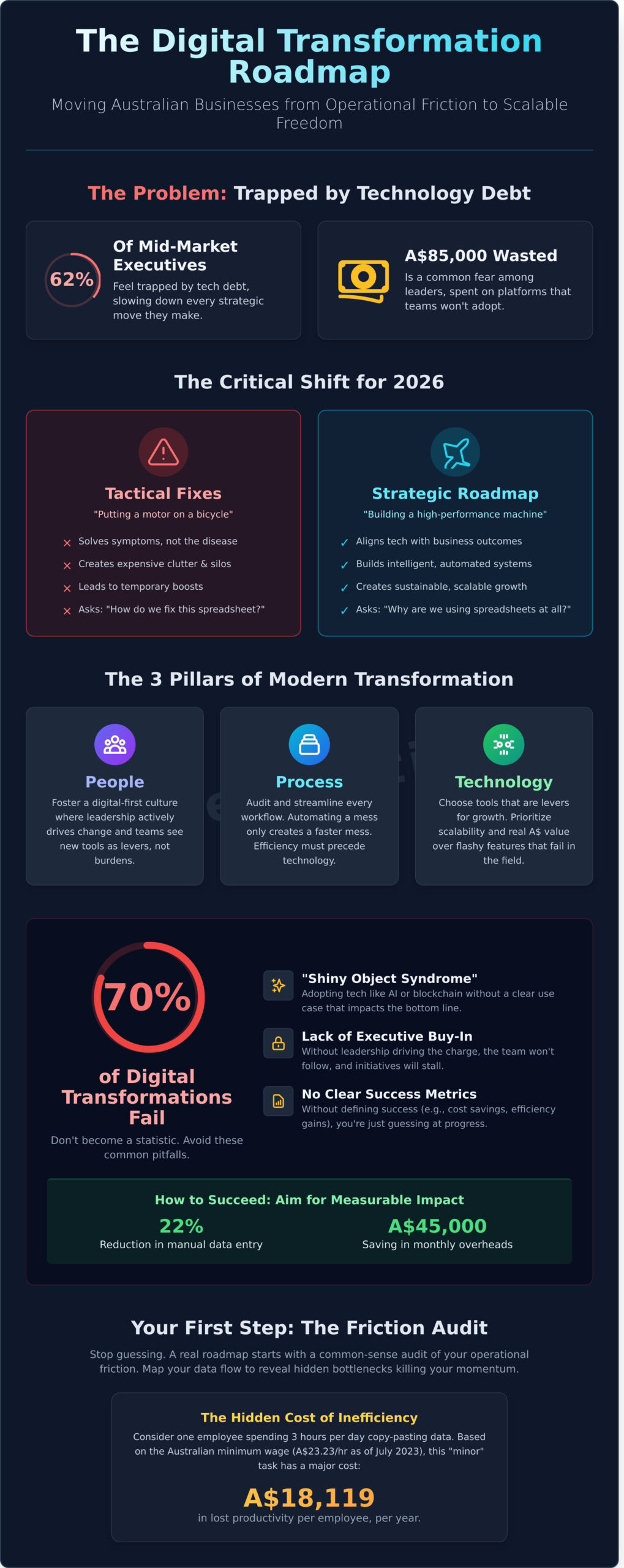
Why are you still working for your software instead of your software working for you? In 2025, a survey of mid-market Australian firms revealed that 62% of executives feel trapped by tech debt that slows down every strategic move. You’ve likely felt that friction. It’s the frustration of systems that don’t talk to each other and the constant fear of wasting another A$85,000 or more on a platform your team won’t even use. You’ve built a successful business, but it’s demanding more of your personal time just to keep the gears turning.
You deserve a business that serves your life, not a job you can’t escape. This is why a clear digital transformation roadmap is no longer optional for the 2026 market. I’ll show you exactly how to build a strategic digital roadmap that moves you from operational friction to scalable growth and personal freedom. We’ll explore the three-step framework to audit your current stack, eliminate systemic bottlenecks, and gain the data visibility you need to lead with absolute serenity.
Key Takeaways
-
Learn why 2026 demands a shift from simple digitization to a strategic transformation that aligns your technology with high-level business outcomes.
-
Identify the "operational ceiling" in your current systems that is quietly capping your growth and creating unnecessary friction in your daily workflow.
-
Master a 5-step framework to architect a digital transformation roadmap that prioritizes high-ROI initiatives over technical busy work.
-
Overcome team resistance by addressing the human element of change, ensuring your transition to new systems is seamless and sustainable.
-
Discover how to move from being trapped in operations to becoming the conductor of your business, reclaiming both your time and your serenity.
Table of Contents
-
What is a Digital Transformation Roadmap? Beyond the IT Jargon
-
Propelling Your Vision: How MichelBoutin Architects Your Future
What is a Digital Transformation Roadmap? Beyond the IT Jargon
Stop thinking about software for a moment. Most Australian entrepreneurs treat technology like a band-aid. They buy a new CRM because sales are lagging, or they adopt Slack because every other firm in Sydney is doing it. That isn’t transformation. It’s expensive clutter. A digital transformation roadmap is a living strategic document that aligns every piece of technology with your ultimate business outcomes. It’s the master plan that moves you from being the person putting out fires to the chef d’orchestre of a high-performance machine. To understand the depth of this shift, we must look at What is Digital Transformation? beyond the superficial level of just going paperless.
By 2027, the Australian market will reward those who move past simple digitization. Current projections suggest that local enterprise IT spending will surpass A$133 billion annually in 2026. If you aren’t using those funds to build intelligent, automated systems, you’re just funding your own obsolescence. Tactical software fixes solve symptoms. A holistic roadmap solves the disease. The goal is operational serenity. It’s the moment you realize your systems are working while you’re sleeping, providing the freedom and clarity you started this business to achieve. It’s about moving from "doing digital" to "being digital" at the core of your operations.
The difference between a tactical fix and a strategic roadmap is the difference between putting a motor on a bicycle and building a Tesla. One is a temporary boost; the other is a fundamental shift in how you move. A tactical fix asks, "How do we make this spreadsheet better?" A strategic roadmap asks, "Why are we still using spreadsheets when an automated API could handle this data in real-time?" This level of thinking propels your business into a new tier of scalability where growth doesn’t equal more stress, but more leverage.
The 3 Pillars of Modern Transformation
You can’t build a skyscraper on sand. Your roadmap rests on three specific pillars. First is People. You need a digital-first culture where leadership isn’t just supportive but actively driving the change. Without a mindset shift, your team will see new tools as burdens rather than levers. Second is Process. If you automate a mess, you just get a faster mess. You must audit and streamline every workflow before a single line of code is written. Finally, Technology. This is the lever. Choose tools that offer scalability and A$ value, not just flashy features that look good in a demo but fail in the field.
Why Most Roadmaps Fail (and How to Avoid It)
Industry statistics consistently show that 70% of digital transformations fail to meet their goals. This usually stems from "shiny object syndrome." Founders get distracted by AI or blockchain without a clear use case that impacts the bottom line. Another killer is the lack of executive buy-in. If you don’t lead the charge, your team won’t follow. Lastly, if you don’t define success metrics, like a 22% reduction in manual data entry or a A$45,000 saving in monthly overheads, you’re just guessing. Clarity is your only protection against wasted capital. Don’t just aim for "going live." Aim for a measurable impact on your quality of life and your profit margins.
The Audit Phase: Mapping Your Vertical Ecosystem
Stop guessing where your business stands. You can’t build a digital transformation roadmap on a foundation of assumptions. It starts with a common-sense audit of your operational friction. Look at your team. If they spend three hours every day copy-pasting data from your CRM into Xero or MYOB, you’ve identified a leak. In Australia, where the minimum wage sits at A$24.95 per hour as of July 2025, these manual inefficiencies aren’t just annoying; they’re a direct hit to your bottom line. You’re paying for talent but receiving basic data entry.
You must identify the ceiling in your current systems. This is the point where your business stops growing because your infrastructure can’t handle the load. If a 20% increase in order volume causes your customer service to collapse, you’ve reached your limit. Your digital requirements aren’t defined by what’s trendy in Silicon Valley. They’re defined by your customer strategy. Every piece of software you adopt must serve the person paying the bills. If a tool doesn’t reduce friction for the client or speed up delivery, it doesn’t belong in your stack.
Mapping data flow across your organisation reveals hidden bottlenecks that kill momentum. Data should move like water, not like sludge. When information gets stuck in a spreadsheet that only one manager can access, your agility dies. To ensure your strategy is robust, you should integrate The 5As Framework for Digital Transformation. This framework helps you balance automation with alignment, ensuring your tech choices actually support your human talent rather than complicating their lives. Clarity is your greatest asset here.
Vertical Ecosystem Optimization
Your digital tools must interact seamlessly across every level of the business. We look for "leaks" in the customer journey where leads drop off because a system failed to follow up. Fixing these gaps is easier than finding new customers. Remember that operational optimisation is a non-negotiable prerequisite for digital growth. You can’t automate chaos and expect freedom. You’ll only get faster chaos. True vertical optimization ensures that from the first click to the final invoice, your business operates as a single, high-performance engine.
The Digital Maturity Assessment
Score your current tech stack from 1 to 5. A "1" means you’re still relying on paper and memory; a "5" means your systems are fully integrated and predictive. Most Australian SMEs we audit land around a 2.4. We also evaluate stakeholder management. Is your team ready for change, or are they clinging to "the way we’ve always done it"? If your infrastructure is a liability, we identify it now. This assessment gives you the honesty required to elevate your leadership and move from a technician to a true visionary. Don’t fear the low score; fear the ignorance of it.
Building the Roadmap: A 5-Step Strategic Framework
Your digital transformation roadmap isn’t a technical manual. It’s your blueprint for freedom. Most entrepreneurs get trapped in the "how" before they understand the "why". This framework ensures you build a business that serves you, rather than one that consumes you. You’re moving from being the engine of the company to becoming its chief architect. A successful digital transformation roadmap requires ruthless prioritization and a focus on long-term scalability.
-
Step 1: Define the North Star. What does freedom look like for your business? You aren’t just installing software; you’re buying back your time. Your North Star might be reducing your operational involvement by 50% within 18 months or achieving a 24/7 automated sales cycle.
-
Step 2: Prioritize Initiatives. Use the ROI vs. Effort matrix. Plot every project on a grid. High ROI and low effort projects go first. These quick wins generate the momentum and capital needed to fund the heavier lifts later.
-
Step 3: Financial Modeling. Budgeting is where many Australian leaders stumble. You must account for fixed implementation fees and recurring operational costs. A typical mid-market Australian firm might allocate A$95,000 for initial architecture and an additional A$3,500 monthly for SaaS licensing. Don’t forget to factor in the cost of internal staff training.
-
Step 4: Vendor Selection. This is about alignment. If a vendor talks about features before they talk about your business outcomes, walk away. You need a partner who understands the Australian regulatory environment and your specific industry hurdles.
-
Step 5: The Pilot Phase. Test for rapid wins. Launch a 90-day pilot in one department, like customer service or inventory management. Prove the concept, measure the A$ impact, and then scale.
Strategy Before Software
Don’t let media buying agencies or aggressive software sales reps lead your vision. Their goal is to sell seats or ad spend, not solve your bottlenecks. You need a functional specification that defines exactly what the tech must do for your specific Australian workflow. Before you sign any contracts, consult a software development australia comparison to see how local providers stack up against global giants. A clear spec prevents the "scope creep" that inflates budgets by 35% on average. You’re the one in control, not the software.
Setting Realistic Timelines
The 6-month transformation is a myth that kills companies. Real change happens on 1, 3, and 5-year horizons. Year one is about stabilizing the core and cleaning your data. Year three focuses on scaling through AI and automated analytics. By year five, you’ve achieved total market dominance. Prepare for the "dip". Data from 2025 shows that productivity often drops by 15% during the first 100 days of implementation. Don’t panic when this happens. Plan for this lull so it doesn’t derail your momentum. Build in quarterly "pivots" to integrate emerging technologies like generative AI without breaking your foundation. This is how you stay agile while remaining structured.
Executing the Transformation: Navigating the Human Element
Your team will resist. It’s a guarantee. In the Australian mid-market, 70% of digital initiatives stall because leaders treat them as software deployments rather than cultural shifts. Resistance isn’t a sign of a bad team. It’s a sign of fear. You’re asking people to abandon the "way we’ve always done it" for an unknown future. To overcome this, your digital transformation roadmap must prioritise psychology over technology. You aren’t just changing tools; you’re changing identities.
Executive advisory plays a critical role here. You need a partner who has seen the friction before and knows how to maintain momentum when the initial excitement fades. This isn’t about hiring a consultant to deliver a report. It’s about having a strategic ally who ensures you don’t retreat to your comfort zone when things get difficult. Without this external pressure, internal politics usually win. Momentum dies. The investment of A$1.2 million in new systems becomes a very expensive paperweight.
For a clear example of the kind of strategic partnership that can guide a business through this complexity, you can check out Mondo Advisory.
Stop pushing your team. Start propelling them. Pushing creates friction. Propelling happens when your staff understands that this shift is the key to their own professional freedom. Communicate the vision by showing them the "before and after" of their daily lives. If a task takes four hours today, show them how the new system reduces it to fifteen minutes. When people see that automation removes the "grind" and leaves room for high-value work, they stop being obstacles. They become drivers.
Establishing a governance model is your final safeguard. This isn’t about bureaucracy; it’s about clarity. You need a steering committee that meets monthly to ensure the digital transformation roadmap stays on track. Assign clear owners to every milestone. If no one is responsible, nothing gets done. This structure provides the "guardrails" that allow your team to move fast without losing sight of the ultimate business goal.
Leadership and Team Development
Digital leadership is a specific skill set. You must train your managers to lead a digital-first workforce where results matter more than "desk time." Focus on 90-day "quick wins" to build organizational confidence. These small victories prove the system works. Remember, this is a leadership challenge, not a technical one. If the CEO doesn’t use the new dashboard, the rest of the company won’t either. You must embody the change you demand from others. For executives who need to master this transition, understanding leadership digital transformation strategies for sustainable growth becomes essential to avoid the costly implementation failures that plague 68% of Australian mid-market firms.
Measuring What Matters
Forget vanity metrics like "system uptime." Measure "Operational Serenity." This means tracking the reduction in manual workarounds and the increase in employee satisfaction. In Australia’s competitive talent market, a seamless digital experience is a retention tool. Track your Net Promoter Score (NPS) and customer loyalty metrics. If your digital shift doesn’t improve the client experience, it’s a failure. Refresh your roadmap every 180 days to stay aligned with market shifts. Flexibility is your greatest asset.
Ready to move beyond the theory and start seeing real results in your business operations?
Book a strategy session to refine your roadmap today
Propelling Your Vision: How MichelBoutin Architects Your Future
You’ve likely felt the weight of operational friction. It’s that 2:00 AM realization that your business depends entirely on your presence to function. MichelBoutin changes this dynamic. We don’t just hand you a list of software; we architect a new reality for your leadership. Our approach blends pragmatic strategy with visionary leadership to ensure you stop being the "Operator" who fixes every leak and start being the "Architect" who designs the expansion. This shift is essential for Australian business owners facing a tightening labour market and rising operational costs.
A well-defined digital transformation roadmap serves as the master plan for this evolution. In the Australian market, where 63% of mid-market firms report "digital fatigue" according to recent productivity surveys, clarity is your greatest competitive advantage. We strip away the noise. We focus on the 20% of systems that drive 80% of your freedom. By transitionsing from the daily grind to strategic oversight, you regain the mental bandwidth needed to scale. It’s about moving from a state of constant reaction to a position of calm, calculated control. The key is mastering leadership digital transformation that prioritises culture and strategy over technology to achieve true operational serenity.
Fixed-Fee Strategic Engagements
Uncertainty kills momentum. That’s why we operate on fixed-fee strategic engagements. You won’t face billable hour surprises or scope creep that drains your budget. A typical digital transformation roadmap project spans four to six weeks. During this time, we audit your current tech stack and identify bottlenecks costing you upwards of A$45,000 annually in lost productivity. You receive a clear, phased execution plan tailored to Australian compliance and data sovereignty standards. You’re not hiring a junior consultant; you’re partnering with a mentor who’s managed these transitions before. This external perspective identifies the blind spots that internal teams often miss due to years of "status quo" bias. We provide the certainty you need to invest in your future with total confidence.
Take the First Step Toward Freedom
Freedom isn’t an accident. It’s the logical result of a structured, common-sense strategy. Your vision deserves more than a "wait and see" approach. It requires a propulsion system that moves your organization from a collection of silos to a high-performance machine. When your systems work for you, your life changes. You gain the ability to step away for a month without the fear of a collapse. You reclaim your weekends and your focus. This isn’t just about business growth; it’s about the quality of your life as a leader. If you’re ready to stop being the bottleneck in your own success, it’s time to audit your current state and map the path forward.
Stop guessing about your next move. Let’s identify the specific levers that will unlock your next level of growth and personal liberty. A well-executed vision starts with a single, decisive conversation.
Book an Executive Advisory Session
Master Your Evolution: From Operational Noise to Strategic Clarity
Your business deserves more than a reactive strategy. It’s time to stop fighting fires and start orchestrating growth. By mapping your vertical ecosystem and applying a structured 5-step framework, you’re not just upgrading software; you’re reclaiming your time. I’ve spent 20+ years consulting at the executive level to help leaders in the Australian retail, automotive, and financial services sectors find this exact balance. We provide fixed-fee project certainty so you can invest with total confidence in your ROI. Are you ready to finally step out of the operational weeds? A well-executed digital transformation roadmap is your primary lever for sustainable serenity. It’s the difference between being owned by your company and truly owning your future. You’ve seen the path from audit to execution. Now, the only question is how fast you want to move. Let’s replace the chaos of legacy systems with a streamlined engine that works for you, not against you. Your vision is within reach. It’s time to claim the freedom you’ve worked so hard to build.
Architect your digital future with a bespoke roadmap
Frequently Asked Questions
What is the first step in a digital transformation roadmap?
The first step is a comprehensive audit of your current processes and technology stack. You can’t chart a course if you don’t know your starting point. In 2026, 70% of digital initiatives fail because leaders skip this diagnostic phase. You must identify exactly where your bottlenecks reside. This clarity allows you to build a digital transformation roadmap that addresses real pain points rather than chasing shiny objects.
How much does a digital transformation roadmap cost for a mid-sized business?
A digital transformation roadmap for an Australian mid-sized business typically costs between A$45,000 and A$180,000 for the planning phase alone. Implementation costs vary but usually require 3% to 5% of your annual revenue. These figures cover expert consultancy, stakeholder workshops, and technical architecture mapping. It’s an investment in your future scalability. You’re buying a blueprint to exit the daily chaos and regain your strategic freedom.
How long does it take to see ROI from a digital transformation?
You should expect to see measurable ROI within 8 to 14 months of starting your implementation. Initial quick wins like automating manual data entry can reduce operational costs by 15% in the first quarter. Full-scale financial transformation usually takes 3 years to reach peak efficiency. It’s a marathon, not a sprint. Success depends on your ability to stay disciplined and follow the milestones you’ve set to propel your business forward.
What is the difference between a digital strategy and a digital roadmap?
A digital strategy defines your ultimate destination while a roadmap provides the specific turn-by-turn directions. Your strategy answers why you’re changing, such as increasing market share by 20% by 2027. The roadmap details the how and when by scheduling specific software deployments and team training sessions. Think of the strategy as your vision and the digital transformation roadmap as your tactical execution plan. Both are essential to your growth.
Do I need to hire a full-time CTO to manage my digital transformation?
You don’t need to hire a full-time CTO immediately to manage your transformation. Many Australian firms with 20 to 100 employees successfully use fractional CTOs or external strategic partners. This approach gives you high-level expertise without the A$250,000 annual salary commitment. It’s about accessing the right brainpower at the right time. You need a navigator, not necessarily a full-time crew member, to reach the next level of performance.
This model is also highly effective for financial oversight; engaging a fractional CFO can provide the strategic financial guidance crucial for such a significant investment. For leaders exploring this option, you can discover SA Unlimited.
How do I handle team resistance during a digital roadmap execution?
You handle team resistance by involving your staff in the design phase and providing 40 hours of structured training per department. Resistance usually stems from a fear of the unknown or a perceived threat to job security. When you communicate how new systems will eliminate 2 hours of tedious admin daily, you turn skeptics into advocates. Leadership isn’t about forcing change; it’s about showing your team a better way to achieve results.
What are the key components of a digital transformation roadmap in 2026?
The key components in 2026 focus on AI-driven automation, robust cybersecurity protocols, and real-time data visualization. Your roadmap must include a specific framework for ethical AI usage and a plan to migrate 90% of legacy data to secure cloud environments. Agility is no longer optional. By 2026, businesses that haven’t integrated predictive analytics into their decision-making will struggle to compete against more nimble, data-backed rivals in the Australian market.
Can a small business benefit from a formal digital transformation roadmap?
Small businesses absolutely benefit from a formal roadmap because it prevents wasted capital on disconnected tools. Even a lean team of 5 can see a 25% increase in productivity by aligning their tech stack with their growth goals. A roadmap ensures every dollar spent on software acts as a lever for future expansion. It’s the difference between guessing your way forward and moving with surgical precision toward your goals of freedom and scale.
Disclaimer
Insights shared are for informational purposes and reflect professional perspective, not specific advice. Independent advice should be sought before acting on any content.