

What if your most expensive marketing investment is actually a sign of a broken system? In 2026, many retail leaders find themselves trapped in a cycle where rising acquisition costs swallow their margins, yet their loyalty programs feel like nothing more than a drain on the balance sheet. You know that sustainable growth doesn’t come from a constant hunt for new faces. It comes from mastering customer retention strategies for retail that actually move the needle. At michelboutinstudio, we see this struggle every day. We understand the frustration of siloed data and disconnected experiences that prevent a unified brand journey.
You deserve a business that offers both predictable revenue and personal serenity. This article shows you how to stop treating retention as a software output and start seeing it as a strategic alignment of your leadership and vertical ecosystem. We’ll explore how operational optimisation can turn one-time shoppers into lifelong brand advocates. You’re about to discover a clear, leadership-led roadmap that moves you from the chaos of daily execution to a position of global strategic pilotage. It’s time to step back from the noise and lead with precision.
Key Takeaways
- Discover why shifting your focus from expensive acquisition to robust customer retention strategies for retail is the only way to protect your margins in 2026.
- Learn how to use RFM segmentation and behavioural triggers to identify at-risk customers before they churn, turning data into a proactive growth engine.
- Understand why retention is a cross-functional leadership responsibility that requires deep operational optimisation rather than just another marketing tool.
- See how michelboutinstudio empowers retail leaders to move from daily execution to a high-level posture of strategic pilotage and vertical ecosystem alignment.
What is Customer Retention in the Modern Retail Ecosystem?
Customer retention is more than a line item on a marketing report. It represents your strategic ability to keep customers returning for subsequent purchases. In the high-velocity environment of 2026, it’s the definitive pulse of your business health. While many retailers focus on the thrill of the hunt, true market leaders understand that effective customer retention strategies for retail are the only way to protect the relationships you already own. You don’t just want a sale; you want a recurring commitment.
Profitability now hinges on this single factor. Why? Because acquisition costs have reached a tipping point where they often exceed the margin of a first purchase. If you aren’t retaining, you aren’t growing; you’re just paying for churn. At michelboutinstudio, we distinguish between passive retention and strategic retention. Passive retention is essentially luck. It’s when a customer happens to remember you. Strategic retention is a deliberate design. It’s a calculated operational alignment that ensures your brand is the only logical choice for the next purchase. It’s the difference between hoping for a return and guaranteeing one.
Your North Star metric must be Customer Lifetime Value (CLV). This isn’t just a number. It’s a reflection of your brand’s relevance in the customer’s life over months and years. When you shift your focus to CLV, you move from the stress of daily sales targets to the serenity of predictable revenue. You stop chasing and start leading.
The 2026 Retail Retention Benchmark
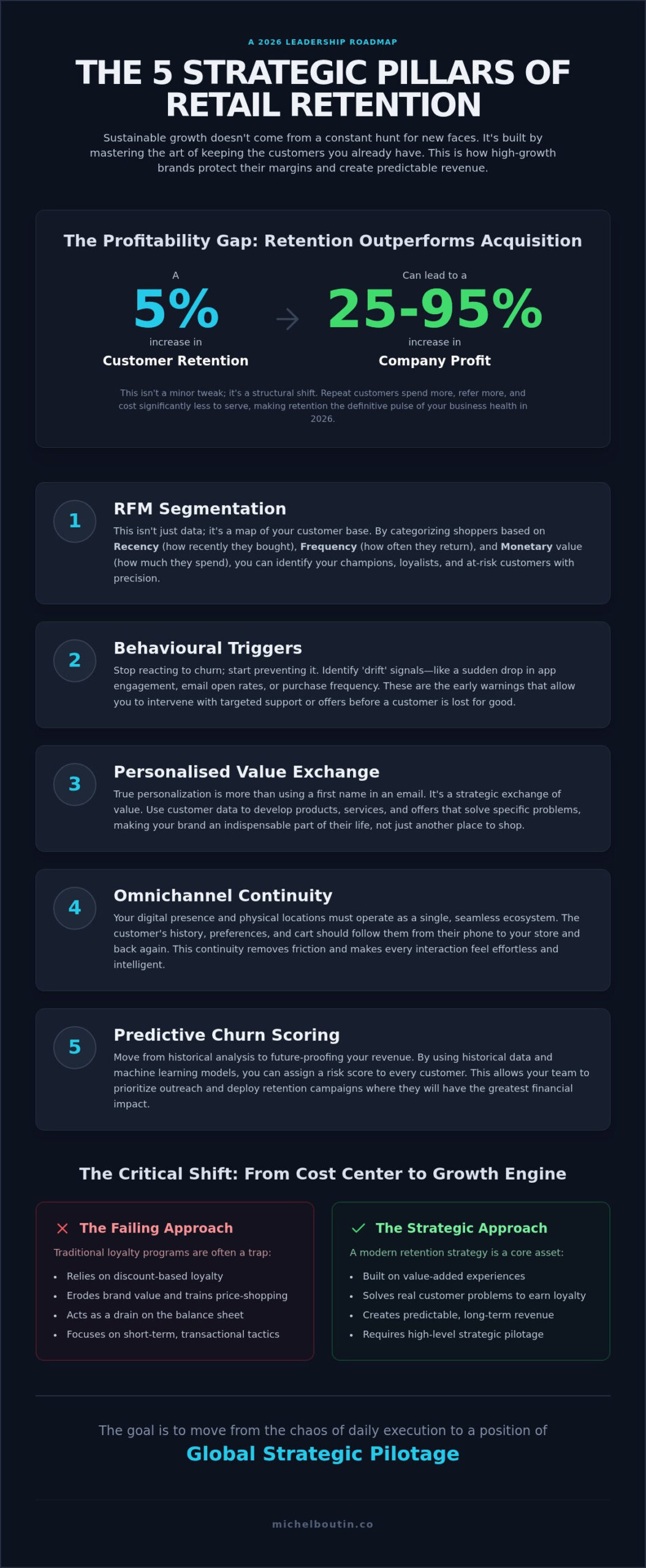
The data remains clear even as the market evolves. Research shows that a 5% increase in customer retention can lead to a profit increase of 25% to 95%. This happens because repeat customers spend more, refer more, and cost significantly less to serve. We’ve moved far beyond transactional loyalty. In 2026, an emotional brand connection is the only thing that survives the noise of the marketplace. For instance, Melbourne Hair Organics exemplifies this by providing a holistic, nurturing environment that prioritizes the client’s well-being over simple service delivery. Re-acquisition costs are now so high that losing a loyal customer isn’t just a missed sale; it’s a structural blow to your margins.
Why Traditional Loyalty Programs Often Fail
Most loyalty programs are actually cost centres in disguise. They fall into the trap of discount-based loyalty, which does nothing but erode your brand value and train customers to wait for a sale. This is a race to the bottom. True loyalty isn’t bought with points; it’s earned through value-added experiences that solve real problems. If your program feels like a burden on your balance sheet, it’s time to rethink your customer strategy. Building lasting bonds requires a shift from execution-heavy tactics to high-level strategic pilotage. You must offer something your competitors can’t replicate: a seamless, intuitive journey that respects the customer’s time and intelligence.
5 Strategic Pillars of Retail Retention for High-Growth Brands
Execution alone won’t save your margins. You need a framework that transforms raw data into a roadmap for loyalty. In 2026, the most successful customer retention strategies for retail are built on five specific pillars. These aren’t just marketing tactics; they’re operational imperatives. When you align your systems with these pillars, you move from reactive firefighting to a position of strategic pilotage. You gain the clarity needed to lead your team with confidence and precision.
- RFM Segmentation: This involves categorising shoppers based on how recently they bought, how often they return, and how much they spend.
- Behavioural Triggers: You must identify ‘drift’ signals, such as a sudden drop in app engagement or email open rates, before a customer actually churns.
- Personalised Value Exchange: True personalisation goes beyond using a first name in an email; it requires developing products and offers that solve specific customer problems.
- Omnichannel Continuity: Your digital presence and physical locations must feel like a single, seamless ecosystem where the customer’s history follows them.
- Predictive Churn Scoring: By using historical data, you can assign a risk score to every customer and intervene with targeted outreach before the relationship fades.
Mastering these pillars allows you to stop guessing and start knowing. If you’re ready to audit your current retention pillars, we can discuss your strategic alignment to ensure your business is built for the long term.
RFM Segmentation: The Executive Framework
To lead effectively, you must know who your ‘Champions’ are. These are the customers who buy frequently and spend the most. They require exclusivity and recognition, not discounts. Conversely, your ‘At Risk’ customers need a different approach. These were once high spenders who haven’t returned recently. Identifying this drift early allows you to deploy specific re-engagement strategies that protect your revenue. RFM analysis serves as the essential backbone of data-driven retail, providing a clear mirror of your customer’s true value. It gives you the data needed to make high-level decisions without getting lost in the weeds of daily execution.
Personalisation Through Product Development
Personalisation isn’t just a marketing layer; it starts with what you sell. By utilizing product development strategy services, you can ensure your offerings evolve alongside your customers’ needs. At michelboutinstudio, we believe in using tight feedback loops to iterate on core offerings. When your customers see their feedback reflected in your new releases, they feel a sense of ownership and partnership. This exclusivity creates a barrier to entry for your competitors. You aren’t just selling a product; you’re providing a curated experience that rewards their continued loyalty. This is how you transform a transactional relationship into a lifelong brand advocacy.
The Profitability Gap: Why Retention Outperforms Acquisition
In 2026, the cost of paid media has reached a point where many retail brands are essentially buying revenue at a loss. Social advertising is no longer the cheap engine it once was. You’ve likely noticed that your Customer Acquisition Cost (CAC) is eating your margins before you even say hello to a new shopper. This is where the profitability gap opens. While CAC continues to climb, your Cost to Retain (CTR) remains a fraction of that initial investment. Effective customer retention strategies for retail aren’t just about being nice to people. They’re about cold, hard financial efficiency. Every repeat buyer creates a compounding effect that lowers your overall marketing overhead and stabilises your cash flow.
You might worry that focusing on existing customers will stall your growth. It’s a common executive concern. But let’s be clear: acquisition brings people through the door, but retention builds the house. Without a solid retention strategy, you’re pouring water into a leaky bucket. You don’t need more water; you need to fix the leaks. True growth in this landscape comes from deepening your share of wallet with those who already trust you. It’s about moving from a transactional mindset to a posture of long-term partnership.
The Economics of the Second Purchase
The first purchase is an experiment; the second is a choice. Data in 2026 shows that once a customer makes that second purchase, the probability of them making a third jumps by over 50%. This is the critical window where your profit starts to materialise. Your marketing & brand strategy must be laser-focused on this first-to-second purchase transition. If you can bridge this gap, the ROI on your marketing spend doesn’t just increase; it multiplies. At michelboutinstudio, we help leaders measure this specific shift to ensure every marketing dollar is working toward a lifetime of value rather than a single moment of sale.
Reducing Friction in the Customer Journey
Retention often fails because of invisible friction. These are the ‘leaks’ in your vertical ecosystem where customers drop off due to minor inconveniences. Maybe your mobile checkout is slow, or your post-purchase communication is inconsistent. These operational inefficiencies damage customer sentiment more than a bad product ever could. Digital transformation is the key to removing these barriers. When you use technology to create a frictionless repeat buying experience, you aren’t just being modern; you’re being profitable. A smooth journey allows your customers to move from intent to purchase without thinking twice. This is the level of operational excellence that michelboutinstudio brings to every partnership.
Operational Optimisation: Aligning Your Team with Customer Success
Retention is not a marketing problem; it’s an operational reality. If your logistics team fails to deliver on time, or if your support staff lacks the data to resolve a query, your marketing efforts are wasted. You must realise that effective customer retention strategies for retail require every department to pull in the same direction. This isn’t about adding more tasks to your team’s plate. It’s about a fundamental shift in how you view success. True operational optimisation begins when you stop looking at software and start looking at your people. This is where leadership & team development becomes your most powerful tool for growth.
Consider how these departments directly influence your retention rates:
- Logistics: Shipping speed and packaging quality define the physical brand experience.
- Customer Support: The ease of returns and problem resolution dictates future trust.
- Sales: Setting accurate expectations prevents the ‘buyer’s remorse’ that fuels churn.
Rethink your incentive structures today. Most retail businesses reward staff for the ‘hunt’, the new sale. However, in 2026, the real value lies in the ‘harvest’, the repeat customer. Start tying team performance bonuses to retention rates and lifetime value metrics. When your staff sees that keeping a customer is as rewarding as finding a new one, their behaviour changes instantly. This alignment is the foundation of Vertical Ecosystem Optimisation. It builds a stable, predictable business that allows you to step back from the daily grind and focus on high-level pilotage. If you’re ready to transform your team’s performance, let’s discuss your operational strategy.
Breaking Down Silos Between Sales and Support
Disjointed communication is the enemy of retention. Many retail leaders manage multi-location networks where the store experience doesn’t match the online brand promise. You need common-sense strategies to unify these touchpoints. Executive advisory helps you see where these silos exist and how to break them down without causing internal friction. Every interaction, whether it’s a return at a physical counter or a chat on your app, must feel like a single, continuous conversation. This consistency builds the trust required for lifelong advocacy. At michelboutinstudio, we ensure your brand promise is felt at every level of the organisation.
The Psychology of Change in Retail Operations
Leading your team through a shift from acquisition-heavy to retention-first requires more than just a memo. It requires an understanding of human motivation. The Psychology of Change is the secret to operational success because it addresses the fear of the unknown that often stalls strategic progress. You must use executive coaching to help your managers maintain focus during this transition. When your team understands that retention leads to a more serene and less chaotic work environment, they’ll embrace the movement. You aren’t just changing a process; you’re evolving your culture to prioritise the long-term health of the business.
Implementing a Customer Strategy with michelboutinstudio
In 2026, the retail market doesn’t reward those who work the hardest; it rewards those who think the clearest. You’ve likely seen competitors pour capital into new software only to find their churn rates remain unchanged. This happens because they’re trying to solve a strategic deficit with a digital tool. At michelboutinstudio, we believe in a “Strategy Before Software” philosophy. We help you move from the exhaustion of daily execution to a posture of strategic pilotage. Our approach ensures that your customer retention strategies for retail are built on a foundation of operational excellence rather than just a shiny new interface.
Achieving profitability in this landscape requires vertical ecosystem alignment. This means every part of your business, from supply chain to post-purchase support, must reinforce the reason your customers chose you in the first place. michelboutinstudio acts as your strategic partner, identifying the friction points that prevent one-time shoppers from becoming brand advocates. We offer both project-based consulting for immediate transformations and ongoing executive advisory for long-term stability. You gain the autonomy and serenity that comes from a business that runs on systems, not just effort.
Executive Advisory for Retail Leaders
True leadership requires a perspective that’s often hard to find when you’re buried in the weeds of multi-location management. Our executive advisory service provides regular strategic coaching, giving you access to over 20 years of industry expertise. We help you filter out the operational noise so you can focus on the high-level decisions that drive growth. This isn’t just about business performance; it’s about your quality of life as a leader. When your customer retention strategies for retail are sound, your revenue becomes predictable, and your role shifts from firefighter to visionary pilot.
Next Steps: Auditing Your Retention Strategy
The path to a more structured and profitable 2026 begins with a clear-eyed look at your current state. A project-based engagement with michelboutinstudio often starts with a deep-dive audit of your existing customer data. We identify the immediate “quick wins” where small operational shifts can lead to significant retention gains. You don’t need a total overhaul to see results; you need surgical precision on the touchpoints that matter most. It’s time to stop guessing and start leading with data-backed confidence. Connect with michelboutinstudio to optimise your customer strategy and take the first step toward strategic autonomy.
Take Command of Your Strategic Evolution
The retail landscape of 2026 doesn’t forgive a lack of focus. You’ve seen how shifting your energy from the high cost of acquisition to the compounding value of repeat buyers creates a more stable, profitable business. By mastering the pillars of RFM segmentation and breaking down operational silos, you move from the stress of execution to the serenity of global pilotage. Success isn’t about buying more software; it’s about aligning your leadership and team with a unified vision of customer success. Implementing sophisticated customer retention strategies for retail is the only way to safeguard your margins against rising market noise.
At michelboutinstudio, we bring over 20 years of executive consulting experience to help you navigate this transformation. As specialists in vertical ecosystem optimisation and digital transformation, we provide the pragmatic roadmap you need to achieve strategic autonomy. You don’t have to manage the complexity alone. It’s time to step back from the daily grind and lead with precision. Connect with michelboutinstudio to drive your 2026 growth strategy. Your next level of growth is waiting for you.
Frequently Asked Questions
What are the most effective customer retention strategies for retail in 2026?
The most effective customer retention strategies for retail in 2026 prioritize emotional connection and operational excellence over transactional rewards. You must align your vertical ecosystem to ensure every touchpoint adds genuine value. This involves moving beyond simple points systems to offer exclusive access and personalized product development. By focusing on these high-level structures, you create a brand experience that is difficult for competitors to replicate.
How do I calculate customer retention rate for my retail business?
You calculate your customer retention rate by taking the number of customers at the end of a period, subtracting new customers acquired, and dividing that result by the number you had at the start. Multiply the final number by 100 to get your percentage. This formula provides a clear mirror of your business health. It allows you to see exactly how many people are choosing to stay with your brand rather than drifting away.
Is it better to focus on customer acquisition or customer retention?
Retention is the primary driver of profitability in the current high-acquisition cost environment. While acquisition brings new faces, retention builds the long-term equity and stability of your business. You should focus on retention to protect your margins and create predictable revenue streams. A balanced approach uses acquisition to fuel the top of the funnel while retention ensures that investment isn’t wasted on churn.
Can a small retail brand compete with giants on customer retention?
Small brands compete successfully by leveraging the agility and personal touch that giants often lack at scale. You can use your smaller size to build deeper, more authentic relationships with your community. While giants rely on massive, impersonal data sets, you can lead with precision and curation. This human-centric approach—which you can also see when you learn more about SCN Travel and their bespoke journey designs—is a powerful tool for building lifelong brand advocates who value connection over mere convenience.
How does digital transformation impact customer loyalty in retail?
Digital transformation acts as the essential infrastructure for modern customer loyalty. It unifies your siloed data and allows for a seamless experience across digital and physical locations. When your systems communicate effectively, you can anticipate customer needs before they even arise. This technological alignment is what enables the high-level strategic pilotage required to thrive in the competitive landscape of 2026.
What role does leadership play in customer retention strategies?
Leadership provides the vision and structural alignment necessary for any strategy to succeed. You must break down the silos between departments to ensure a unified customer journey across every touchpoint. Without executive-led change, customer retention strategies for retail often become isolated marketing tasks rather than core business priorities. Your role is to mentor your team and foster a culture that values long-term relationships over quick wins.
How can I reduce churn without offering constant discounts?
You reduce churn by identifying behavioural triggers and offering value-added experiences that solve real problems. Instead of eroding your margins with discounts, focus on providing exclusive early access or personalized service. Use your data to spot “drift” signals early. Proactive outreach that offers genuine recognition is far more effective at building lasting loyalty than a generic coupon code that trains customers to wait for a sale.
How do I know if my retail business needs a customer strategy consultant?
You likely need a consultant if your team is stuck in daily execution and lacks a clear strategic roadmap for growth. If your acquisition costs are rising while your margins shrink, it’s time for an outside perspective. michelboutinstudio helps retail leaders move from the noise of management to the clarity of strategic pilotage. We provide the expertise needed to optimize your vertical ecosystem and ensure long-term profitability through structured systems.
Disclaimer
Insights shared are for informational purposes and reflect professional perspective, not specific advice. Independent advice should be sought before acting on any content.