

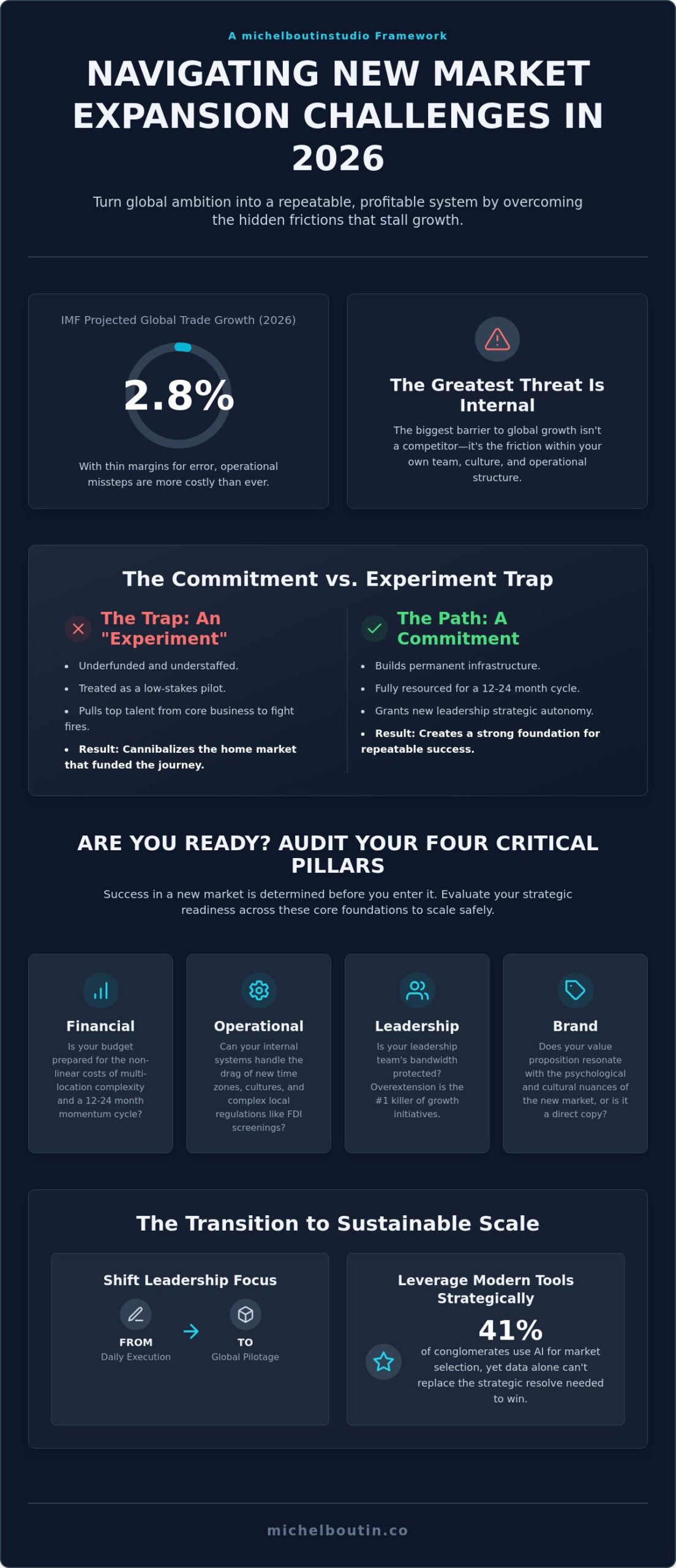
What if the greatest threat to your global growth isn’t a competitor, but the friction within your own team? You likely wonder what the biggest mistakes are when moving into a new territory. With the IMF projecting global trade growth at a modest 2.8% in 2026, the cost of a misstep is higher than ever. You’ve felt the strain of overextended resources and the fear of losing brand relevance in an unfamiliar culture. These new market expansion challenges often signal that your operational structure isn’t yet ready to support your ambition.
At michelboutinstudio, we know that successful expansion is a test of your customer strategy and internal systems, not just your product. You’ll discover how to navigate these complex hurdles by aligning your vision with operational excellence. This guide provides a repeatable framework to help you allocate resources with confidence and grant your leadership team true strategic autonomy. It’s time to accelerate your transition from daily execution to a posture of calm, global pilotage.
Key Takeaways
- Learn why traditional growth strategies often fail and how to identify the specific new market expansion challenges that could stall your progress in 2026.
- Audit your readiness across the four critical pillars of finance, operations, leadership, and brand to build a foundation that supports rapid scaling.
- Master vertical ecosystem optimization to penetrate new segments by controlling the entire customer journey from the start.
- Transition your leadership team from daily execution to global pilotage, ensuring they maintain strategic autonomy across different time zones.
- Partner with michelboutinstudio to implement a pragmatic roadmap that turns complex expansion into a repeatable and profitable system.
Defining The Landscape Of New Market Expansion Challenges In 2026
Entering a new market is a bold move. It represents a Market development strategy where you introduce your existing products to entirely new geographies or customer segments. In 2026, the landscape has shifted. You can’t rely on the old playbooks that worked before the total digital transformation of global trade. Today, success requires more than just a good product. It demands a deep understanding of the new market expansion challenges that lie beneath the surface of a simple growth chart. With the IMF projecting global trade growth at only 2.8% in 2026, there’s little room for error.
You must distinguish between a market experiment and a strategic commitment. An experiment allows you to test the waters with minimal risk. It’s a pilot. A commitment, however, requires you to build a permanent infrastructure. Many leaders fail because they treat a commitment like an experiment. They underfund it. They understaff it. This lack of clarity often leads to the hidden threat of cannibalization. When you pull your best people away from your home market to put out fires abroad, your core business suffers. You don’t want to win a new territory only to lose the one that funded your journey.
Expansion is not a linear process. It’s a transformation of your entire organizational structure. If you aren’t prepared for the operational drag, your growth will stall. At michelboutinstudio, we see this often. Leaders focus on the potential revenue but forget the internal cost of coordination. You have the vision; we provide the structure to ensure that vision doesn’t collapse under its own weight.
The Reality Of Resource Overextension
Expansion costs more than you think. You might assume doubling your footprint simply means doubling your budget. It doesn’t. The complexity of managing multiple locations adds a layer of friction that simple math fails to capture. You will find that your existing leadership team has a breaking point. When they are stretched across time zones and cultural barriers, their decision-making quality drops. Resource overextension is the #1 killer of growth in 2026. You must protect your team’s bandwidth to maintain excellence at home while building abroad.
Regulatory And Cultural Friction
Cultural adaptation goes far beyond mere translation. You need to grasp the psychological nuances of how your new customers think and buy. What worked in your home market might feel intrusive or irrelevant elsewhere. Simultaneously, legal uncertainties can derail your progress. Domestic playbooks often ignore the intricacies of localized compliance. In 2026, new regulations like the mandatory FDI screening in all 27 EU member states mean your digital transformation roadmap must be flexible enough to handle varied data and security requirements. These new market expansion challenges require a partner who understands the ground reality of global operations—for example, firms expanding into France can discover My Paris Concierge to manage their luxury on-ground logistics and executive needs.
Evaluating Strategic Readiness And Product-Market Fit
Success in Australia doesn’t guarantee a win in Singapore, London, or New York. It’s a hard truth many leaders ignore. You might have a dominant product at home, but common pitfalls in market expansion often stem from a lack of cultural and operational alignment. To scale safely, you must evaluate your strategic readiness across four specific pillars: Financial, Operational, Leadership, and Brand. Each pillar must be strong enough to withstand the pressure of a new environment. You need to know if you’re winning before the revenue hits. Track your pipeline velocity. Monitor local brand sentiment. These early indicators are your compass when navigating new market expansion challenges.
Don’t fall into the experiment trap. Treating a new territory as a low-stakes test often leads to half-hearted execution and inevitable retreat. Real growth requires a 12 to 24 month momentum cycle. You must commit the resources to see it through. If you aren’t prepared for this timeline, you aren’t ready to expand. In 2026, 41% of conglomerates use AI as a primary tool for market selection, yet data alone can’t replace the strategic resolve needed to push through the initial friction. If you’re looking for a partner to help you navigate these waters, you can reach out to our team for a strategic consultation.
The Product-Market Fit Audit
A product-market fit audit is your first line of defense. You must analyze local competition through the lens of your unique value proposition. Does your advantage still resonate? Technical standards also vary wildly by region. You may need to adapt your product development strategy services to ensure compliance and user satisfaction in the new territory. This is where many businesses stumble. They assume their current offering is good enough for everyone, only to find that local preferences or regulations require significant transformation of their core product.
Financial Sustainability And Resource Allocation
Financial sustainability is about more than just a budget; it’s about protecting your margins during the climb. You have to calculate the true cost of customer acquisition in territories where nobody knows your name. It’s expensive. You must maintain a 24-month runway to survive the initial learning curve. Balancing marketing spend with localized customer success is critical. If you spend all your capital on generating leads but have no one to service them locally, your churn will destroy your growth. At michelboutinstudio, we emphasize that efficiency in resource allocation is the only way to sustain long-term global expansion in a fragmented 2026 economy.
Solving The Customer Strategy Gap In New Territories
Many organizations treat expansion as a sales challenge. They focus on lead generation and transactional volume. This is a mistake. True growth in a new region requires you to bridge the customer strategy gap. If you don’t understand how a local customer makes decisions, your entry will be shallow and short-lived. You must move beyond a transactional mindset to achieve long-term profitability. This involves navigating the challenges of international business by building a brand that feels native, not imported.
One of the most overlooked new market expansion challenges is the failure to secure early adopters through meaningful engagement. You can’t just buy market share; you have to earn loyalty. This starts with the design of your loyalty programs and how you reward those who take a chance on your brand first. In 2026, customers are more discerning than ever. They expect a seamless, personalized experience that reflects their specific cultural context. If you fail to deliver this, you’re merely a temporary guest in their market. At michelboutinstudio, we focus on creating systems that turn these first-time buyers into long-term advocates.
Vertical Ecosystem Optimization For Growth
You penetrate a market effectively by owning the entire customer journey. This is vertical ecosystem optimization. It means looking at every touchpoint, from initial awareness to post-purchase support, and ensuring they work together as a unified system. You must identify which touchpoints carry the most weight for local users. If you need a partner to help you map this out, a CUSTOMER STRATEGY CONSULTANT AUSTRALIA can provide the framework needed to optimize these interactions for maximum impact. This approach ensures you aren’t just present in a market, but integrated into it.
Brand Strategy And Localization
Localization is not just about changing the currency on your website. It is a strategic decision that affects your entire brand identity. You must ensure your corporate values translate effectively without losing what makes you unique. This balance is delicate. Your corporate soul must remain intact while your delivery adapts to local expectations. For a deeper look at how to align these elements, explore the latest MARKETING & BRAND STRATEGY trends for 2026. Relevance is your ultimate shield against the volatility of new markets. Don’t just translate your message; transform your approach.
Leadership And Operational Optimization For Scaled Growth
Expansion is more than a logistical feat. It is an evolution of your role as a leader. You must stop being the chief problem solver and start being the strategic pilot. When you manage a multi-location network, you cannot be in every room. This transition is one of the most significant new market expansion challenges you will face. If you remain stuck in executive execution, you become the bottleneck. You must build a leadership team that operates with total autonomy across time zones. Many leaders underestimate the new market expansion challenges inherent in managing human capital at a distance. This requires a shift from monitoring tasks to monitoring outcomes.
Strategic pilotage relies on a single source of truth. In 2026, data fragmentation is a silent growth killer. You need a unified digital infrastructure that gives you a clear view of your global operations without requiring constant check-ins. When your systems are optimized, friction disappears before it scales into a crisis, allowing you to maintain a posture of calm assurance. Efficiency is not just about saving money; it is about buying back your time and peace of mind—which is why many expanding firms integrate AI-powered surveillance and access control from Digital-Vision.AI to secure their international commercial properties. You want a structure that works for you, not the other way around.
The Psychology Of Change In Leadership
Expansion demands a mental shift. You cannot use the same thinking that won your home market to conquer a new one. This is where executive coaching becomes vital. You must adopt a ‘Think Different’ approach to manage internal expectations and prevent ‘expansion burnout’ in your core team. If your people are exhausted, your expansion will fail. Investing in TRAIN THE TRAINER AND THE PSYCHOLOGY OF CHANGE helps you propel targeted expertise throughout your organization, ensuring your vision remains clear even as the distance increases.
Operational Efficiency And Digital Transformation
Will your current systems break under the weight of a second or third market? You must audit your operations before you scale. Automation is no longer optional; it is the engine that maintains customer experience standards globally. By leveraging DIGITAL TRANSFORMATION, you create a scalable framework that supports cross-border growth. This ensures that a customer in Sydney receives the same excellence as one in Singapore. If you are ready to optimize your leadership and operations for the next level of growth, book a strategic consultation with michelboutinstudio today.
Navigating Expansion With michelboutinstudio
Expansion isn’t a puzzle to be solved once. It’s a system to be built. At michelboutinstudio, we don’t believe in abstract theories that look good on paper but fail on the ground. We provide a pragmatic roadmap designed for profitable growth. You’ve seen how new market expansion challenges can drain your energy and resources. Our role is to ensure those hurdles become milestones in a repeatable method. This isn’t just about one successful move. It’s about creating a framework you can use every time you decide to scale. Whether you’re entering a new geography or a new segment, we help you maintain alignment during the critical 12 to 24 month growth curve.
We offer fixed-fee strategic consulting for defined expansion scopes. This removes the uncertainty of escalating costs and allows you to focus on results. Our ongoing executive advisory ensures that as your organization scales, your vision remains the primary driver. We don’t just give you a plan; we stay with you as you navigate the complexities of a multi-location network. This partnership transforms expansion from a source of stress into a logical outcome of your operational excellence. You gain the confidence to allocate resources where they’ll have the most impact without sacrificing your core market’s stability.
A Partner In Strategic Autonomy
True success isn’t just about the numbers. It’s about your ability to lead with serenity. michelboutinstudio focuses on the intersection of organizational performance and your personal quality of life. We bring 20 years of concrete industry experience across automotive, retail, and finance to your table. We’ve seen the operational breaking points in these sectors and know how to avoid them. michelboutinstudio helps you detach from the friction of daily execution to adopt a high-level posture of strategic pilotage. This shift allows you to lead from a place of strength and clarity while your team operates with autonomy.
Getting Started On Your Roadmap
You don’t need complex, jargon-filled reports to win. You need common-sense strategies that deliver faster results. We start with your specific goals and build a custom roadmap. This journey can begin with ad-hoc advisory to address immediate blockers or move straight into a full project commitment for a total transformation. The goal’s always the same: strategic autonomy for your team and a clear path to profitability. We value the human element of management as much as the rigour of our systems. If you’re ready to stop reacting to new market expansion challenges and start driving your global vision, it’s time to take the first step.
Partner with michelboutinstudio for your next expansion and turn your ambition into a structured, repeatable reality.
Mastering Your Global Horizon
You now have the clarity to see that expansion is a test of your organizational structure, not just your product’s appeal. Success in 2026 belongs to those who align their vision with a robust operational framework. You’ve learned that vertical ecosystem optimization is your primary tool for penetration and that strategic autonomy for your leadership team is non-negotiable. Navigating new market expansion challenges requires a fundamental shift from daily execution to a posture of strategic pilotage. It’s about protecting your core business while capturing new opportunities with surgical precision.
With over 20 years of executive consulting experience, michelboutinstudio specializes in creating pragmatic, project-based strategic roadmaps that deliver results. We are specialists in vertical ecosystem optimization, helping you build systems that turn first-time buyers into long-term advocates. You don’t have to face the complexity of global growth alone. It’s time to transform your ambition into a repeatable, profitable reality that enhances both your performance and your quality of life.
Scale with confidence—consult with michelboutinstudio
Your next level of growth is within reach. Take the leap with a partner who understands the ground reality of global operations and is ready to help you lead with serenity.
Frequently Asked Questions
What is the most common reason for failure in new market expansion?
The most common reason for failure is resource overextension and a lack of strategic readiness. Leaders often underestimate the complexity of managing new market expansion challenges while trying to maintain their home market’s performance. When your best people are stretched too thin, decision-making quality drops and your core business suffers. Success requires a commitment to building a permanent infrastructure rather than treating the move as a low-stakes experiment.
How do I know if my business is ready for international expansion?
You are ready when you have verified strength across the four pillars of finance, operations, leadership, and brand. This means having a 24-month financial runway and a leadership team capable of autonomous pilotage. If your current systems break under slight pressure at home, they will certainly collapse abroad. A formal audit of your strategic readiness is the only way to move forward with calm assurance.
How much should I budget for a new market entry project?
Your budget should cover a minimum of 24 months of operations to survive the initial learning curve. While costs vary by region, you must account for localized customer success teams and the true cost of customer acquisition in unproven territories. In 2026, corporate travel spend alone is projected to reach $1.69 trillion globally, reflecting the high cost of physical presence. Focus on efficiency and cost control through optimized systems.
Can I use the same marketing strategy in a new country or region?
No, you cannot use an identical marketing strategy because cultural and psychological nuances vary by region. Localization is a strategic decision that goes beyond simple translation. You must ensure your corporate values translate while your delivery adapts to local expectations. Aligning your brand strategy with local technical standards and consumer behavior is critical for securing early adopters and achieving long-term relevance in a fragmented 2026 economy.
How do I manage a multi-location team during a period of growth?
Managing a multi-location team requires a transition from executive execution to strategic pilotage. You must empower your leadership team to operate with autonomy across time zones. This shift relies on a single source of truth for global data, allowing you to monitor outcomes rather than individual tasks. Building a structure that supports detachment from daily execution is the only way to maintain your quality of life during rapid growth.
Is it better to hire local experts or send my existing team to a new market?
What are the first signs that a market expansion is not working?
The first signs of failure are stagnant pipeline velocity and high customer churn among early adopters. If your early indicators don’t show movement within the first 12 months, your customer strategy likely lacks resonance. You might also notice expansion burnout in your core team or a drop in performance in your home market. These signals suggest your operational structure isn’t supporting your ambition and requires immediate optimization.
How does digital transformation help with geographic expansion?
Digital transformation provides the unified infrastructure needed to maintain a single source of truth for global data. It allows you to automate routine processes, ensuring consistent customer experience standards regardless of geography. In 2026, 41% of conglomerates use AI for market selection and management. These tools allow you to scale your operations without scaling your head count at the same rate, protecting your margins and your sanity.
Disclaimer
Insights shared are for informational purposes and reflect professional perspective, not specific advice. Independent advice should be sought before acting on any content.