

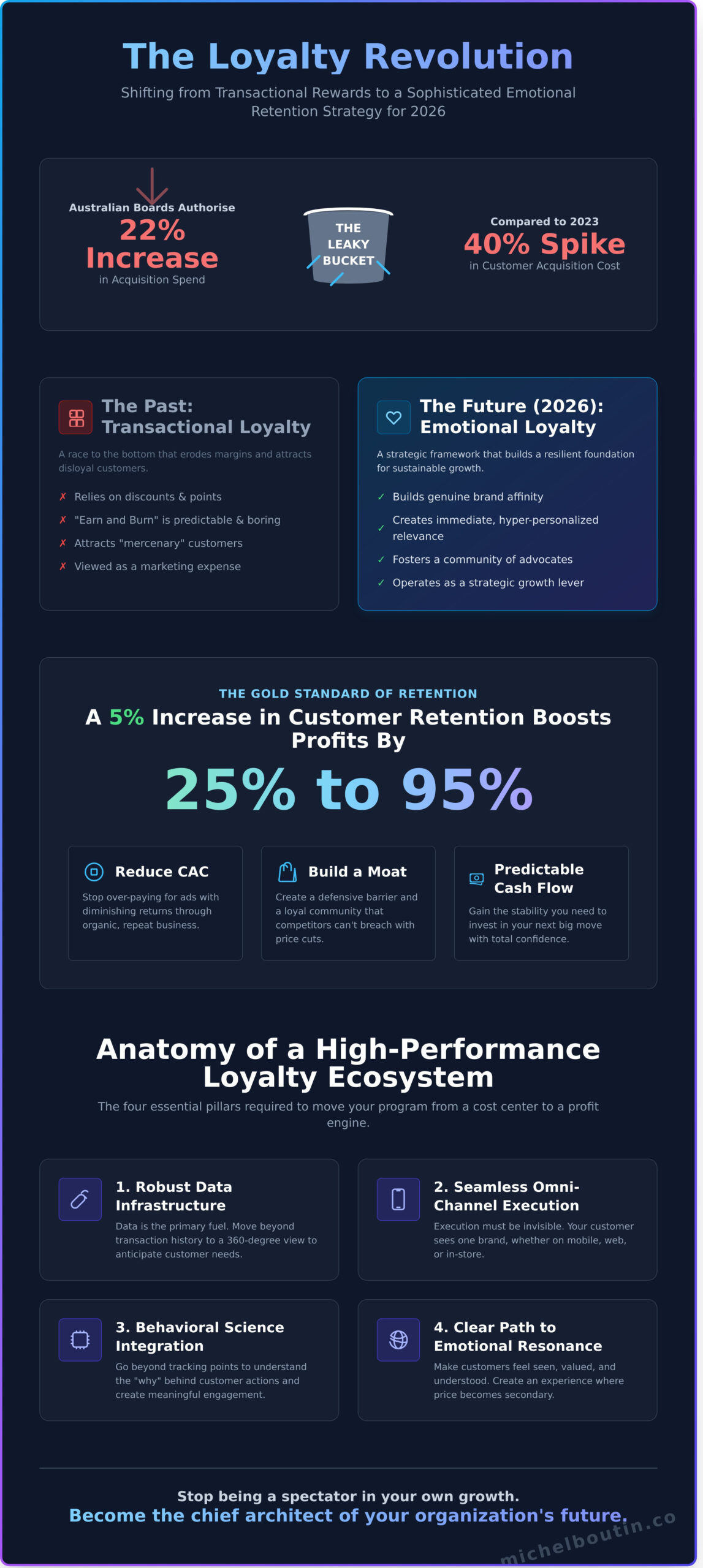
Most Australian boards are currently authorising a 22% increase in acquisition spend while ignoring the leaky bucket at the heart of their business. If you’re tired of seeing your marketing budget vanish into a black hole, you’re not alone. You’ve likely realised that standard customer loyalty programs have become commoditised point-collecting exercises that fail to move the needle on genuine retention. It’s a race to the bottom that drains your energy and your profit margins.
I understand the pressure to hit high-growth targets while battling a rising CAC that feels impossible to control. This guide promises to shift your perspective from transactional rewards to a sophisticated emotional retention strategy designed for the 2026 market. You’ll learn how to build a self-sustaining growth ecosystem that increases your Customer Lifetime Value and grants you the strategic freedom you’ve been working for. We’re going to dismantle the "points" myth and replace it with a structure that delivers predictable, recurring revenue. It’s time to stop being a spectator in your own growth and start acting as the chief architect of your organisation’s future.
Key Takeaways
-
Transition from transactional discounts to emotional brand affinity to build a resilient foundation for sustainable growth in the Australian market.
-
Master the four essential components of high-performance customer loyalty programs to turn raw data into your most valuable strategic asset.
-
Evaluate the structural leverage of tiered, paid, and coalition models like Flybuys to identify the most effective engine for your brand’s scalability.
-
Implement a clear five-step roadmap to align your departments and propel your organization toward a unified, high-growth retention ecosystem.
-
Discover how bespoke executive design allows you to bypass generic solutions and build a loyalty strategy that delivers both financial performance and operational freedom.
Table of Contents
Beyond the Card: What are Customer Loyalty Programs in 2026?
Stop viewing your loyalty efforts as a marketing expense. By 2026, the era of the plastic card and the "buy ten, get one free" punch card has ended. You must view customer loyalty programs as a sophisticated value exchange. It’s a strategic framework that propels your business from a commodity to a necessity. You’re building a system, not a gimmick. To truly lead your market, you need to understand What are Customer Loyalty Programs in a world where data is the new currency and attention is the scarcest resource.
Transactional loyalty relies on discounts. It’s a race to the bottom that erodes your margins and attracts "mercenary" customers who leave the moment a competitor drops their price by A$5. Emotional loyalty is your true goal. It’s the brand affinity that makes a customer choose you because they feel seen, valued, and understood. In the Australian market of 2026, where the Consumer Data Right has made switching easier than ever, your program must be the heartbeat of your broader Customer Strategy. If you treat loyalty as a side project, you’re leaving your growth to chance.
Traditional "earn and burn" models are failing because they lack soul. They’re predictable and boring. Your customers don’t want to wait six months to save A$10 on a purchase they’ve already made. They want immediate relevance. They want a partner in their lifestyle, not a ledger for their points. You have to move beyond the transaction to become the architect of an experience that rewards engagement, advocacy, and shared values.
The Evolution of Retention in the Digital Age
Data transparency has matured into a non-negotiable expectation. By January 2026, Australian consumers know exactly what their data is worth. They won’t hand over their preferences for a generic newsletter. They demand hyper-personalization that feels like a concierge service. "Set and forget" programs are a recipe for churn. If your rewards don’t adapt to real-time behavior, you’re effectively telling your customers that you aren’t paying attention. You must use data to predict needs, not just react to them.
Why Loyalty is the Ultimate Growth Lever
The math of retention is the most powerful tool in your arsenal. Data from Bain & Company remains the gold standard: a 5% increase in customer retention can boost your profits by 25% to 95%. This isn’t just a statistic; it’s a structural reality for your P&L. In 2026, the cost of acquiring a new customer in major Australian hubs has spiked by 40% compared to 2023. You cannot afford to keep pouring water into a leaky bucket.
-
Reduce CAC: Organic repeat business means you stop over-paying for social media ads that yield diminishing returns.
-
Build a Moat: A loyal community is a defensive barrier that competitors can’t easily breach with a simple price cut.
-
Predictable Cash Flow: Loyal customers provide the stability you need to invest in your next big move with total confidence.
When you master customer loyalty programs, you stop being a slave to the algorithm. You gain the freedom to lead your industry from a position of strength. You aren’t just selling a product anymore. You’re leading a movement. This is how you reclaim your time and scale your vision without losing your sanity.
The Anatomy of High-Performance Customer Loyalty Programs
Stop viewing loyalty as a discount scheme. It’s a strategic asset. In 2026, profitable customer loyalty programs function as sophisticated ecosystems designed to capture value while delivering it. To move from a cost center to a profit engine, your program requires four essential components: a robust data infrastructure, seamless omni-channel execution, behavioral science integration, and a clear path to emotional resonance. If one pillar crumbles, your ROI follows.
Data isn’t a byproduct of your program; it’s the primary fuel for your growth. You aren’t just tracking points. You’re mapping the DNA of your most valuable assets. By 2025, 70% of Australian consumers expect brands to anticipate their needs before they even express them. This requires moving beyond transactional history. You must integrate your CRM with real-time behavioral triggers to create a 360-degree view. Successful programs build an emotional connection with customers that makes price secondary to the experience.
Your execution must be invisible. Your customer doesn’t distinguish between your Melbourne flagship store and your mobile app. They see one brand. If a member earns points in-store at 2:00 PM, those points must be available for a digital purchase by 2:01 PM. Friction is the enemy of retention. Any lag in your omni-channel integration acts as a tax on your brand equity, driving customers toward competitors who offer more fluidity.
Data-Driven Personalization: The New Standard
Forget "Dear [First Name]" emails. That’s a relic of the past. Modern personalization uses predictive modeling to forecast the next logical purchase. You need to leverage zero-party data. This is information customers give you intentionally, like their lifestyle preferences or sustainability values. Use this to build profiles that feel human. Ensure your strategy aligns with the 2024 updates to the Australian Privacy Act to build trust through transparency. If you want to refine your strategic vision and gain true operational freedom, your data must work for you, not the other way around.
The Psychology of Rewards: Why We Stay
Behavioral economics is the secret sauce of high-performance customer loyalty programs. Use the "Endowed Progress Effect" to kickstart engagement. Research shows that a loyalty card with two "bonus" stamps already filled out performs 15% better than a blank card with fewer total requirements. It creates a psychological momentum that’s hard to break. People don’t like leaving things unfinished.
Balance is key. Use fixed rewards to build habits and variable rewards to create delight. A predictable A$20 voucher for every A$200 spent provides stability. However, a surprise "member-only" invitation to a private event worth A$500 creates an "Aha!" moment. These unexpected peaks in the customer journey transform a routine transaction into a story they tell their friends. You’re not just selling a product; you’re designing a feeling of belonging. This is how you scale your impact without sacrificing your sanity.
For a truly unforgettable "Aha!" moment, some brands even offer exclusive international experiences; for inspiration, you can explore Art & Culture Group Tours that create deep brand affinity.
-
Predictive Analytics: Move from reactive reporting to proactive offer generation.
-
Zero-Party Data: Ask, don’t guess, what your customers value most.
-
Gamification: Use progress bars and tiers to trigger the dopamine hit of achievement.
-
Omni-channel Sync: Ensure a unified balance across every Australian touchpoint.
Points vs. Purpose: Choosing the Right Loyalty Model
Stop treating your customer loyalty programs like a digital stamp card. It’s a strategic engine, not a ledger of discounts. Traditional points systems are becoming background noise. In 2024, 62% of Australian consumers reported they’d abandon a program if rewards felt unattainable. You must choose a model that propels your brand forward, not one that just tracks the status quo. You’re building a structure for growth, not a charity.
Coalition models like Flybuys or Everyday Rewards offer massive reach. They touch over 80% of Australian households. However, for an independent brand, these are often a trap. You trade your most valuable asset, customer data, for a sliver of someone else’s ecosystem. You want to own the relationship. You want the leverage that comes with direct insight. Why give your data to a third party when you can use it to fuel your own machine?
Premium loyalty is the real disruptor in the Australian retail sector. Look at the expansion of Amazon Prime or the Catch.com.au "Club Catch" model. Australians are willing to pay for better service. A 2023 report showed that members of paid programs are 60% more likely to spend more with a brand after joining. This isn’t about charging for access. It’s about filtering for your most profitable 5% and giving them a reason to never look elsewhere. It’s a commitment, not a transaction.
"But Michel, won’t this cannibalize my margins?" This is the question that keeps CEOs awake. It’s the wrong question. You aren’t losing 3% on a sale. You’re investing that 3% to increase purchase frequency by 22% or lift average order value from A$85 to A$112. If you don’t build a structure to retain them, your acquisition costs will eventually swallow your profit entirely. You’re buying future stability, not discounting today’s revenue.
Tiered Systems and the Power of Status
Exclusivity drives behavior. A points balance is a debt; a status level is an identity. When you design tiers, make the first level easy to reach. Make the top level feel like an elite club. Use non-monetary perks. Australian luxury retailers see a 15% higher retention rate by offering "first look" access to new collections rather than simple cashback. Status is the ultimate lever for emotional connection.
Value-Based Loyalty: Aligning with Customer Beliefs
Modern consumers want to see their values reflected in their spending. This is where you build a community. Brands like Who Gives A Crap or Country Road, with their recycling initiatives, aren’t just selling products. They’re selling a sense of belonging. In Australia, 48% of Gen Z shoppers prefer brands that support social causes. Align your customer loyalty programs with sustainability or local charities. You’ll move from being a vendor to being a partner in their personal mission. That’s how you achieve true market leadership.
-
Points: Good for high-frequency, low-cost items.
-
Tiers: Best for lifestyle and aspirational brands.
-
Paid: Ideal for high-volume retailers focused on LTV.
-
Purpose: Essential for brands targeting younger demographics.
Choose the model that fits your vision. Don’t copy your competitor. Lead them. Your business deserves a structure that creates freedom, not more operational headaches. It’s time to decide what your brand stands for and build the system to prove it.
A Strategic Roadmap for Designing Your Loyalty Ecosystem
Building a world-class loyalty program isn’t a marketing project; it’s a structural transformation of your business model. You don’t need another generic points scheme that clutters a customer’s digital wallet. You need a system that drives predictable revenue. To achieve this, you must align your Sales, Marketing, and Operations teams under a single vision. If your Ops team can’t fulfill the promises your Marketing team makes, your program will fail before it starts. This alignment ensures that every touchpoint reinforces the value proposition, turning a transactional interaction into a long-term partnership.
You must adopt a "Strategy Before Software" mindset to avoid the trap of technical debt. Many Australian executives rush to sign a SaaS contract only to find the software dictates their strategy rather than the other way around. By 2026, the most successful customer loyalty programs will be those built on a foundation of clear business logic, not just flashy features. Follow this five-step framework: model the financials, map the journey, select the tech, pilot the concept, and iterate based on hard data. This structured approach protects your margins and ensures scalability.
Step 1: Financial Modeling and Objective Setting
Success starts with your North Star metric. For most, this is Customer Lifetime Value (CLV), but you might focus on reducing Churn Rate or boosting Net Promoter Score (NPS). You need to calculate the "Cost of Loyalty" against the "Cost of Acquisition." In the current Australian market, acquiring a new customer can cost upwards of A$150, while retaining an existing one through a loyalty program often costs less than A$30. Set a realistic ROI timeline. Don’t expect a profit in month three; aim for a 14-month window where the increase in purchase frequency offsets the initial setup costs. Precision here prevents your program from becoming a cost centre.
Step 2: Customer Journey Mapping and Friction Removal
You can’t build loyalty on a broken foundation. Identify the exact points where customers drop off. Data from 2024 shows that 62% of Australian shoppers abandon a brand due to a friction-filled checkout or a confusing rewards interface. You must design the "Golden Path" to the first repeat purchase. This involves removing every hurdle between the initial transaction and the first reward redemption. By refining your Customer Strategy Pillar, you ensure that the path to loyalty is the path of least resistance. Smooth operations are the greatest driver of retention.
Step 3: Technology Stack Selection
Your tech stack must be an enabler, not a bottleneck. Choose between a custom-built solution for total control or a SaaS loyalty platform for speed to market. The critical requirement is a seamless CRM and POS integration. You need a single view of the customer across every channel, from your flagship Sydney store to your online shop. Future-proof your stack by ensuring it can handle AI-driven automation. By 2026, 85% of high-performing customer loyalty programs will use AI to deliver hyper-personalised offers in real-time. If your tech can’t adapt, it’s already obsolete. To understand how to unify your AI and CRM systems into a single growth engine, explore this executive guide on ai strategy for customer experience that maps out the integrated approach your loyalty ecosystem demands.
For e-commerce brands, navigating this complex technical landscape is a common challenge. Teaming up with a dedicated consultancy can be a game-changer; firms like Ecom Expedition – Your Growth Partners specialize in architecting these integrated systems for profitability.
Once your framework is set, launch a pilot with a small, controlled segment of your audience. Use this phase to gather real-world feedback and iron out operational kinks. Don’t wait for perfection; move fast and iterate. Your customers will tell you what’s working through their behavior. Listen to the data, refine your rewards, and then scale with confidence. This iterative process turns a risky launch into a calculated expansion, giving you the freedom to lead your market with authority.
Ready to stop guessing and start growing? Book a strategy audit today and let’s build a loyalty ecosystem that propels your business forward.
Elevating Your Retention Strategy with michelboutin
Most Australian executives view retention as a marketing expense. It’s actually a structural investment. If your 2026 roadmap relies on generic points and rewards, you’re building on sand. High-level customer loyalty programs require more than a software plug-in; they demand a fundamental shift in how your business delivers value. MichelBoutin provides the bespoke strategic design needed to move beyond the "cookie-cutter" trap that stalls growth in 74% of mid-market enterprises.
Bespoke loyalty design isn’t about copying global giants. It’s about identifying the unique friction points in your specific customer journey. Since January 2024, data shows that Australian consumers have become increasingly resistant to "standard" loyalty tiers. They want relevance. We help you build a system that rewards behavior, not just spend. This structural approach ensures your loyalty promise is backed by operational reality.
-
Eliminate operational bottlenecks that frustrate your best customers.
-
Design high-margin rewards that don’t erode your bottom line.
-
Create a system that functions without your constant intervention.
-
Align your team’s KPIs with long-term retention goals.
The Executive Advantage: Strategy Over Tactics
Buying a software subscription is easy. Implementing a strategy that drives a 22% increase in Lifetime Value (LTV) is hard. Many Australian firms commit A$60,000 or more annually to loyalty platforms only to find their churn rates remain stagnant. This happens because they’ve mistaken a tool for a solution. A tool without a vision is just another overhead cost. MichelBoutin acts as your strategic partner to bridge this gap.
Our focus is on the "why" before the "how". Through our Executive Coaching Services, we help you transition from tactical thinking to strategic orchestration. We don’t just look at the front-end app; we audit your back-end operations. If your fulfillment team can’t handle the "VIP" promise your loyalty program makes, you’re burning brand equity. We ensure your infrastructure can support your ambition.
Propel Your Business to the Next Level
True leadership is about clarity and structure. It’s about moving from "doing the work" to "orchestrating the growth". By the time 2026 arrives, the gap between leaders who systemise and those who micro-manage will be an unbridgeable chasm. MichelBoutin provides the map to the right side of that divide. We focus on creating a business that offers you freedom and serenity, not just a higher A$ turnover.
The MichelBoutin promise is simple: we provide the structure so you can experience the freedom. A well-designed retention strategy should be a profit engine that runs on autopilot. When customer loyalty programs are integrated into the very DNA of your operations, your role shifts. You stop being the firefighter and start being the visionary. You gain the headspace to look at the next palier of growth while your systems take care of the present.
Don’t let your retention strategy be an afterthought. Book a Strategy Consultation today to audit your current approach and identify the levers that will propulse your business forward in 2026. Let’s build a structure that delivers both profit and peace of mind.
Propel Your Brand Beyond the Transaction
The Australian retail landscape in 2026 demands more than just a digital punch card. You’ve discovered that customer loyalty programs must now function as sophisticated value ecosystems that balance purpose with profit. High-performance models aren’t optional; they’re the primary engine for sustainable growth across multi-location networks. By shifting from points to purpose, you’re not just securing a sale, you’re building a fortress around your market share.
Michel Boutin leverages 20+ years of executive experience to transform these complex operational challenges into streamlined growth engines. We specialize in creating bespoke strategic roadmaps that allow you to step back from the daily grind and lead with clarity. Don’t let your retention strategy become a cost center. Instead, turn it into a lever for total business freedom and capture the A$ millions often left on the table through customer churn.
Propel your brand with a bespoke Customer Strategy
The path to market leadership is clear. It’s time to take the first step toward your new strategic reality and reclaim your time as a visionary leader.
Frequently Asked Questions
Do customer loyalty programs really work for small businesses?
Customer loyalty programs act as a powerful growth lever for Australian SMEs, driving a 20% increase in repeat visits on average. You don’t need a massive corporate budget to win. A 2024 study shows that local businesses using digital loyalty tools see immediate impact within six months. Stop chasing new leads constantly. Focus on the 20% of your customers who generate 80% of your revenue. It’s about structure, not size.
What is the most effective type of loyalty program in 2026?
Personalized, omnichannel hybrid models are the most effective choice for 2026. Data from the Australian Retailers Association indicates that 72% of consumers prefer programs that offer instant, tailored rewards across both physical and digital storefronts. You must move beyond simple plastic cards. Use AI-driven insights to predict what your client wants before they even ask. This level of clarity propels your brand ahead of the competition.
How much does it cost to implement a strategic loyalty program?
Implementation costs for Australian mid-market firms typically range from A$500 to A$5,000 per month. You’re investing in a system, not just software. Initial setup fees for custom integration often sit around A$10,000 for complex retail environments. View this as a capital allocation toward your company’s scalability. Are you willing to pay for the structure that grants you long-term freedom? High-level strategy requires proper investment.
How do you measure the success of a customer loyalty program?
Track your Customer Lifetime Value (CLV) and your reward redemption rate to measure success accurately. A healthy program sees a redemption rate above 25% according to 2025 industry benchmarks. If your numbers are stagnant, your system is failing. Use these metrics to gain a high-level perspective on your operational health. Do the numbers reflect the growth vision you’ve set for your organization? Numbers don’t lie.
Can a loyalty program help reduce customer churn?
A well-structured program reduces churn by 15% by creating a tangible value proposition for staying. You create a "switching cost" that makes it illogical for your clients to leave. This isn’t about traps; it’s about consistent value. When you systematize the reward process, you build a fortress around your market share. It gives you the serenity to focus on high-level strategy instead of constant firefighting.
What is the difference between a loyalty program and a rewards program?
Rewards programs focus on the transaction, while customer loyalty programs build a lasting emotional and behavioral connection. One is a simple discount; the other is a deep relationship. In 2026, 68% of Australians state they stay with brands that align with their personal values. Are you just giving away margins, or are you building a community? True loyalty propels your brand into a different league entirely.
How do I relaunch a failing loyalty program?
Audit your existing data and cut the friction immediately to save a failing program. Most initiatives fail because they’re too complex for the user and the staff. Simplify the structure. Relaunch with a clear, time-bound incentive to bring back 10% of your inactive database within 30 days. You need to bousculer the status quo to regain your momentum. Clarity is your best friend during a relaunch.
Should I use a points-based or a tiered loyalty system?
Tiered systems outperform simple points-based models by 35% because they provide a clear roadmap for customer ascension. Each tier represents a new level of status and exclusivity. This structure mirrors the growth you want for your own life. Why settle for a flat line when you can build an upward trajectory for your revenue? Tiers create the aspiration that drives long-term engagement and higher spending.
Disclaimer
Insights shared are for informational purposes and reflect professional perspective, not specific advice. Independent advice should be sought before acting on any content.