

What if the problem isn’t that your team needs to work harder, but that your systems make good work harder than it should be? If day-to-day execution is pulling you away from leadership and growth, searching for “operational efficiency consultant australia” is only the first step. The next is to identify where work gets stuck and how to address it without losing sight of customers or business priorities.
You may already know something needs to change. But is the main constraint a workflow, unclear decision-making, or a lack of accountability? An effective operational efficiency consultant helps you investigate the cause, then connect practical changes to outcomes that matter. Better operations should support performance and give you more room to lead.
This guide explains what an operational efficiency consultant does, how to assess an adviser’s experience and fit, and what to look for in a practical approach to change. You’ll learn how to turn operational friction into clearer systems, stronger internal capability, and a more focused path to growth.
Key Takeaways
- An operational efficiency consultant australia can help trace friction to its source, including slow decisions, poor hand-offs, and unclear responsibilities.
- Look beyond process changes. Assess whether a consultant can connect recommendations to customer needs, business priorities, and practical implementation.
- Compare advisers on relevant experience, working style, implementation support, and their approach to building your team’s capability.
- Prepare for an engagement by defining the challenge, gathering evidence, aligning leaders, and agreeing how to assess progress.
- michelboutinstudio brings operational optimisation together with customer strategy, leadership, and digital transformation to support business growth.
Why Australian Businesses Consider an Operational Efficiency Consultant
When daily execution keeps pulling you into routine decisions, the answer isn’t always to cut costs or ask your team to move faster. An operational efficiency consultant helps improve how work is organised and carried out so it better supports your business priorities. If you’re considering an operational efficiency consultant australia, focus on the outcomes an adviser can help you improve, not simply the number of steps they can remove.
Operational efficiency is about how well your organisation turns time, effort, and resources into valuable outcomes. Cost reduction may follow, but it isn’t the whole goal. A cheaper process that creates more customer effort or shifts pressure onto an already stretched team isn’t a lasting improvement. Operational efficiency can be considered in terms of how effectively work produces its intended results. In practice, that means assessing customer experience, profitability, and your organisation’s ability to deliver on its priorities together.
What operational efficiency means in practice
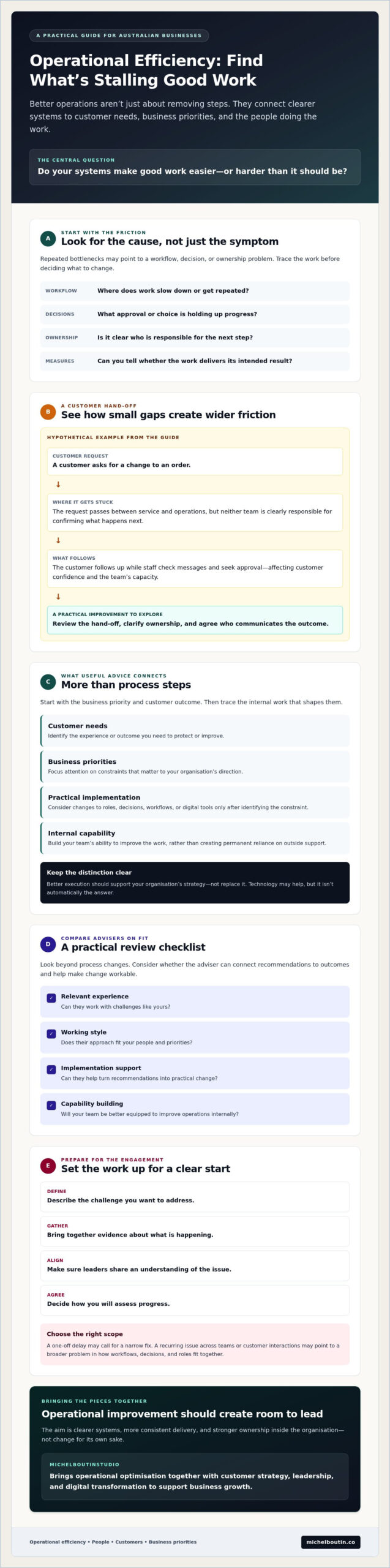
Workflows show how tasks move through the organisation. Decision-making determines whether work can keep moving, roles clarify who owns each step, and measures show whether the process is delivering the intended result. When these elements don’t support one another, delays and repeated work can become routine.
Hypothetical example: A customer asks for a change to an order. The request passes between a service team and an operations team, but neither is clearly responsible for confirming the next step. The customer has to follow up, while staff spend time checking messages and seeking approval. The issue affects customer confidence and the team’s capacity to handle other work. Reviewing the hand-off, clarifying ownership, and agreeing who communicates the outcome could address both sides of the problem.
When outside operational advice may be useful
Outside advice may help when the same bottlenecks keep returning, ownership is unclear, or leaders are repeatedly pulled into execution to keep routine work moving. These signs don’t automatically mean the whole operation needs redesign. A one-off delay may call for a narrow fix. A recurring issue across teams or customer interactions may point to a broader problem in how decisions, roles, or workflows fit together.
A useful adviser helps you distinguish between these possibilities before recommending change. They should build your understanding of what’s happening and help your people develop the capability to improve it. The goal is clearer systems and stronger internal ownership, not permanent reliance on outside support. That can give leaders more room to focus on direction while the organisation delivers more consistently.
What an Operational Efficiency Consultant Does Beyond Process Changes
Changing a workflow can remove a visible obstacle, but lasting improvement starts with a clear view of your business priorities. An operational efficiency consultant helps connect those priorities to how work moves across teams, then supports a practical path from diagnosis to recommendations and implementation.
This work should consider more than process steps. An adviser can examine how decisions are made, where hand-offs stall, who owns each responsibility, and which measures show whether work is producing the intended result. Technology may help, but it isn’t automatically the answer. First, identify the constraint. Then decide whether a change to roles, decision-making, workflow, or digital tools is likely to address it. The Institute for Strategy & Competitiveness at Harvard Business School cautions leaders not to mistake operational effectiveness with strategy. Better execution should support your organisation’s direction, not replace it.
Customer strategy can help determine where to focus. Start with the customer outcome you need to protect or improve, then trace the internal work that shapes it. If a delay affects an important customer interaction, that constraint may deserve attention before an internal process with little bearing on customer experience or business goals. This keeps improvement focused on value, rather than activity for its own sake.
How consultants diagnose operational constraints
Diagnosis means tracing work across teams to find where delays, repetition, or unclear decisions occur. An adviser should speak with leaders and the people doing the work, then test initial assumptions against day-to-day experience. This helps distinguish a process problem from a decision or ownership issue. Prioritise evidence and business relevance over adopting a fashionable framework that may not fit your organisation.
How recommendations become workable changes
Useful recommendations make the next steps clear. Each action needs an owner, practical milestones, and agreed measures so your team can review progress and address obstacles. Leadership alignment matters too. When leaders explain why a change supports customer and business priorities, teams have a clearer basis for putting it into practice.
Process changes last when someone owns them, teams understand their purpose, and agreed measures show whether they’re working. If a recommendation involves technology, connect it to a wider digital transformation strategy rather than treating a new tool as a fix by itself.
If you’re considering how operational optimisation could support your broader priorities, you can discuss your operational priorities with MichelBoutin.
How to Compare Operational Efficiency Consultants in Australia
Choosing an operational efficiency consultant australia is about more than finding someone who can identify inefficiencies. You need an adviser who understands your customers, business model, and sector-specific constraints—such as how The Clinic Project assists allied health practices with tailored operational strategy—then connects recommendations to outcomes you can assess. A polished presentation or impressive terminology isn’t proof of a suitable approach. Ask for clear reasoning, a defined scope, and a practical plan for building internal capability.
Use these criteria to compare candidates consistently:
| What to assess | What to look for |
|---|---|
| Strategic fit | Can they connect operational changes to your priorities and customer needs? |
| Relevant experience | Can they explain experience with organisations, challenges, or sectors relevant to yours? |
| Working style | Will they involve the people who understand how work happens day to day? |
| Implementation support | Is it clear how recommendations can move into action and how responsibilities will be agreed? |
| Knowledge transfer | Will your team gain the understanding to maintain and improve changes? |
Customer priorities should help determine which constraints deserve attention first. If you want to clarify how customer needs connect to business choices, explore this Australian customer strategy guide.
Questions to ask before selecting a consultant
Use the discussion to understand how the adviser thinks, not just which tools they use. Ask:
- How will you distinguish root causes from symptoms, and test your findings with the team?
- Who needs to be involved, and what will you need from our leaders?
- How will you prioritise recommendations against our customer and business priorities?
- How will we assess progress and whether our internal capability is growing?
Look for answers grounded in your organisation, not promises tied to unverified benchmarks or a framework applied by default.
How to assess fit, scope, and evidence
Ask candidates to describe relevant experience without relying on unsupported claims about results. They should explain what they did, the context, and what they learned that could apply to your situation. Discuss whether project-based, retainer-based, or hourly work best fits the scope, and confirm what’s included before proceeding.
A clear proposal sets out the boundaries, expected deliverables, how recommendations will be prioritised, and how knowledge will transfer to your team. Compare that clarity, not broad promises of efficiency. Established advisory practices like LR Consultants focus on anchoring operational excellence and project management to tangible deliverables. The right fit gives you a sound basis for action while keeping ownership of improvement within your organisation.
How to Prepare for an Operational Efficiency Consulting Engagement
A focused engagement starts with a clear view of the challenge, not a preselected solution. Before you meet an operational efficiency consultant, bring together what you know, what you suspect, and what you need to improve. A search for “operational efficiency consultant australia” may help you find advisers, but thoughtful preparation helps you make better use of their expertise.
Define the problem before commissioning advice
Replace broad concerns such as “we need to be more efficient” with specific observations. Where does work stall? Which decisions take too long? What are customers or teams experiencing as a result? Separate confirmed facts from assumptions you want the engagement to test. Include leaders and employees who can explain the process firsthand, not only those who see its outcomes.
Different people may experience the same issue differently. A manager might see missed handover dates, while the team describes unclear priorities and customers report having to repeat information. Bringing these views together can reveal how the issue affects customers, employees, and business priorities.
Set outcomes that support lasting change
Use this preparation sequence to give the work direction:
- Clarify the challenge. Describe what happens, where it occurs, and why it matters.
- Gather available evidence. Bring relevant internal information, such as existing process records, customer feedback, or measures your team already tracks. Don’t invent industry benchmarks without a reliable source.
- Align leaders and stakeholders. Agree on the business priority behind the work and invite perspectives from the teams involved.
- Agree on measures. Choose practical indicators that reflect the challenge and can be reviewed consistently.
Measures should help you understand whether the defined problem is changing. Depending on the issue, that might mean reviewing an existing measure of delays, repeat work, or customer effort. Establish what you can observe now, then agree who will review progress and how often. Avoid selecting a target before you understand the starting point.
Before recommendations are delivered, clarify who will own decisions and actions. Consider whether a focused project or ongoing advisory support better matches the need, then confirm the proposed scope with the adviser. Clear ownership helps your people carry improvements forward rather than treating them as an external assignment.
Ready to clarify your operational priorities and prepare for a focused discussion? Talk with MichelBoutin about your operational challenge.
How michelboutinstudio Connects Operational Efficiency With Business Growth
Once you’ve established what to look for in an adviser and clarified your priorities, consider how operational improvement could support the next stage of your business. MichelBoutin is an independent executive consulting studio offering operational optimisation alongside customer strategy, leadership and team development, and digital transformation.
This connected perspective matters. A change to internal work can affect customer experience, team capacity, and your ability to pursue growth priorities. The aim is to consider those effects together, then identify a practical direction that fits your organisation. Michel Boutin brings over 20 years of industry experience, working with start-ups and established organisations across retail, automotive, and financial services. That experience informs the advice, while the recommendations still need to reflect your specific context.
A strategic view of operational improvement
For an organisation seeking an operational efficiency consultant australia, the right conversation goes beyond asking where to cut steps. It asks which operational constraint is holding back a priority, how that constraint affects customers and teams, and what leadership decisions could help resolve it.
MichelBoutin brings operational optimisation into view alongside customer strategy, leadership, and digital transformation. This helps leaders consider whether a challenge calls for clearer responsibilities, better alignment, or a change in how work is supported. Digital transformation is part of the studio’s offerings, but technology isn’t assumed to be the answer to every operational issue. The focus is practical, common-sense strategy and leadership involvement, with attention to building capability within your organisation.
The shape of an engagement can vary with the work required. It may be project-based, retainer-based, or hourly, depending on scope. Discuss what each option would cover, which decisions and people need to be involved, and how the arrangement supports the outcome you’re seeking. Confirm the scope and deliverables together rather than assuming a standard format.
Choose a next step that fits your organisation
You don’t need a complete solution before starting a conversation. Bring one persistent operational constraint and describe its impact on customers, teams, or business priorities. Then identify the decision or outcome you want to move forward. This gives the discussion a useful starting point and keeps the focus on your organisation’s needs.
Is the challenge clear, but the next move isn’t? Contact MichelBoutin about your operational priorities to discuss your context and consider a suitable next step.
Turn Operational Friction Into Your Next Growth Step
Lasting efficiency isn’t about pushing your team harder or cutting costs at any price. It starts with finding the constraints that affect customers, business priorities, and your people, then choosing an adviser who can connect clear recommendations with practical action.
As you assess an operational efficiency consultant australia, look for strategic fit, relevant experience, a transparent scope, and a commitment to building capability within your organisation. Before an engagement, clarify the challenge, bring together available evidence, and agree on how you’ll recognise progress.
MichelBoutin offers operational optimisation alongside customer strategy and leadership services. Michel Boutin brings over 20 years of industry experience, working with organisations across retail, automotive, and financial services. A useful next step can begin with one persistent constraint and the outcome you want to move forward.
Contact MichelBoutin to discuss your operational priorities and explore a practical way ahead. With clearer systems and shared ownership, you can create more room to lead and grow with confidence.
Frequently Asked Questions
What does an operational efficiency consultant do?
An operational efficiency consultant helps you understand how work gets done and where it could better support business priorities. They may review workflows, decisions, hand-offs, responsibilities, and existing measures, then recommend practical changes. The goal isn’t simply to remove steps. It’s to improve how your organisation uses its capacity to deliver outcomes for customers and the business, while helping your team understand and sustain agreed improvements.
When should a business hire an operational efficiency consultant?
Consider outside advice when the same bottlenecks keep returning, ownership is unclear, or leaders are regularly pulled into routine execution. These patterns may point to a wider issue in how work is organised, rather than a single isolated problem. Before engaging a consultant, identify what you’ve observed and how it affects customers, teams, or business priorities. A specific challenge gives the discussion a useful starting point.
How do you choose an operational efficiency consultant in Australia?
Choose an adviser who can explain how they’ll understand your customers, business model, and constraints before recommending changes. Ask how they test assumptions with the people doing the work, define scope, prioritise actions, and transfer knowledge to your team. Compare relevant experience and working style, not impressive terminology alone. If you’re seeking an operational efficiency consultant australia, look for clear outcomes and a practical approach suited to your organisation.
Can an operational efficiency consultant help improve customer experience?
Yes. Operational work can influence how easily customers get what they need. Delayed hand-offs, repeated requests for information, or unclear ownership can create friction for customers as well as extra work for employees. A consultant can help trace those experiences back to the workflows and decisions that shape them. This lets you prioritise improvements that support customer needs and business goals together, rather than optimising internal activity in isolation.
How does an operational efficiency consultant measure progress?
Progress should be assessed using measures that relate to the challenge you’ve agreed to address. Start with information your organisation already has, such as existing records of delays, repeat work, or customer feedback, where relevant. Agree how often to review it and who is responsible. Avoid relying on invented industry benchmarks. The aim is to see whether the change is addressing the original constraint and supporting the intended customer or business outcome.
What is the difference between operational efficiency and cost cutting?
Operational efficiency focuses on improving how work produces useful outcomes for customers and the business. Cost cutting focuses on reducing expenditure. Lower costs may result from better operations, but cutting resources without understanding the work can create delays, repeat effort, or more customer friction. A sound improvement considers the effect on service, team capacity, and business priorities, not only the immediate reduction in spending.
How long does an operational efficiency consulting engagement take?
There isn’t one fixed timeframe. The duration depends on the challenge, the organisation’s needs, and the agreed scope. A defined piece of work may suit a project-based arrangement, while ongoing priorities may call for retainer-based advice. Targeted input may be hourly. Before starting, clarify the expected deliverables, who needs to be involved, and how progress will be reviewed. Confirm the timing and scope directly with the adviser.
Disclaimer
Insights shared are for informational purposes and reflect professional perspective, not specific advice. Independent advice should be sought before acting on any content.