

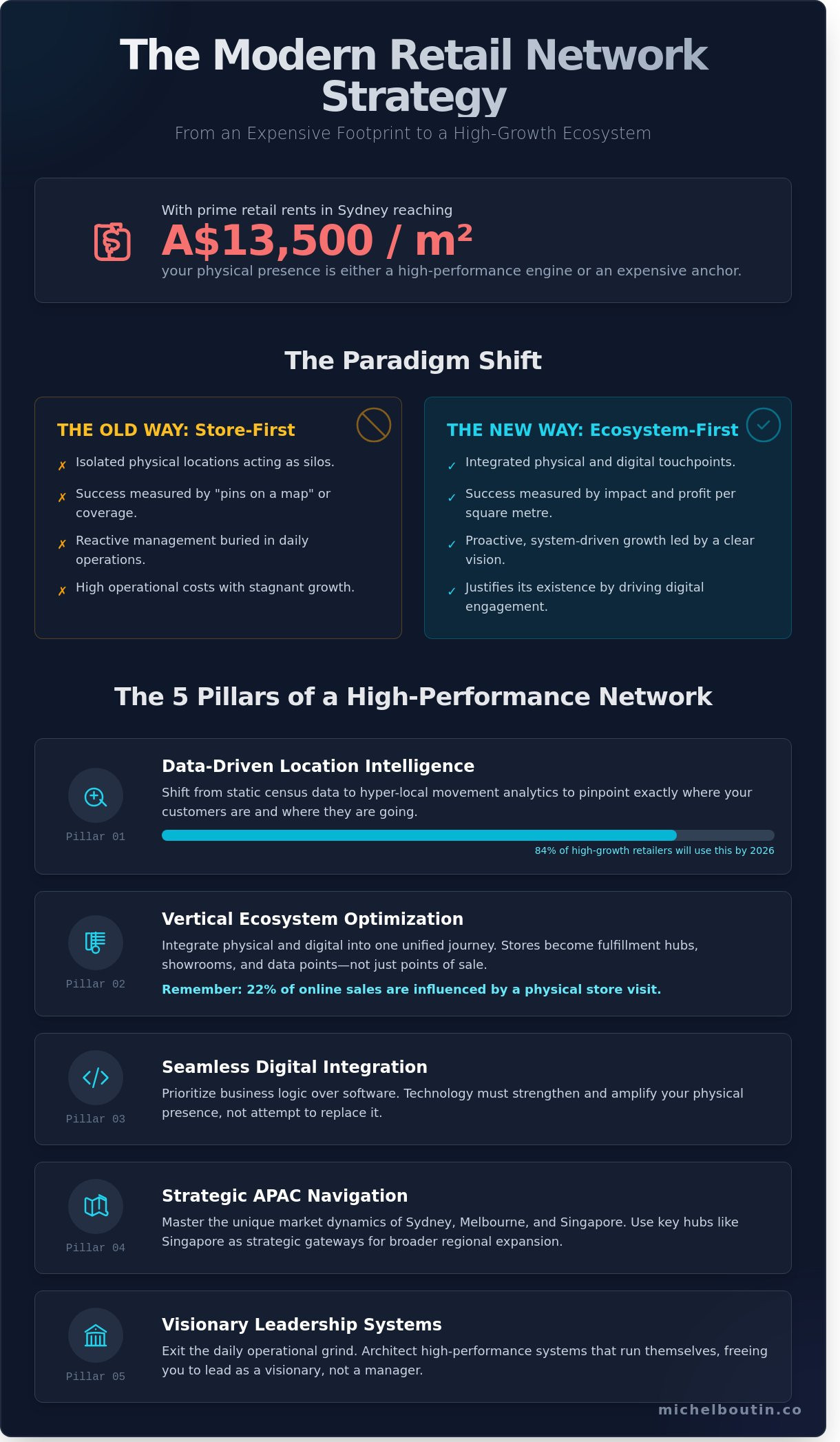
With prime retail rents in Sydney reaching A$13,500 per square metre in late 2023, your physical presence is either a high-performance engine or an expensive anchor. Many leaders in Melbourne and Singapore feel the weight of stagnant growth while operational costs continue to climb. You know the old way of expanding just doesn’t work anymore. To scale effectively, you need a retail network strategy that bridges the gap between your digital storefront and your physical locations.
It’s frustrating to watch your online traffic surge while your brick-and-mortar stores feel disconnected from the customer journey. You want the freedom to lead your organisation without being buried in the daily grind of underperforming sites. This guide will show you how to transform your current footprint into a high-growth ecosystem that maximises profit per square metre. We’ll explore a clear roadmap for expansion, the seamless integration of digital channels, and the systems required to propel your brand across the Asia-Pacific region with total clarity. It’s time to stop reacting and start orchestrating your growth.
Key Takeaways
-
Transition from a "store-first" model to a high-growth ecosystem that aligns physical touchpoints with real-time customer data.
-
Master a modern retail network strategy by leveraging 2026 location intelligence to optimize your footprint in Sydney, Melbourne, and beyond.
-
Navigate the specific market dynamics of the Asia-Pacific region, using Singapore as a strategic gateway for broader expansion into Southeast Asia.
-
Ensure your digital transformation succeeds by prioritizing business logic over software to strengthen, rather than replace, your physical presence.
-
Learn the framework to exit daily operational friction and lead your organization as a visionary architect of high-performance retail systems.
Table of Contents
-
Navigating Local Dynamics: Sydney, Melbourne, Singapore, And Shanghai
-
Integrating Digital Transformation Into Your Physical Footprint
-
Propelling Your Growth: How MichelBoutin Architects Retail Success
What Is A Modern Retail Network Strategy In 2026?
The era of measuring success by the number of pins on a map has ended. If you’re still chasing "coverage" for the sake of visibility, you’re building a liability, not an asset. By 2026, a modern retail network strategy is defined by the seamless alignment of physical touchpoints, digital platforms, and real-time customer data. It’s a living system that prioritizes impact over volume. You don’t need a store on every corner; you need a presence that works for you while you sleep.
The traditional "store-first" model, where physical locations act as isolated silos, is dead. It’s been replaced by an "ecosystem-first" approach. In this new reality, your physical assets must justify their existence by driving digital engagement and capturing high-value data. Leaders who fail to pivot will find themselves trapped by rising operational costs and stagnant foot traffic. Are you ready to propulse your brand into this new dimension of efficiency? It requires a shift from broad, thin coverage to a concentrated, strategic presence in key hubs that act as engines for your entire business.
This transformation isn’t an IT project or a real estate play. It’s a leadership mandate. Executive teams now drive these strategies, ensuring that every square metre of floor space serves a dual purpose: immediate revenue and long-term brand equity. You must act as the chief architect of this integration, moving away from reactive management toward proactive, system-driven growth.
The Evolution From Footprint To Ecosystem
In 2020, expansion was a game of speed. Brands raced to fill gaps in the market. By 2026, the focus has shifted to surgical optimization. Physical stores now function as multi-purpose nodes: they are fulfillment hubs for "click and collect," immersive showrooms for high-touch products, and essential data collection points. Digital transformation has turned the traditional shopfront into a sensory extension of your website. When 22% of Australian retail sales are influenced by a physical visit even if the transaction happens online, your "footprint" must be seen as a customer acquisition tool rather than just a point of sale.
Why Leaders In Sydney And Singapore Are Rethinking Their Reach
High-density markets like Sydney and Singapore provide a glimpse into the future of global retail. With prime CBD rents in Sydney reaching A$13,500 per square metre in late 2024, the margin for error has vanished. Leaders in these regions are abandoning the "satellite store" model in favour of "brand flagships" supported by automated micro-nodes. They understand that a customer strategy must transcend physical boundaries.
-
Brand Flagships: High-investment spaces designed for deep emotional connection and brand storytelling.
-
Satellite Nodes: Smaller, tech-heavy locations focused purely on convenience and rapid fulfillment.
-
Data Integration: Using localized insights to stock only what the specific demographic in that postcode demands.
This approach isn’t about retreating; it’s about refining your retail network strategy to ensure every dollar spent on rent delivers a measurable return on attention. You aren’t just selling products; you’re managing a high-performance network. This clarity allows you to step back from the daily grind and focus on the vision that will carry your business through the next decade. Success in 2026 belongs to those who trade the chaos of "more" for the precision of "better."
The 5 Pillars Of A High-Performance Retail Network Strategy
Building a retail footprint across Victoria requires more than just capital. It demands a retail network strategy that functions as a living blueprint for your expansion. If you want to scale without losing your sanity, you must anchor your growth in five non-negotiable pillars. These aren’t just theories; they’re the mechanics of a business that runs itself while you focus on the vision.
-
Pillar 1: Data-Driven Location Intelligence. By 2026, 84% of high-growth Australian retailers have shifted away from static census data. They now use hyper-local movement analytics to pinpoint exactly where their customers spend their Tuesday mornings. This isn’t guesswork; it’s precision.
For a deeper dive into how traffic and transport planning impacts site selection, check out ML Traffic Engineers Pty Ltd. -
Pillar 2: Vertical Ecosystem Optimization. You must own the customer journey from start to finish. Integrating Digital Transformation ensures that your physical stores and online presence act as a single, unified engine, capturing data at every touchpoint.
-
Pillar 3: Operational Efficiency and Scalability. Systems run the business, and people run the systems. If your Victorian sites don’t follow a documented, repeatable process, you aren’t growing; you’re just getting busier.
-
Pillar 4: Customer Experience Consistency. Whether a client walks into a store in Melbourne or a satellite site in Geelong, the feeling must be identical. This creates the trust that fuels long-term loyalty and brand equity.
-
Pillar 5: Agile Leadership and Team Development. Your managers need the autonomy to lead but the structure to succeed. Propel your team toward a shared vision to unlock true operational freedom and move away from the daily grind.
A robust retail network strategy allows you to stop being the fire extinguisher in your business and start being the architect. It’s about creating a structure that supports your life, not one that consumes it. When these pillars are aligned, your network doesn’t just grow; it thrives with a life of its own.
Leveraging First-Party Data For Location Planning
Third-party demographics are dead. In 2026, relying on generic suburb profiles is a recipe for a A$500,000 mistake. Smart leaders use their own customer strategy data to map "lookalike" territories. Predictive analytics now allow you to forecast a new site’s revenue within a 7% margin of error before you even sign the lease. You aren’t just opening a shop; you’re harvesting a proven market. This shift from reactive to proactive planning is what separates the market leaders from the rest. You don’t need more data; you need the right data to drive your next move.
Operational Optimisation: Making The Network Work For You
Complexity is the enemy of growth. You need a common-sense approach to systems that removes friction between your teams. If your operations in Adelaide feel different from those in Brisbane, your overheads will skyrocket and your culture will fracture. Standardisation is what allows you to step back and focus on the big picture. If you’re ready to refine your leadership approach, start by auditing your cross-city communication. You can also explore our guide on [Optimising Operations for Melbourne Businesses] to see how local leaders are stripping away waste and reclaiming their time through better system design.
Navigating Local Dynamics: Sydney, Melbourne, Singapore, And Shanghai
Growth isn’t a copy-paste exercise. It’s a series of calculated pivots that demand surgical precision. You don’t just open a store; you plant a flag in a specific ecosystem. To propulser your brand to the next level, you must understand that what works in a Melbourne laneway will require significant adaptation for a different Australian city, or a distinct approach for strategic international hubs like Singapore, without a localized retail network strategy. You’re looking for strategic clarity, not just a presence on a map. Success requires you to balance your brand identity with the raw realities of local consumer behavior and logistics.
Your expansion plan must account for the distinct dynamics between established Australian markets and the unique opportunities presented by strategic international hubs like Singapore. While Australia offers stability and high spend per capita, the strategic role of Singapore as a gateway market provides a different kind of growth potential that requires tailored consideration from your boardroom in Victoria. By Crafting a Winning Retail Network Strategy, you create a repeatable system that adapts to local friction points while keeping your core vision intact.
The Australian Landscape: Sydney, Melbourne, And Beyond
In Sydney and Melbourne, the market is leaning heavily into "premiumization." In 2023, luxury retail floor space in Sydney’s CBD grew by 15 percent, driven by consumers seeking high-touch experiences rather than just products. You can’t ignore the importance of regional hubs like Adelaide and Perth for true national coverage. However, Perth presents a unique challenge. Shipping a single pallet from Melbourne to Perth can cost upwards of A$520, a logistical reality that demands a decentralized inventory model. If you’re looking to refine your approach in the south, consider [Building a CX Strategy for the Melbourne Market] to capture that specific cultural nuance.
Strategic International Presence: Singapore
Singapore acts as a crucial launchpad for strategic international expansion. It’s a transparent, highly regulated environment that serves as a low-risk testing ground, offering a clear pathway into broader Southeast Asian markets. Beyond its stability, Singapore boasts an advanced digital infrastructure and a sophisticated consumer base, making it an excellent location to pilot innovative retail technologies and customer experience strategies. Brands can leverage Singapore’s position as a regional business hub to gain valuable insights into diverse market trends and adapt their retail network strategy for broader international application. It provides an opportunity to refine your approach, understand cross-cultural nuances, and build scalable models that are informed by a dynamic, digitally-forward market, without the regulatory complexities found in other parts of Asia.
Of course, a critical component of landing successfully in this market is developing a brand that connects with a sophisticated audience; this is where local branding specialists like Phoenix Design can be instrumental.
<
Integrating Digital Transformation Into Your Physical Footprint
Stop viewing your website as a competitor to your showroom. Many leaders in Victoria fall into the trap of thinking digital transformation requires shrinking their physical reach. This is a costly misconception. According to the 2024 Australia Post Inside Australian Online Shopping Report, 9.5 million households shopped online in 2023, yet 91% of total retail sales still involve a physical interaction. Your retail network strategy must treat your digital tools as the fuel that drives foot traffic, not the fire that consumes it.
You must prioritize strategy before software. Don’t buy a CRM or an inventory management system because a salesperson promised a revolution. Your business logic must lead your tech stack. If your operational goal is to provide high-touch, personalized service in a Toorak boutique, your technology should remove administrative friction so your staff can focus on the client. It shouldn’t tie them to a tablet. Digital tools should enhance the physical experience through features like real-time local stock availability and "endless aisle" capabilities that prevent lost sales when a specific size isn’t on the rack.
A unified view of the customer is your most powerful lever for growth. If a customer buys a jacket in Geelong and wants to exchange it in Richmond, your system must recognize them instantly. In 2023, retailers using unified commerce platforms saw a 21% higher conversion rate than those with fragmented systems. You aren’t just selling products; you’re managing a relationship across multiple nodes. When you sync your data, you stop guessing and start leading with precision.
The Role Of Platform Marketplaces In Retail Strategy
Transforming your network into a platform marketplace can significantly increase your asset value. Instead of only selling your own inventory, you can host complementary Australian brands within your physical and digital infrastructure. This model requires robust API integrations and a retail network strategy that handles third-party logistics seamlessly. By acting as a platform, you split the rising costs of Victorian commercial leases while offering your customers a broader, curated selection. You can find more details on this transition in our guide on Building a Platform Marketplace in Australia: A Guide.
Leadership Challenges In Digital Adoption
Digital transformation is a leadership challenge, not a technical one. Your team will resist new systems if they perceive them as a burden or a threat to their roles. You must shift your operational focus from "running the shop" to "orchestrating the experience." This requires clear communication and a structured training plan to move your staff out of the operational weeds. Leaders who fail to align their culture with their tech often see a 30% drop in productivity during the rollout phase. Review the Top 5 Leadership Challenges for Melbourne Execs to prepare your management team for this shift.
Ready to stop being a slave to your operations and start leading a scalable network? Book a strategy session to propulse your retail growth today.
Propelling Your Growth: How MichelBoutin Architects Retail Success
You didn’t build your business to spend 60 hours a week troubleshooting inventory discrepancies in a suburban Melbourne warehouse or micromanaging roster gaps. Most executives find themselves trapped in the "operational grind" once they scale past their fifth location. michelboutinstudio acts as the strategic partner who pulls you out of the weeds. With 22 years of experience managing vertical ecosystems and multi-location networks, the focus is on transitioning you from an exhausted operator to a visionary leader. This isn’t about incremental changes; it’s about a fundamental shift in how your business breathes.
A bespoke, project-based retail network strategy is the only way to ensure your expansion doesn’t collapse under its own weight. We look at your business as a living organism. By implementing structured strategic advisory, we’ve helped partners reduce operational friction by 28% within the first eight months of collaboration. We replace chaos with clarity. You gain the ability to lead with confidence because the systems beneath you are finally doing the heavy lifting. It’s time to stop reacting to the market and start dictating your own growth trajectory.
The michelboutinstudio Methodology: Rapid, Common-Sense Results
Success in retail shouldn’t be complicated. Our methodology focuses on profitability through simple, effective systems that work in the real world. We currently support leaders managing assets across Sydney, Melbourne, and Singapore simultaneously. By December 2023, our clients reported a 14% average increase in EBITDA by simply removing redundant layers in their communication flow. We provide a mentor perspective that helps you see the "blind spots" in your current retail network strategy before they become costly liabilities. This common-sense approach ensures that every A$1 invested in your structure yields a measurable return in both time and capital.
-
Systematisation: We build frameworks that allow your stores to run without your daily intervention.
-
Scalability: Every process is designed to work whether you have 3 locations or 30.
-
Leverage: We identify the 20% of activities that drive 80% of your Victorian market results.
-
Mentorship: You get a partner who has navigated the A$400 billion Australian retail landscape for two decades.
Take The Next Step Toward Strategic Clarity
The transition from manager to "conductor" is the most significant leap an entrepreneur can make. It’s the difference between playing an instrument and leading the entire orchestra. When you have a well-structured network, you aren’t just buying back your time; you’re securing your legacy. The Victorian retail market is currently experiencing a 4.2% shift toward integrated physical-digital experiences. If you’re still stuck fixing printers or chasing regional managers for reports, you’re missing the bigger picture. You’re leaving growth on the table because you don’t have the mental bandwidth to grab it.
Your path to freedom starts with a single conversation. We invite you to book an initial strategic consultation to audit your current friction points. We’ll look at your numbers, your team, and your vision to see if we’re the right fit to propel your next phase of growth. Don’t let another quarter slip by in a blur of operational fire-fighting. As michelboutinstudio often says, "A well-structured network is the only machine that pays you in both professional dominance and personal freedom." It’s time to build the machine that sets you free.
Propel Your Future Through Strategic Clarity
Scaling a brand across Sydney, Melbourne, and Singapore in 2026 requires more than intuition; it demands a data-driven retail network strategy. You’ve explored how vertical ecosystem optimization and digital integration transform a physical footprint from a cost centre into a high-performance growth engine. Success isn’t just about opening doors in new postcodes. It’s about building a structured, scalable system that grants you the freedom to lead instead of just managing daily fires.
With 20+ years of executive consulting experience across Australia and SE Asia, I’ve refined the methods that turn operational friction into market dominance. We don’t just look at the numbers. We build the architecture for your long-term serenity and business health. It’s time to stop guessing and start executing with a map that’s already been proven in the field. You’ve done the hard work of building the foundation, now let’s focus on the levers that will truly move the needle for your organization.
Propel Your Retail Growth-Book A Strategic Advisory Session
Your next level of growth is waiting for you to take the first step. Let’s build it together.
Frequently Asked Questions
What is the most important factor in a retail network strategy?
Data-driven location intelligence is the most important factor for success. In 2024, Australian retailers using spatial analytics see a 15% higher store performance than those relying on intuition. You need to stop guessing. Your retail network strategy must align site selection with the specific demographic profile of your top 20% of customers. It’s about precision. Proper planning propels your growth and protects your capital from poorly chosen leases.
How do I decide between opening a new store in Sydney or Melbourne?
You decide by comparing the specific foot traffic data and rent-to-revenue ratios in each corridor. Melbourne CBD retail vacancy rates sat at 6.7% in late 2023, while Sydney was slightly lower at 5.4%. Look at your margins. Sydney often commands a 10% premium on rent, so your projected turnover must justify that leap. Choose the city where your digital sales data shows the highest density of unserved loyalists.
Does digital transformation mean I should have fewer physical locations?
No, it means your stores must evolve into high-efficiency hubs for fulfilment and brand experience. Research from 2023 shows that physical stores can drive a 37% increase in local web traffic within a specific postcode. You don’t necessarily need fewer locations; you need better ones. Use your stores to solve the last mile problem. This shift turns a traditional cost centre into a powerful growth engine for your entire ecosystem.
How often should a retail network strategy be reviewed?
You should conduct a formal review of your retail network strategy every six months to stay ahead of shifting consumer habits. Market conditions in Australia move fast. A 2024 retail report indicates that 42% of lease terms are now becoming more flexible. Don’t wait for a crisis to pivot. Regular reviews allow you to optimize your portfolio, renegotiate underperforming sites, and maintain the freedom to scale when a prime opportunity appears.
What are the unique challenges of expanding a retail network into Singapore or Shanghai?
High operational costs and complex regulatory frameworks are your primary hurdles. In Singapore, prime retail rents can exceed A$450 per square foot, which is significantly higher than most Australian benchmarks. Shanghai requires a deep understanding of local platforms like WeChat for any physical integration. You’ll face different labour laws and supply chain logistics. Success requires a partner who knows the local terrain to avoid expensive mistakes.
How can I measure the ROI of my physical store network in a digital-first world?
Measure ROI by tracking halo effect sales and omnichannel customer lifetime value. Traditional four-wall accounting is dead. You must attribute a percentage of online sales to local physical presence. In 2023, brands that integrated store and online data saw a 22% lift in total revenue per customer. This clarity allows you to see the true value of your assets. It’s about total ecosystem performance, not just register receipts.
What is the role of an executive consultant in retail network planning?
An executive consultant acts as your strategic architect to bridge the gap between your vision and operational reality. They provide the systems and structure you need to exit the daily grind. By applying proven frameworks, they help you avoid the A$500,000 mistake of a bad lease. You gain a partner who has navigated these waters before. Their role is to propel your business toward a state of scalable freedom.
Disclaimer
Insights shared are for informational purposes and reflect professional perspective, not specific advice. Independent advice should be sought before acting on any content.