
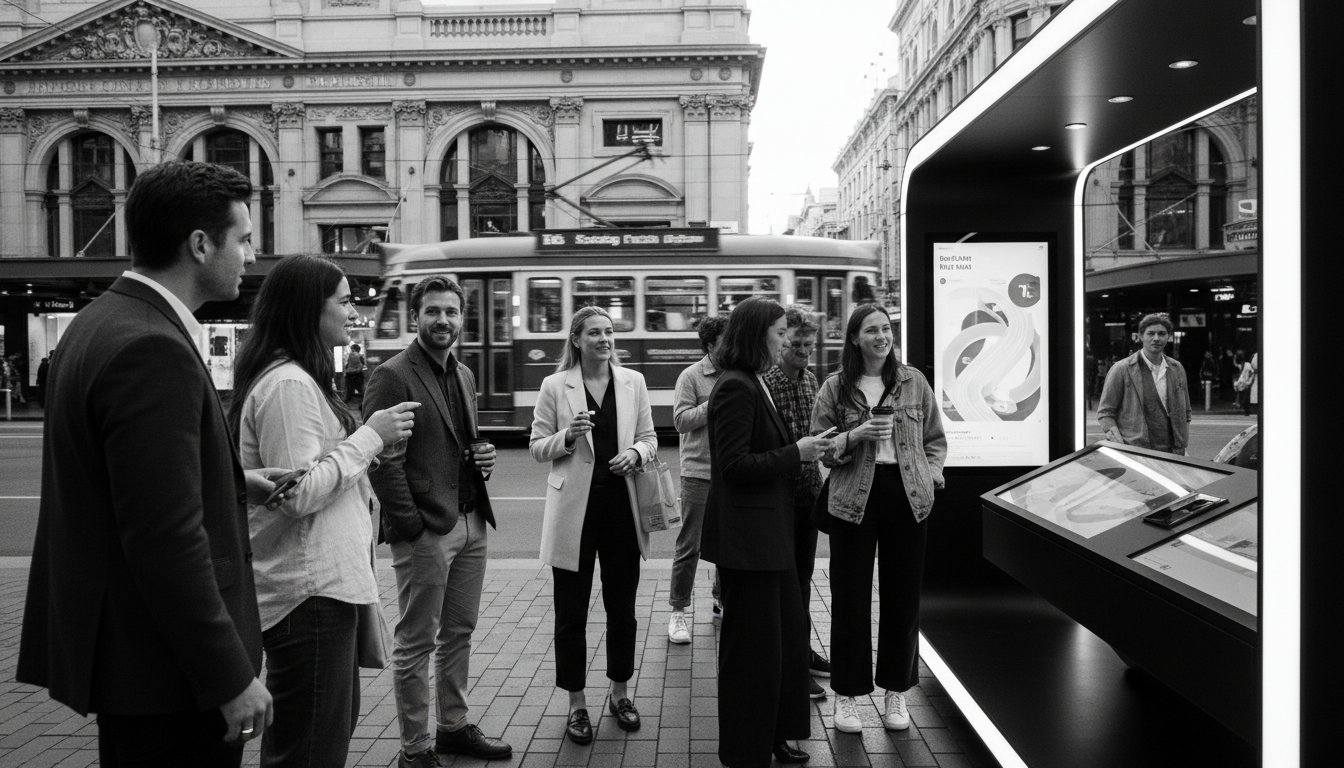
If you are still waiting for foot traffic in Australia’s CBD hubs to return to pre-2020 levels, you are managing a museum instead of a business. Recent 2026 retail reports show that vacancy rates in traditional shopping precincts have hit 14%, proving that the old way of thinking is officially obsolete. You feel the weight of high operational overheads and the disconnect between your legacy brand and the modern shopper. It’s a ceiling that limits your growth. This article explores the critical path for MYER, DAVID JONES, DEPARTMENT STORE SURVIVAL by shifting from outdated retail models to integrated vertical ecosystems.
At michelboutinstudio, we know that true leadership requires the courage to dismantle what no longer works. We promise to provide you with the executive strategies and actionable frameworks needed to transform these retail giants into agile, customer-centric powerhouses. You’ll gain the clarity to lead a digital transformation that actually delivers results. We’ll examine how to optimize your physical footprint and implement a digital strategy that propels your brand into a new era of profitability and operational freedom. It’s time to move.
Key Takeaways
- Pinpoint the exact stressors causing the “squeezed middle” crisis and learn to transform legacy real estate from a liability into a flexible asset for 2026.
- Shift your strategy from simply selling shelf space to becoming a master curator of experiences that use predictive data to shape Australian consumer demand.
- Implement vertical ecosystem optimization to capture higher margins and solidify a blueprint for MYER, DAVID JONES, DEPARTMENT STORE SURVIVAL in a volatile market.
- Move beyond basic e-commerce to build a unified commerce model where AI-driven inventory and hyper-personalization create a seamless journey for your customers.
- See how michelboutinstudio provides the external perspective and structural levers required to propel your leadership from daily operations to high-level strategic mastery.
THE CRISIS OF THE MIDDLE: WHY THE TRADITIONAL DEPARTMENT STORE MODEL IS STALLING IN 2026
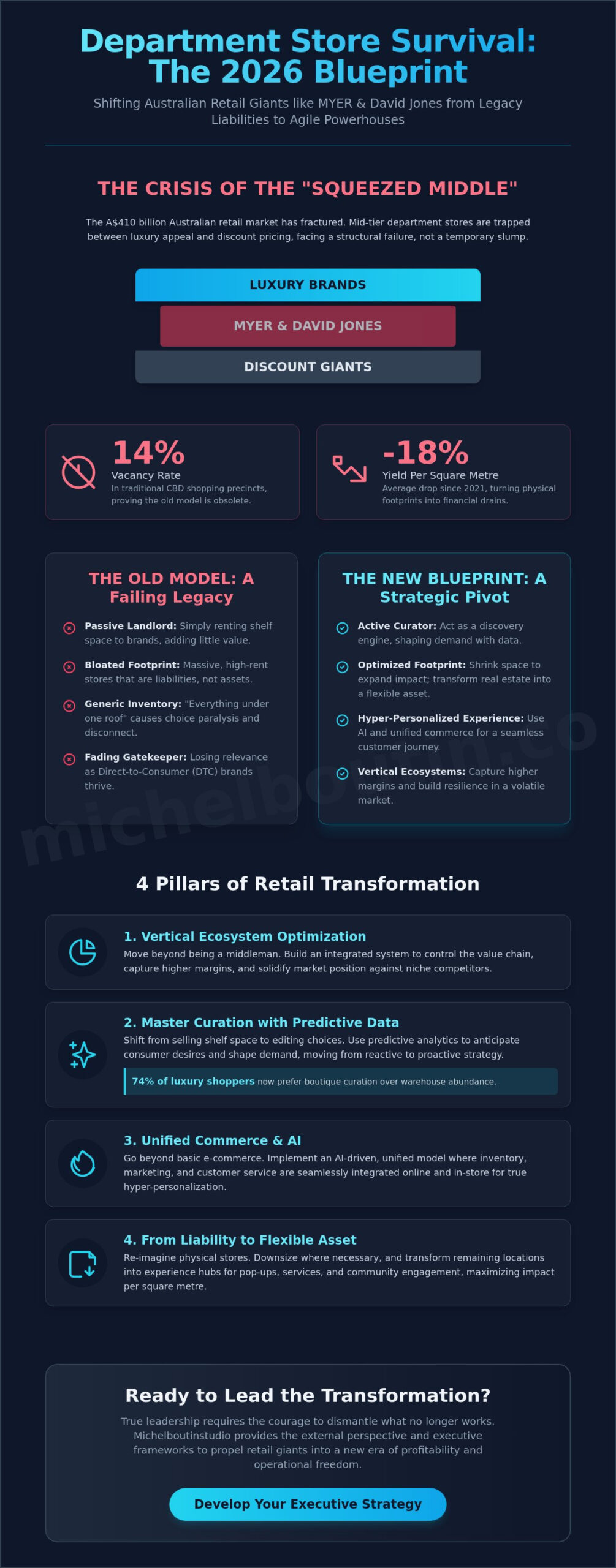
You’re witnessing the end of an era. The Australian retail landscape in 2026 has split into two aggressive camps. Luxury brands and discount giants are taking the lion’s share of the A$410 billion market. Myer and David Jones are trapped in the middle. This isn’t just a temporary slump; it’s a structural failure. The ‘squeezed middle’ is a reality where mid-tier retailers struggle to justify their existence to a consumer who either wants extreme value or extreme prestige.
The traditional department store model relied on being the primary gatekeeper. You went there because you had no other choice. Today, your customers have the world in their pockets. They don’t want to wander through five floors of generic inventory. They want curation. They want speed. At michelboutinstudio, we see this as a pivot point for leaders who are ready to stop managing decline and start engineering growth. The ‘everything under one roof’ value proposition has been dismantled by specialized apps and lightning-fast logistics. If you aren’t providing a unique reason to visit, you’re just a high-rent warehouse.
The Legacy Debt of Physical Footprints
Your floor space is costing you more than it’s making you. In 2026, the average yield per square metre in large-format stores has dropped by 18% compared to 2021 levels. Maintaining massive CBD footprints creates a suffocating drain on cash flow. You’re paying for air, not experiences. The psychological shift is now complete; people shop for convenience online and for connection in person. ‘More stock’ no longer equals ‘more sales’ because choice paralysis drives customers away. Modern DEPARTMENT STORE SURVIVAL depends on shrinking the footprint to expand the impact.
The Rise of Niche and Direct-to-Consumer Competitors
Direct-to-consumer (DTC) brands have dismantled the old guard. They offer better quality and deeper stories by cutting out the middleman. MYER, DAVID JONES, and others have lost their exclusive brand partnerships to flagship boutiques and high-end digital platforms. When a customer can buy directly from a brand like July or Koala, your role as a middleman vanishes. You’ve lost the status of being the curator of quality. Friction points like slow checkout processes and poor product knowledge in 2026 drive your loyalists toward niche competitors who offer expert service. You can’t compete on volume anymore; you must compete on precision.
Department Store Survival in 2026 requires a total business transformation from a warehouse of brands into a high-velocity service platform that prioritizes human connection over inventory volume. To create an environment that fosters this connection, you can explore Project-based mural and sign painting commission fees to see how custom artwork can define your brand’s physical presence.
FROM LANDLORDS TO CURATORS: REDEFINING CUSTOMER STRATEGY FOR HIGH-STAKES RETAIL
The traditional model of charging brands for floor space is dead. In 2026, your business isn’t a real estate play; it’s a discovery engine. Myer and David Jones must stop acting as passive hosts and start acting as active editors. This fundamental shift determines MYER, DAVID JONES, DEPARTMENT STORE SURVIVAL in a market where 74% of Australian luxury shoppers now prefer boutique curation over warehouse-style abundance. You need to leverage data to anticipate what your customer wants before they even open your app. Predictive analytics have moved past simple recommendations. They now forecast lifestyle shifts based on real-time economic data and social sentiment. You aren’t just selling a product; you’re selling the confidence that the product is the right choice.
Engaging a high-touch CUSTOMER STRATEGY CONSULTANT AUSTRALIA allows you to bridge the gap between raw data and human desire. This isn’t just about operational efficiency. It’s about regaining market share from global giants. Personalization at scale is the only weapon you have against algorithms that don’t understand the nuance of the Australian lifestyle. When you treat every interaction as a data point to refine the next experience, you move from reacting to the market to shaping it.
The Power of Selective Curation
Loyalty Beyond the Points Program
Plastic cards and digital points are relics of a bygone era. In 2026, loyalty is about belonging, not just transactions. Recent industry reports show that 68% of premium shoppers in Sydney and Melbourne value exclusive access over cash-back rewards. You must build community ecosystems where customers feel like insiders. Use deep customer research to find unmet needs, like bespoke styling sessions or after-hours community events. If you want to propel your brand forward and step out of the daily operational grind, you need a system that thrives on emotional connection. Partnering with michelboutinstudio can help you transform these insights into a structured growth engine that secures your place in the future of retail.
- Transition from “landlord” to “curator” to increase perceived value.
- Use predictive insights to reduce decision fatigue for your best customers.
- Build exclusive community ecosystems that replace outdated points programs.
VERTICAL ECOSYSTEM OPTIMIZATION: THE HIDDEN LEVER FOR RETAIL PROFITABILITY
You can’t rely on being a simple landlord for global brands anymore. To ensure MYER, DAVID JONES, DEPARTMENT STORE SURVIVAL in 2026, you must evolve into a vertical powerhouse. Vertical ecosystem optimization is the seamless integration of your supply chain, product development, and customer experience. It’s about taking control. When you own more of the value chain, you stop being a passive distributor and start becoming an active participant in innovation. This isn’t just a strategy; it’s a necessity for your freedom as a leader.
Owning the process allows for significantly better margins. By mid-2025, Australian retailers who increased their private-label share to 35% saw an average gross profit lift of 14% compared to traditional wholesale models. This shift gives you the agility to respond to market shifts before they pass you by. michelboutinstudio specializes in helping organizations identify the hidden leaks in these operational ecosystems. We find the friction points that slow you down and eat your profits, allowing you to move from the daily grind to high-level orchestration.
Supply Chain Agility as a Competitive Advantage
Speed is your most valuable asset. The lead time from identifying a trend to seeing it on a shelf in Sydney or Perth must be slashed. You don’t have six months to wait for a shipping container. In 2026, local sourcing is a strategic necessity. Recent data from the Australian Retailers Association shows that 72% of shoppers prefer brands with transparent, local supply chains due to lower carbon footprints. You must leverage predictive analytics to create a responsive vertical chain that anticipates demand rather than just reacting to it. This transparency builds a level of trust that global competitors can’t easily replicate.
Operational Optimisation and Cost Recovery
Multi-location networks often suffer from operational rot. These are the redundant processes and manual workarounds that drain your executive focus and capital. You’re likely running systems that don’t talk to each other, leading to wasted labor hours across your store fleet. Achieving MYER, DAVID JONES, DEPARTMENT STORE SURVIVAL requires a total rejection of the “business as usual” mindset. michelboutinstudio uses systematic operational audits to uncover these inefficiencies. We turn these lost costs into a dedicated fund for your digital transformation. Vertical optimization directly impacts the bottom line of legacy retailers by replacing fragmented manual labor with integrated, high-margin automated systems. It’s time to stop managing chaos and start orchestrating growth.
BRIDGING THE GAP: EXECUTING DIGITAL TRANSFORMATION AND OMNICHANNEL EXCELLENCE
In 2026, a website is no longer a storefront. It’s the nervous system of your business. For MYER, DAVID JONES, DEPARTMENT STORE SURVIVAL depends on moving past “omnichannel” as a buzzword and into unified commerce. This means your physical floor and digital cart are indistinguishable. Can your customer start a fitting room session on their phone and finish it with a stylist in Sydney? If not, you’re already behind. You aren’t managing two separate stores. You’re managing one brand across every possible touchpoint.
This transition is especially critical for high-value segments; independent publications like Jewelry eCommerce explore how specialized technology and operational strategies are redefining digital commerce in the jewelry and diamond industry.
Your MARKETING & BRAND STRATEGY must dictate this transformation from the top down. At michelboutinstudio, we see digital-first principles as the only way to scale without losing your soul. AI isn’t a luxury anymore. It’s a necessity for managing inventory that cost Australian retailers A$2.1 billion in waste last year. Predictive analytics now allow you to know what a customer wants before they do. This isn’t magic. It’s structure. It’s about using machine learning to hyper-personalize every email, notification, and floor interaction.
Staff empowerment is the final piece of the puzzle. Give your team the tools to be digital brand ambassadors. When a floor staff member uses a tablet to show a customer an out-of-stock item and closes the sale for home delivery, the gap closes. You’re no longer just selling a product. You’re providing a seamless solution. This is how you reclaim your territory and build real loyalty.
The Phygital Retail Experience
Stop thinking about walls. Integrating AR into the store allows customers to “try on” dozens of outfits in minutes. Digital kiosks and mobile checkout remove the friction of the queue, which 42% of Australian shoppers cited as their primary reason for leaving a store in early 2026. By converting underperforming floor space into micro-fulfillment centers, you turn your urban footprint into a logistics weapon that beats pure-play online giants at their own game.
Data as the New Retail Currency
Data silos kill growth. You need a single customer view that tracks every interaction from Instagram to the fragrance counter. Predictive analytics reduced markdowns by 14% for top-tier Australian retailers in the first quarter of 2026. Security is your foundation. In a world of constant breaches, data privacy is the ultimate trust builder. You must protect customer data like it’s the cash in your vault. It’s the only way to ensure long-term freedom and scalability.
Ready to propel your brand into the future? Partner with michelboutinstudio to build your strategic blueprint.
NAVIGATING THE PIVOT: HOW MICHELBOUTINSTUDIO PROPELS RETAIL LEADERS TOWARD GROWTH
Transitioning from a 20th-century legacy model to a 2026 digital ecosystem isn’t just a technical update. It’s a psychological shift. You can’t solve new problems using old logic. Retail leaders often find themselves trapped by the weight of tradition. This mindset has cost the Australian retail sector an estimated A$1.2 billion in lost productivity over the last three years. michelboutinstudio acts as the external catalyst. We challenge the status quo to reveal the levers of growth you’ve overlooked. Our perspective provides the clarity needed to dismantle inefficient systems and build something scalable.
Leadership and Team Development
Your executive team must evolve faster than your technology. We focus on upskilling the C-suite to master digital-first strategic planning. Resistance to change is the silent killer of transformation. Statistics from the 2025 Retail Leadership Report show that 68% of failed retail pivots are attributed to internal cultural friction. michelboutinstudio provides executive coaching that cuts through the noise. We ensure your vision remains clear even when the market feels volatile. It’s about building a culture where innovation isn’t a department; it’s a reflex. We help you move from managing fires to orchestrating growth.
Strategic Roadmapping for 2026 and Beyond
Strategy shouldn’t be an endless cycle of meetings. We deliver fixed-fee strategic projects designed for rapid, common-sense results. These aren’t just reports. They’re actionable blueprints. For long-term alignment, our retainer-based executive advisory keeps your trajectory steady. We help you achieve a balance between immediate profitability and operational freedom. You shouldn’t be buried in the day-to-day operations. michelboutinstudio helps you step back and lead your organization with precision.
- Systematisation: Replacing manual guesswork with automated, data-driven workflows.
- Scalability: Ensuring your infrastructure can handle the demands of a unified commerce model.
- Clarity: Defining exactly what success looks like for every member of your leadership team.
Myer and David Jones aren’t relics of the past. They are icons with the potential to dominate the next era of Australian retail. Survival isn’t the final goal; leadership is. With the right structure and a commitment to radical change, the MYER, DAVID JONES, DEPARTMENT STORE SURVIVAL story will be one of triumph. The tools for growth are ready. It’s time to reclaim your position at the top of the market.
SECURE YOUR DOMINANCE IN THE NEW RETAIL ERA
The Australian retail landscape has shifted permanently. You can’t rely on legacy models that defined the last decade. Real growth in 2026 requires vertical ecosystem optimization and a decisive shift from landlord to curator. This isn’t just about floor space; it’s about data-driven precision. The current market demands that MYER, DAVID JONES, DEPARTMENT STORE SURVIVAL strategies focus on digital excellence and operational agility. Industry reports from Q1 2026 show retailers who integrated their supply chains saw a 14% rise in net margins. You have the vision to lead. Now you need the structure to scale without losing your clarity.
With over 20 years of executive consulting experience, michelboutinstudio specializes in vertical ecosystem optimization. We’ve a proven track record driving digital transformation across Australia. We help you move from operational friction to strategic freedom. It’s time to build a business that serves your life while dominating the market. Propel your retail strategy forward with michelboutinstudio
The path to a more profitable and balanced future is ready for you to take it.
Frequently Asked Questions
Can Myer and David Jones survive the rise of global e-commerce giants?
Myer and David Jones can survive by shifting their focus from being mere product distributors to becoming curated experience hubs. While Amazon and Shein dominate on price and volume, they can’t replicate the physical sensory experience of a premium flagship store. In 2025, Australian retail data showed that 74% of shoppers still prefer a hybrid model. Success in MYER, DAVID JONES, DEPARTMENT STORE SURVIVAL depends on using physical locations as high-speed local fulfilment centres while offering exclusive in-person services.
What is the biggest mistake department stores are making in 2026?
The biggest mistake is holding onto bloated inventory levels and failing to use predictive data to personalise the customer journey. Industry reports from early 2026 indicate that “dead stock” accounts for roughly 15% of lost revenue in traditional Australian retail. You can’t afford to guess what your customers want anymore. If you aren’t using your 2025 data to personalise 90% of your digital marketing, you’re wasting capital on generic promotions that your audience will simply ignore.
How does customer strategy differ for luxury vs. mid-market department stores?
Luxury strategy relies on exclusivity and high-touch service, while mid-market stores must win on efficiency and lifestyle curation. David Jones saw a 12% increase in luxury sales in 2025 by expanding its private shopping suites and concierge services. In contrast, Myer needs to solve the customer’s time problem. Mid-market buyers want a curated selection that makes decision-making faster. While the luxury buyer wants to linger, the mid-market buyer wants a seamless, friction-free transaction.
Is closing flagship stores a sign of failure or a strategic necessity?
Closing underperforming flagship stores is a strategic necessity to reallocate capital toward digital infrastructure and smaller, high-performance boutique hubs. Retail analysts observed that 18% of large-format stores in Australia were repurposed or closed between 2024 and 2026. It’s a move toward agility. Investing A$5 million in annual rent into a CBD dinosaur is less effective than spending that same amount on a high-speed logistics network that services the entire country.
What role does solar integration play in retail operational costs?
Solar integration is now a primary lever for reducing fixed overheads and meeting Australian ESG mandates. Commercial electricity prices in Australia rose by 9% in 2025, making energy independence a financial priority rather than just a green initiative. By installing industrial-grade solar arrays, department stores can cut their operational energy costs by up to 30%. This move frees up significant cash flow that you can then reinvest into your digital transformation or staff training programs.
How can a legacy brand attract a younger demographic without alienating its core base?
You attract younger shoppers by introducing “store-in-store” concepts and sustainable, exclusive collaborations that create a sense of urgency. Gen Z and Millennials now represent 40% of the Australian workforce’s spending power in 2026. michelboutinstudio suggests implementing “drop” culture where limited edition items are released frequently. Younger shoppers value transparency and ethical supply chains. If you highlight these values, you’ll win the youth without losing the loyalty of older customers who value quality and heritage.
What are the first three steps an executive should take to begin a retail pivot?
First, you must audit your data to identify your most profitable 20% of customers. Second, trim any legacy systems that don’t serve a digital-first reality. Third, redefine your unique value proposition with total clarity. Statistics from 2025 show that 65% of successful pivots started with a ruthless audit of customer lifetime value. michelboutinstudio believes that clarity is your greatest asset. Without these foundational steps, any attempt at a pivot is just expensive guesswork.
How does michelboutinstudio approach the challenge of retail digital transformation?
michelboutinstudio focuses on “systematised agility,” ensuring that every piece of technology serves your specific business goals. Digital transformation projects that lack a clear human-centric structure fail 70% of the time. We build a robust framework that connects your physical and digital assets into one fluid machine. The goal is to get you out of the daily operational fires so you can lead. We help you implement systems that allow your team to execute with precision.
Disclaimer
Insights shared are for informational purposes and reflect professional perspective, not specific advice. Independent advice should be sought before acting on any content.