

What if your latest A$500,000 investment in technology is actually the very thing anchoring your business to the past? In 2023, data from Boston Consulting Group showed that 70% of digital transformation efforts fail to meet their targets, often leaving leaders trapped in more complexity than before. You know the frustration of watching legacy systems create bottlenecks while your teams in Sydney or Singapore struggle to connect expensive IT projects with real customer satisfaction. It’s exhausting to manage the friction instead of the growth, especially when cultural resistance slows every move you make.
I’m here to tell you that it doesn’t have to be this way. You deserve a business that runs with precision, allowing you to step back from the daily grind and lead with true vision. This article provides a pragmatic, customer-led roadmap to turn digital complexity into operational freedom. We’ll explore how to build a scalable model that gives you a clear competitive advantage in local markets like Brisbane or Shanghai. It’s time to move past the technical noise and propel your organization toward a future of clarity, growth, and genuine leadership balance.
Key Takeaways
- Redefine your approach by treating technology as a delivery mechanism for customer strategy rather than a standalone IT project.
- Navigate the high cost of tech talent in Sydney and Melbourne by focusing on systems that provide immediate operational freedom.
- Implement a pragmatic 5-step roadmap for digital transformation designed to turn regional complexity into a clear path for growth.
- Protect your bottom line by avoiding fragmented toolsets and the common “tech trap” that wastes valuable A$ investment on unused software.
- Transition from daily operational fire-fighting to strategic leadership with a bespoke partnership that prioritises structure and scalability.
THE REALITY OF DIGITAL TRANSFORMATION IN SYDNEY AND SINGAPORE IN 2026
The year 2026 has arrived, and the business landscape in Sydney and Singapore looks radically different than it did five years ago. Many entrepreneurs still struggle to grasp what we actually mean by change. They think moving a few folders to a cloud drive is enough. It isn’t. To understand What is Digital Transformation? you must look past the hardware. It’s a fundamental shift in how your business delivers value. It’s not an IT project; it’s a total reimagining of your operational DNA.
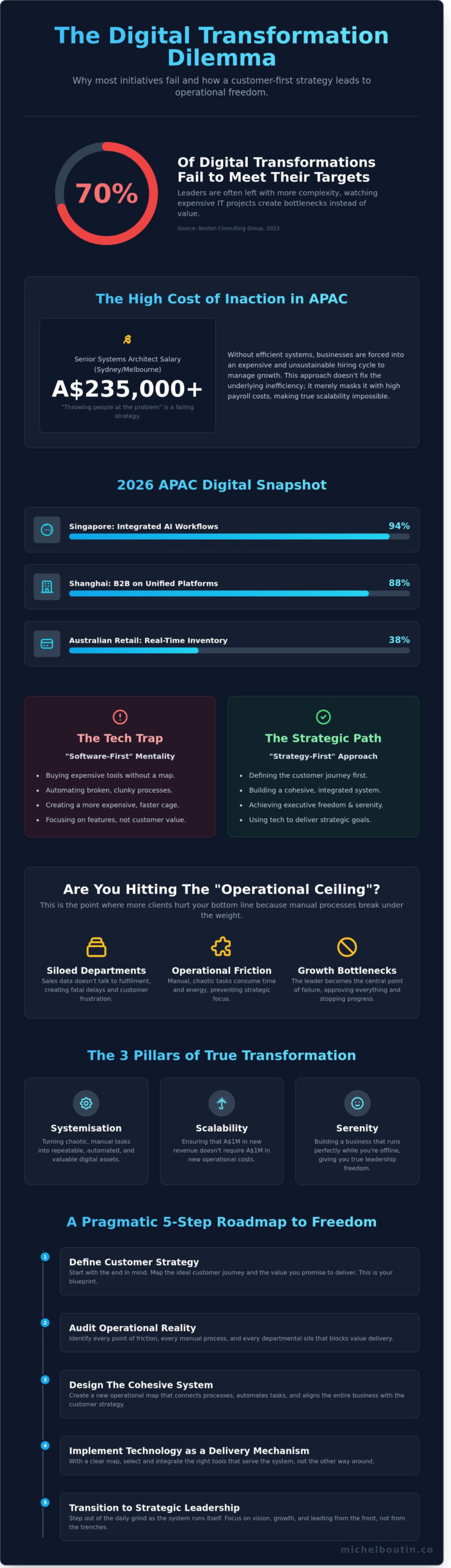
In the current APAC market, the cost of staying still is higher than ever. Tech talent in Melbourne and Sydney has reached a pricing peak. A senior systems architect now commands a base salary exceeding A$235,000. This makes “throwing people at the problem” a failing strategy. You can’t afford to hire your way out of inefficiency anymore. You must systemise. You must automate. You must build a structure that scales without adding a linear headcount.
We’ve seen “digital transformation” become a tired buzzword. Too often, it’s used to mask simple IT upgrades that don’t actually move the needle. Real transformation doesn’t just make you faster; it makes you freer. My perspective is clear: if your technology doesn’t lead to executive freedom and operational serenity, you’ve simply built a more expensive cage. You’re still the bottleneck. Your business still owns you. True digital transformation propels you out of the daily grind and into a position of strategic command.
The State Of Play In Australian And Asian Business Hubs
Singapore remains the gold standard for digital maturity in 2026, with 94% of enterprises utilizing integrated AI workflows. In contrast, Perth and Adelaide are carving out niches in industrial tech, moving away from legacy mining models toward automated resource management. Shanghai continues to dominate through vertical ecosystems where 88% of B2B transactions occur on unified platforms. Recent 2026 data shows Australian retail has hit a tipping point, with 38% of mid-market firms now using real-time predictive inventory systems to combat rising logistics costs.
Why Traditional Models Are Failing In 2026
Siloed departments are the silent killers of growth. If your sales data doesn’t talk to your fulfillment team in real time, you’re losing money every hour. This friction creates an “Operational Ceiling.” It’s the point where taking on more clients actually hurts your bottom line because your manual processes break under the weight. Many Melbourne startups fail because they adopt a “Software-First” mentality. They buy expensive tools without a map. You need a “Strategy-First” approach. You don’t need more apps; you need a cohesive system that removes you from the “how” so you can focus on the “why.”
- Systemisation: Turning chaotic tasks into repeatable, digital assets.
- Scalability: Ensuring A$1M in extra revenue doesn’t require A$1M in extra costs.
- Serenity: Building a business that runs perfectly while you’re offline.
You’re at a crossroads. You can continue to patch up old systems, or you can commit to a structure that offers genuine leverage. The choice isn’t about technology. It’s about your life as a leader. Are you ready to stop being the engine and start being the pilot? The 2026 economy doesn’t wait for those who hesitate. It rewards the structured, the clear, and the bold.
BEYOND SOFTWARE: WHY CUSTOMER STRATEGY DRIVES SUCCESSFUL TRANSFORMATION
Stop looking at the IT department. Your digital transformation starts in the mind of your customer. Too many Australian business owners treat technology as a magic wand. It isn’t. Technology is an amplifier. If your customer journey is clunky or confusing, automation just makes you annoying at scale. You must define the experience you want to provide before you buy a single piece of software.
Your customer strategy is the blueprint; the digital tools are the construction crew. Transformation acts as the delivery mechanism for that strategy. It’s the bridge between what you promise and what you actually provide. When you align these two, you create a business that scales without losing its soul. You gain the freedom to step back because the system delivers the value for you.
Automating a broken process is a recipe for disaster. If your Sydney-based sales team takes three days to return a call, a CRM won’t fix the culture of delay. It will only record your failures more efficiently. While local regulations and market nuances differ, the UK’s Digital Development Strategy provides a global perspective on how sustainable growth requires a foundation of responsibility and clarity. You need that same clarity in your operations before you hit the “accelerate” button.
Use this framework to map your customer pain points to digital solutions:
- Identify the Friction: Where do your clients drop off? Is it the booking process or the invoice payment?
- Quantify the Cost: A friction point that loses you five leads a month in Brisbane might be costing you A$10,000 in potential revenue.
- Select the Lever: Choose the tool that specifically removes that friction. Don’t buy a platform; buy a solution to a proven problem.
The Customer Experience (CX) Anchor
Think of the CX Anchor as the non-negotiable value you provide to your Melbourne or Brisbane clients. It’s the one thing they can always count on. Use direct customer research, like surveys or one-on-one interviews, to identify which digital tools are actually necessary to protect that anchor. If your clients value personal connection, a cold AI chatbot might hurt you. Instead, look at how a loyalty program design can be integrated into your digital ecosystem to reward repeat business and simplify the re-ordering process.
Case Study: From Friction To Freedom
Imagine a health clinic network with 12 locations across Sydney. In 2023, they struggled with manual stakeholder management and a booking system that required constant human intervention. Front-desk staff spent 40% of their time on the phone just confirming appointments. The friction was palpable, and it capped their growth.
They shifted to an automated, transparent system that integrated real-time scheduling with automated SMS reminders and digital intake forms. This wasn’t just a software update; it was a strategic move to free their staff for high-value patient care. By mid-2024, they saw a 30% increase in operational efficiency. They saved approximately A$15,000 per month in administrative overhead while improving patient satisfaction scores. If you’re ready to build a business that serves your life, start by auditing your customer touchpoints. This is how you digital transformation efforts move from a cost centre to a growth engine.
STRATEGY OVER SYSTEMS: AVOIDING THE TECH TRAP IN MELBOURNE AND BRISBANE
You’ve likely felt the sting of a software subscription that promises the world but delivers nothing but a monthly invoice. It’s the number one fear for business owners in Melbourne and Brisbane. In 2023, research from Boston Consulting Group revealed that 70% of digital transformation projects fail to reach their stated objectives. This happens because leaders buy tools before they define their targets. You don’t need more software; you need a strategy that propels your vision forward and removes the bottlenecks holding you back.
Stop chasing fragmented toolsets that don’t talk to each other. The answer lies in Vertical Ecosystem Optimization. This means building a cohesive stack where every piece of technology integrates seamlessly, eliminating manual data entry and human error. Instead of managing 15 different apps, you focus on a unified flow. Many IT consultants in Melbourne will tell you how to install a server or migrate to the cloud. They rarely ask why it matters for your bottom line or your quality of life. We prioritize a “minimal viable tech” approach. We identify the 20% of digital changes that will generate 80% of your growth. It’s about high-impact strategic wins, not just buying the latest shiny object to keep up with the competition.
The Problem With IT Consultants
Most traditional consultants operate on a vendor-led model. They’re often incentivized by commissions from software sales, not your long term freedom. You need independent executive advisory to navigate the selection process without bias. There’s a massive difference between IT maintenance, which simply keeps the lights on, and strategic digital transformation, which fundamentally changes how you compete in the Australian market. One is an unavoidable expense; the other is a lever for massive scalability. Demand transparency and focus on business outcomes, not just technical specifications that your team won’t use.
This challenge of selecting the right independent advisor is universal. For a helpful guide on how to choose the right technology partner, written from a European perspective, you can click here.
Systematisation As A Growth Engine
Systematisation isn’t about replacing your people with robots. It’s about building a business that runs itself so you can finally breathe. You must transition from the role of “Executive-as-Operator” to “Executive-as-Orchestrator.” This shift requires more than just code. It demands intentional leadership development. If your team isn’t trained to lead within a newly digitalised workforce, your A$60,000 investment becomes an expensive paperweight. When systems handle the mundane, repetitive tasks, you gain the mental clarity to focus on high-level strategy and expansion. This is where your true freedom begins. You aren’t just managing daily fires anymore; you’re conducting a high-performance machine designed for sustainable, long term profit. To ensure that knowledge stays within your organisation rather than walking out the door, embracing a train the trainer approach grounded in the psychology of change is essential for building targeted expertise across your teams.
EXECUTING TRANSFORMATION: A PRAGMATIC ROADMAP FOR APAC LEADERS
Stop viewing digital transformation as a nebulous, multi-year project that drains resources without immediate returns. It’s a tactical execution. I call this “Ambition Mastered.” It’s the art of starting with a localized, high-impact win in your Sydney office while building the infrastructure to scale into Singapore or Shanghai. You don’t need to change everything at once. You need to change the right things with surgical precision.
Successful execution follows a 5-step framework: Audit, Architect, Align, Automate, and Accelerate. This isn’t about chasing the latest tech trend. It’s about building a business that operates with or without your physical presence. By focusing on these pillars, you move from being the primary engine of your company to becoming its visionary architect.
Step 1: The Strategic Audit
Your first move isn’t buying software. It’s identifying where your Perth or Sydney office loses time. A 2023 study showed that Australian mid-market firms lose an average of 14 hours per week per employee on manual data entry and “work about work.” This is operational friction. Your audit must identify your “Pillars of Profitability”-the core activities that actually drive revenue. Ask yourself: what does freedom look like for your leadership style? If it’s the ability to step away for a month while profits grow, your audit must reveal every bottleneck preventing that reality.
Step 2: Building The Digital Architecture
Your digital structure must support global expansion. If you plan to enter the Shanghai market, your platforms need to handle multi-currency transactions and complex cross-border logistics from the start. Prioritize integrations that eliminate human error. Every time a staff member manually copies data from a spreadsheet into a CRM, your profitability drops. Build a system where data flows seamlessly. This isn’t just about efficiency; it’s about ensuring your digital presence aligns with your brand strategy and corporate values of excellence and precision.
A core part of this digital presence is your company website, which serves as the main touchpoint for customers. If you’re looking to build or revamp this crucial asset, you can explore Custom Website Design options that reflect your unique brand.
This alignment also extends to your brand’s visual identity. As you digitize, ensuring your visual assets are professional and consistent across all platforms is critical for maintaining customer trust. To see how a dedicated agency approaches this, you can discover DesignEdge.
Step 3: Leadership And Cultural Alignment
Technology is easy; people are difficult. You must communicate the “why” to your stakeholders to dissolve resistance. If your team feels threatened by automation, they’ll subconsciously sabotage the rollout. Use organisational coaching to help them adapt to new workflows. You’re moving them out of their comfort zones to propel them toward higher-value work. Set a pace of positive urgency. You want your team to feel the excitement of growth, not the exhaustion of burnout. A leader’s job is to provide the map and the confidence to walk it. This is where leadership digital transformation strategies become essential for ensuring your culture and technology work in harmony.
Measuring the success of your digital transformation requires looking at two specific metrics. First, the financial ROI. Aim for a specific target, such as a 20% increase in net profit margin within 18 months through reduced operational waste. Second, measure executive time-freedom. If you’ve spent A$200,000 on new systems but you’re still working 70 hours a week, the transformation has failed. Real success is measured by the A$ value of the hours you reclaim for strategic thinking and personal life.
Ready to stop grinding and start scaling with a proven system?
PROPULSING YOUR VISION: HOW MICHELBOUTINSTUDIO ACCELERATES TRANSFORMATION
Most Australian business owners find themselves trapped in the “Agency Cycle.” You hire a firm, they bill by the hour, and six months later, you’re left with a 100-page academic report and zero tangible growth. michelboutinstudio breaks this pattern. It isn’t a career consultant; it’s a strategic partner who has already walked the path of building and scaling profitable enterprises. This experience allows michelboutinstudio to bypass the fluff and focus on the 20% of actions that drive 80% of your results.
Success in the Australian market requires more than just new software. A comprehensive approach to leadership digital transformation ensures that your culture, strategy, and technology work together to create sustainable competitive advantage. This alignment is what separates successful transformations from expensive failures.
TAKE COMMAND OF YOUR STRATEGIC EVOLUTION
The roadmap to 2026 requires more than just adopting new tools. You’ve seen that true success in Sydney and Singapore relies on placing customer strategy ahead of software acquisition. In cities like Melbourne and Brisbane, the most resilient firms are those that avoid the tech trap by focusing on clear, actionable outcomes rather than complex systems. Your role as an executive is to move beyond the daily operational grind and become the architect of a scalable future.
Effective digital transformation demands a partner who understands the nuances of the APAC market. I bring over 20 years of global executive experience in Sydney, Singapore, and Shanghai to help you navigate these shifts. Through Vertical Ecosystem Optimization, we’ll refine your business structure to ensure every system supports your long term vision. It’s time to trade operational friction for the freedom to lead with clarity and purpose.
Don’t let legacy processes hold your growth back. Propel your organisation forward with a bespoke Digital Transformation Strategy. Your next level of performance is waiting for you to claim it.
FREQUENTLY ASKED QUESTIONS
What is the difference between IT support and Digital Transformation?
IT support fixes what’s broken; digital transformation reimagines how you create value. While IT maintenance ensures your servers stay online, transformation uses technology to restructure your entire business model for scalability. You’re moving from a cost center to a growth engine. Australian businesses that bridge this gap see a 20% increase in operational efficiency within 18 months of implementation. It’s the difference between staying afloat and propelling your growth.
How much should a mid-sized Sydney business budget for Digital Transformation in 2026?
A mid-sized Sydney business should allocate between 3% and 5% of its annual revenue for digital transformation in 2026. If your firm generates A$15 million, plan for a dedicated investment of A$450,000 to A$750,000. This covers cloud infrastructure, cybersecurity, and staff upskilling. Sydney’s competitive talent market means you’ll likely spend approximately 40% of this budget on specialized local expertise. For those operating in the global fintech or digital banking sectors, Mark Loucas Ltd offers the executive search solutions necessary to ensure your systems are built for long-term scalability.
How do I know if my company culture is ready for a digital shift?
Your culture is ready when your team stops fearing failure and starts experimenting with new tools. Check if your staff currently suggests process improvements once a month or if they wait for instructions. A 2023 study showed that companies with high digital dexterity are 3.3 times more likely to succeed in their shift. If your employees don’t feel safe questioning old methods, your transformation will stall regardless of the software you buy.
Can I undergo Digital Transformation without hiring a full-time CTO?
You can successfully lead a digital transformation using a fractional CTO or a strategic advisor. Hiring a full-time executive costs an average of A$280,000 per year in Australia, which often drains the budget needed for actual implementation. Currently, 42% of growing Australian businesses opt for part-time strategic leadership to maintain agility. This approach gives you the high-level roadmap without the permanent overhead, allowing you to invest more in the tools that drive results.
What are the most common reasons digital transformation projects fail in Australia?
How does Digital Transformation impact customer loyalty and retention?
Digital transformation boosts loyalty by removing the friction that makes customers look elsewhere. When you automate your service, you reduce response times by an average of 45%. Modern Australian consumers expect seamless interactions across every channel. Providing a unified experience increases your customer lifetime value by 2.3 times compared to businesses stuck in manual, siloed processes. It’s about creating a bond through effortless service and consistent delivery.
What role does AI play in Digital Transformation for 2026?
AI acts as the primary engine for predictive decision-making and hyper-automation in 2026. It’s no longer just about chatbots; it’s about systems that anticipate supply chain disruptions before they happen. CSIRO projects that AI will add A$22.1 billion to the Australian economy by 2030. You’ll use AI to analyze data patterns that human eyes miss, giving you the clarity to pivot faster than your competitors and stay ahead of market shifts. To implement these solutions effectively, you can explore Custom Software and AI Development Services that align with your long-term transformation goals.
How can I measure the ROI of my transformation efforts?
You measure ROI by tracking specific metrics like customer acquisition cost (CAC) and employee productivity hours. Don’t look at vague improvements; look at how your digital transformation reduces operational costs by a target of 15% in the first year. Compare your current data against a fixed baseline from 2024. If your technology doesn’t free up your time or increase your margins, it’s just an expense. Real transformation delivers the freedom to focus on your vision.
Disclaimer
Insights shared are for informational purposes and reflect professional perspective, not specific advice. Independent advice should be sought before acting on any content.