

88% of your competitors are already using artificial intelligence, yet many are still drowning in noise and wasting capital on software that doesn’t solve a single core problem. Are you leading your technology, or is the technology leading you? It’s common to feel overwhelmed by the relentless pace of development, especially as agentic AI begins to manage entire workflows independently. You want to grow; you also want the strategic space to breathe. At michelboutinstudio, we understand that a true ai strategy for business growth isn’t about the tools you buy. It’s about the executive autonomy you regain.
We agree that the current pace is exhausting and the risk of expensive missteps is real. This guide provides a clear, common-sense framework to leverage AI for enhancing your customer strategy and driving sustainable growth across Australia. You will learn how to move beyond basic automation to build a vertical ecosystem that actually serves your vision and propels your leadership to the next level. We’ll preview the essential steps to align with 2026 regulations, like the EU AI Act, while ensuring your digital transformation results in more personal freedom and a stronger bottom line.
Key Takeaways
- Stop viewing AI as a series of disconnected software subscriptions and start treating it as a strategic roadmap for intelligence.
- Learn why a robust ai strategy for business growth focuses on customer strategy and data integrity to ensure your transformation is both profitable and sustainable.
- Discover the five-step implementation plan that allows you to audit your current systems and reclaim your executive autonomy.
- Transition from “Tool-First” thinking to a “Strategy-First” mindset to avoid the common pitfalls of wasted capital and operational noise.
- Understand how michelboutinstudio leverages vertical ecosystem optimization to turn technical complexity into a repeatable method for success.
Why AI Strategy For Business Growth Is Essential In 2026
In 2026, an ai strategy for business growth acts as your definitive roadmap for using intelligence to solve specific business challenges. It isn’t a shopping list of software subscriptions or a collection of fancy chatbots. Instead, it’s a high-level integration of the core principles of strategic management with the raw power of machine reasoning. Australian businesses that chose a “wait and see” approach in previous years are now struggling to compete. With 88% of companies now reporting AI use in at least one business function, the gap between the leaders and the laggards has become a chasm. Traditional growth methods rely on linear improvements. AI-driven insights offer exponential potential by identifying opportunities that remain invisible to the naked eye.
Think of AI as a mentor-level tool. It provides the high-level strategic oversight you need to reclaim your time and focus on the vision. Global spending on AI is projected to reach $2 trillion this year, and that investment isn’t just about technical performance. It’s about achieving a state of ambition mastered, where your systems work for you, rather than you working for your systems.
The Shift From Automation To Intelligence
Automation saves you hours; intelligence drives new revenue streams. While basic tools handle repetitive tasks, true intelligence identifies the subtle patterns in customer behaviour that your team might miss. It’s the difference between reacting to a drop in sales and proactively adjusting your customer strategy before the trend even hits your dashboard. Intuit reports that 78% of businesses now see improved productivity through these tools. This shift allows you to move from reactive fire-fighting to proactive leadership. You aren’t just doing things faster. You’re doing the right things with surgical precision.
Why Executives Must Lead The AI Charge
AI is far too important to be left solely to the IT department. As a leader, your role is to set the vision and the ethical boundaries for how intelligence is used within your organization. Without executive direction, teams often fall victim to “shiny object syndrome,” adopting tools that create noise rather than value. A clear ai strategy for business growth ensures every technological investment maps directly to your bottom line and your personal autonomy. At michelboutinstudio, we believe the leader must be the architect of this transformation. You define the ecosystem; the technology simply powers it. This top-down approach prevents wasted capital and ensures your digital transformation remains human-centric and deeply profitable.
The Core Pillars Of A Profitable AI Strategy
Profit isn’t an accident. It’s the byproduct of a structure that prioritizes results over hype. A successful ai strategy for business growth rests on three non-negotiable pillars: Customer Strategy, Data Integrity, and Operational Efficiency. In 2026, these pillars don’t exist in isolation. They form a vertical ecosystem where intelligence flows seamlessly from your back-office systems to your front-line customer interactions. Every AI initiative you approve must have a direct, visible link to profitability. If a tool doesn’t lower your acquisition costs or increase your lifetime value, it has no place in your roadmap. Understanding how to build an AI business strategy requires you to look past the technical specifications and focus on the commercial outcomes that matter most to your leadership.
Customer Strategy As Your North Star
Why do we build? We build for the person on the other side of the transaction. AI must start with a deep understanding of the customer journey, identifying points of friction that human teams often overlook. By leveraging predictive intelligence, you can personalize loyalty programs and brand experiences at a scale previously thought impossible. This is where we excel. As a leading CUSTOMER STRATEGY CONSULTANT AUSTRALIA, michelboutinstudio helps you transform raw data into emotional resonance. AI shouldn’t make your brand feel colder; it should make it feel more intuitive and responsive to individual needs.
Building A Resilient Data Ecosystem
Data is the fuel for your ai strategy for business growth. Without clean, structured information, even the most advanced reasoning models will fail. You don’t need more data; you need better data. Your focus should be on building a resilient ecosystem that balances aggressive collection with the strict privacy mandates of 2026, such as the California AI Transparency Act. Use this checklist to assess your current standing:
- Accuracy: Is your customer data updated in real-time across all touchpoints?
- Relevance: Are you capturing the specific metrics that drive your core business goals?
- Accessibility: Can your AI agents reach the data they need without manual intervention?
- Governance: Do you have clear documentation on your training data to meet AB 2013 requirements?
When your data is structured, your AI becomes a true partner in your growth. It frees you from the noise of operational execution and allows you to adopt a posture of global pilotage. If you’re ready to step out of the daily grind and into a role of strategic oversight, connect with our team to begin your transformation.
Strategy Over Software: Avoiding Common Pitfalls
Many executives view AI as just another line item on a budget. They treat it like a premium software subscription that might, eventually, do something useful. This is a dangerous misconception. If you buy a tool before you define the problem, you aren’t growing; you’re just accelerating your inefficiency. An effective ai strategy for business growth isn’t found in a checkout cart. It’s built through a rigorous DIGITAL TRANSFORMATION that aligns your technical capabilities with your commercial vision. Most AI projects fail because they lack clear business objectives. They become “shelfware,” expensive tools that sit idle because they don’t solve a real-world friction point for your customers or your team.
The difference between success and failure lies in your starting point. Use the table below to evaluate where your current thinking sits.
| Feature | Tool-First Thinking | Strategy-First Thinking |
|---|---|---|
| Primary Goal | Adopt the latest “shiny object” | Achieve specific growth KPIs |
| Data Usage | Fragmented across new apps | Unified in a vertical ecosystem |
| Team Impact | Operational noise and confusion | Increased executive autonomy |
| ROI Focus | Vague productivity hopes | Measurable revenue streams |
Developing an ai strategy for business growth requires a detached perspective. You must audit your current tech stack before adding new layers of complexity. As IBM suggests, implementing a successful AI strategy involves a deep assessment of your operational readiness. Don’t add intelligence to a broken system. Fix the system first.
The Trap Of Tool-First Thinking
Buying software without a plan is a recipe for wasted capital. In 2026, the market is flooded with “Agentic AI” that promises to manage your entire workflow. However, if those agents aren’t guided by your specific customer strategy, they’ll simply automate your mistakes. Start by identifying your biggest bottleneck. Is it customer retention? Is it operational lag? Define the problem with surgical precision. Only then should you look for the intelligence that solves it. This prevents your organization from becoming a collection of disconnected tools that nobody knows how to use effectively.
Balancing Human Leadership With Machine Insights
AI provides the data; you provide the context. Machine reasoning can identify a pattern, but it cannot understand the nuance of your brand’s soul. Introducing these systems to your team also requires a deep understanding of the PSYCHOLOGY OF CHANGE. Resistance is natural when roles shift from execution to oversight. Your role as a leader is to manage this transition through executive coaching and clear communication. When your team sees AI as a partner that enhances their expertise rather than a threat to their job, your growth becomes unstoppable. You aren’t just building a smarter company. You’re building a more resilient one.
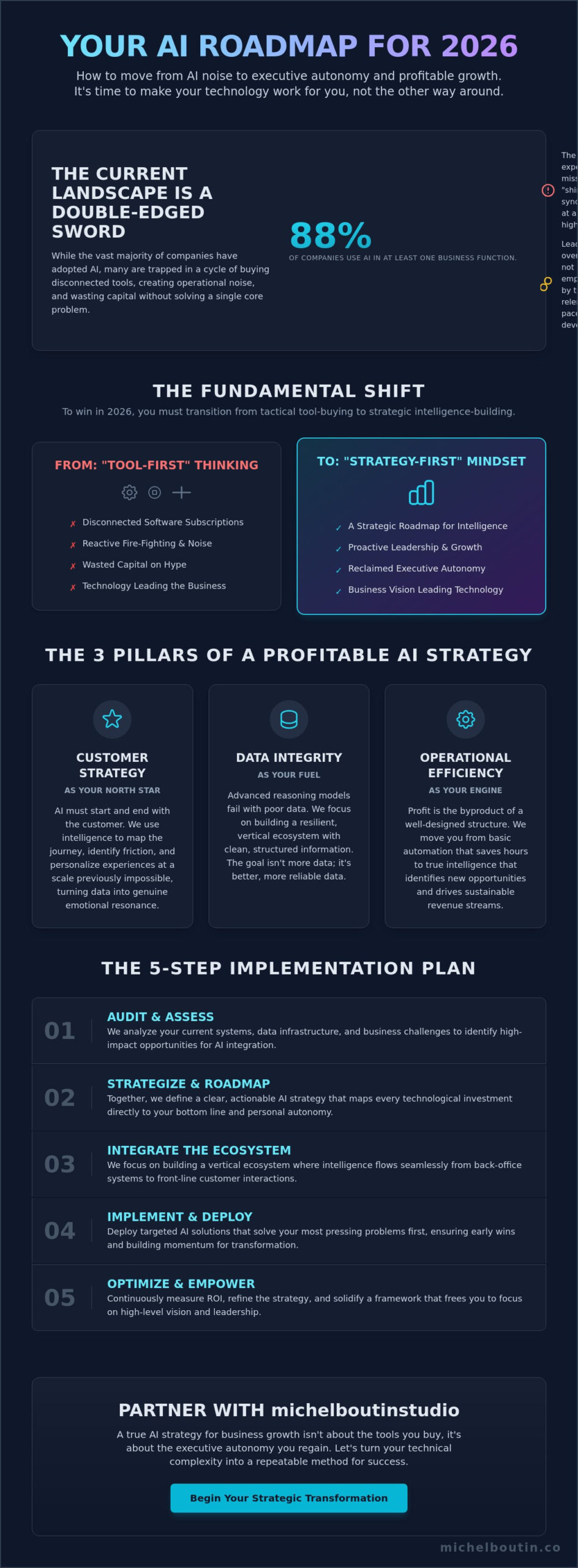
Implementing Your AI Roadmap For Scalable Growth
Execution is where vision meets reality. You have defined your pillars and avoided the common pitfalls of tool-first thinking. Now, you must act. A successful ai strategy for business growth requires a disciplined approach to deployment that prioritizes momentum over perfection. In 2026, the speed of market shifts means you cannot afford a two-year rollout. You need results in months, not years. This roadmap provides a clear path for leaders to follow starting today, ensuring every step strengthens your executive autonomy and your bottom line.
- Step 1: Audit existing customer data and pain points. Review the resilient data ecosystem we discussed earlier. Identify exactly where your customer journey breaks down.
- Step 2: Identify one high-impact use case. Focus on a specific problem, such as predictive churn analysis, that offers a clear path to revenue retention.
- Step 3: Select the right partners. Look for targeted expertise from SoTechnology that understands both the technology and your specific business vertical.
- Step 4: Pilot, measure, and refine. Run a controlled test. Gather real-world data. Adjust your approach based on actual performance rather than assumptions.
- Step 5: Scale across other business units. Once the pilot proves profitable, move the intelligence into other areas of your organization.
Scaling isn’t about doing more things. It’s about doing the right things across a larger surface area. If you want to move from operational noise to strategic pilotage, book a strategic implementation audit with our team to refine your roadmap.
Identifying High-Impact Use Cases
Choosing your first project is a strategic decision, not a technical one. You want a win that is both easy to implement and high in ROI. Many leaders find these quick wins within PRODUCT DEVELOPMENT STRATEGY SERVICES, where AI can drastically reduce the time from concept to market. Alternatively, look at your marketing and brand strategy. Can AI personalize your outreach to recover lost leads? By focusing on customer-facing impact first, you build the internal buy-in necessary for deeper digital transformation later.
Measuring Success And ROI
Your ai strategy for business growth must be held to the same financial standards as any other investment. Define your KPIs early. Customer Lifetime Value (CLV) is often the most revealing metric in 2026. If your AI agents are effectively managing workflows, you should also see a measurable increase in operational efficiency. Don’t settle for vague promises of “better engagement.” Look for specific numbers. Most successful implementations show a return on investment within six to nine months. If you don’t see movement in your core KPIs by then, your strategy needs a surgical adjustment. Precision is your greatest ally in a competitive market.
Partnering With michelboutinstudio For Strategic Transformation
Developing a robust ai strategy for business growth is a journey that requires more than technical insight. It demands a partner who understands the high-stakes environment of executive leadership. At michelboutinstudio, our philosophy is rooted in common-sense strategy designed for rapid, tangible results. We cut through the operational noise that often paralyzes decision-making in 2026. You don’t need another vendor; you need a mentor who has navigated the complexities of digital transformation across multiple industries. Our executive advisory services provide a calm, structured perspective that filters out the hype and focuses exclusively on what moves your bottom line.
True leadership isn’t about being the smartest person in the room regarding algorithms. It’s about having the clarity to direct those algorithms toward a higher purpose. To ensure your mission is clearly defined as you scale, you can learn more about Branding TITANS™. We help you bridge the gap between technical potential and commercial reality. This partnership allows you to stop managing the minutiae and start steering the ship. By integrating intelligence into your core operations, we create a system that runs with surgical precision, even when you aren’t in the office. You’ve already seen how the pillars of data and customer strategy support your vision; now it’s time to unify them.
The michelboutinstudio Approach To Innovation
With over 20 years of experience in customer strategy, we bring a depth of knowledge that software companies simply cannot match. We view MARKETING & BRAND STRATEGY as the primary growth engine for any modern enterprise. Our methods are reproducible and transparent. To suit your specific needs, we offer both fixed-fee projects for targeted transformations and retainer models for ongoing strategic oversight. This flexibility ensures that your ai strategy for business growth remains agile and responsive to the regulatory shifts we’ve seen throughout this year. We don’t just hand over a report; we help you build a vertical ecosystem that scales.
Reclaiming Your Strategic Autonomy
Why did you become a leader? It likely wasn’t to spend your days troubleshooting software or managing repetitive workflows. The ultimate promise of AI is the gift of time. We encourage a decisive shift away from daily execution toward a posture of global pilotage. When your systems are optimized, your personal autonomy increases. You gain the serenity to focus on long-term vision while your organization scales through machine-driven efficiency. It’s time to step into your role as a visionary architect. Book a consultation with michelboutinstudio to build your AI roadmap and start your transformation today.
Stepping Into Your Strategic Future
The landscape of 2026 demands more than just technical adoption. It requires a fundamental shift in how you view your role as a leader. You have seen how prioritizing strategy over software prevents wasted capital and how a robust data ecosystem fuels sustainable results. By focusing on vertical ecosystem optimization, you move from the exhausting noise of daily operations to a posture of global pilotage. A successful ai strategy for business growth is your definitive path to reclaiming the time you need for high-level vision and personal balance.
Success isn’t about the complexity of your tools; it’s about the clarity of your roadmap. With over 20 years of executive consulting experience, michelboutinstudio brings a proven track record in customer strategy and digital transformation to your corner. We specialize in turning technical potential into a repeatable method for success. It’s time to stop executing and start leading. Scale your business with a common-sense AI strategy from michelboutinstudio. Your next level of growth is ready when you are.
Frequently Asked Questions
What is an AI strategy for business growth?
An ai strategy for business growth is a high-level roadmap that aligns artificial intelligence with your core commercial objectives. It focuses on using machine reasoning to solve specific friction points in your customer journey and operational workflows. Rather than simply collecting software, this strategy ensures every technical investment drives measurable revenue and increases your executive autonomy.
Does my business need a full AI department to see results?
No, you do not need a dedicated internal department to achieve significant transformation. In 2026, most successful leaders leverage targeted expertise and agentic AI systems that handle complex workflows independently. Success depends more on your strategic vision and the rigour of your systems than on the size of your technical headcount. Focus on leadership and team development to bridge the gap.
How much does it cost to implement an AI strategy in 2026?
Initial implementation costs vary based on the scale of your organization. For small businesses with 10 to 50 employees, costs typically range from $5,000 to $50,000. Mid-sized businesses with up to 250 employees often see investments between $25,000 and $150,000 for a comprehensive rollout. These figures generally cover readiness assessments, strategy roadmaps, and pilot implementations tailored to specific business needs.
How do I ensure my AI strategy is ethical and responsible?
Compliance with current regulations is the foundation of a responsible ai strategy for business growth. You must adhere to the transparency obligations of the EU AI Act and state laws like the California AI Transparency Act (SB 942). Establishing clear governance frameworks and ensuring data integrity helps you avoid algorithmic bias while maintaining the trust of your customers and stakeholders.
What is the difference between AI and traditional automation?
Traditional automation follows rigid, pre-defined rules to perform repetitive tasks. AI differs because it can reason, plan, and adapt to new information. While automation saves time on simple execution, agentic AI manages entire workflows by making autonomous decisions. This shift from simple rules to machine intelligence allows your business to move from being reactive to being proactive.
Can AI help with customer retention and loyalty programs?
Yes, AI is exceptionally effective at identifying patterns in customer behaviour that suggest a risk of churn. By using predictive analysis, you can intervene with hyper-personalized offers before a customer leaves. These systems allow you to scale loyalty programs that feel deeply personal to every individual, significantly improving long-term retention and increasing your overall Customer Lifetime Value.
How long does it take to see ROI from an AI strategy?
Most organizations begin to see a measurable return on investment within six to nine months of implementation. This timeline allows for the initial pilot phase, data refinement, and the stabilization of new AI-driven workflows. ROI often manifests as a combination of reduced operational lag and increased revenue from improved customer strategy and more efficient product development cycles.
What should I look for in an AI strategy consultant?
Look for a partner who prioritizes your commercial outcomes over technical specifications. A credible consultant should have deep experience in vertical ecosystem optimization and a clear understanding of how systems impact executive quality of life. At michelboutinstudio, we focus on providing a common-sense approach that removes operational noise, allowing you to focus on high-level pilotage and long-term vision.
Disclaimer
Insights shared are for informational purposes and reflect professional perspective, not specific advice. Independent advice should be sought before acting on any content.