

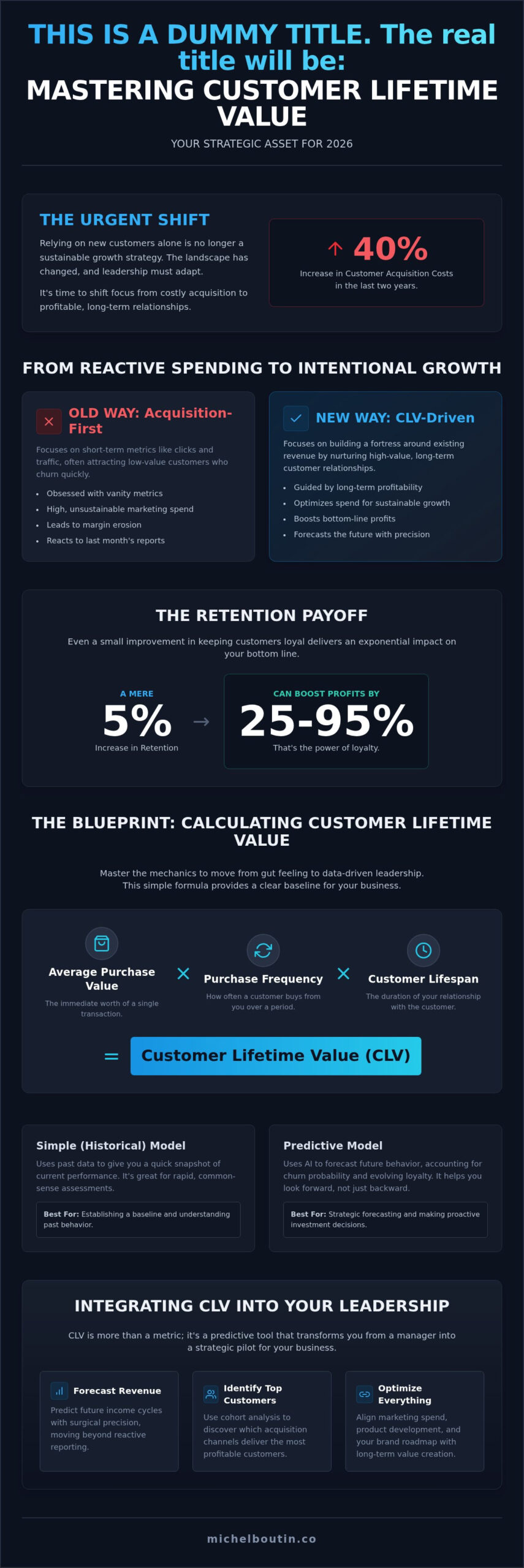
With customer acquisition costs surging by 40% in the last two years, your existing database is no longer just a list. It is your most precarious yet valuable asset. You likely feel the weight of justifying marketing spend to stakeholders while data silos prevent a clear view of the customer journey. You know that not all revenue is created equal, yet identifying which customers drive real profit remains a constant challenge. Calculating customer lifetime value is the strategic pivot that moves you from reactive spending to intentional, high-growth leadership.
We believe that true executive autonomy comes from mastering the data that defines your future. This guide shows you how to transform precise CLV calculations into a resilient customer strategy for 2026. You will gain a clear formula for CLV, learn to align your marketing spend with long-term growth, and discover methods to increase retention at a time when the average eCommerce retention rate sits at only 38%. We’ll bridge the gap between operational difficulty and strategic vision, giving you the tools to accelerate your results with calm assurance and measurable precision.
Key Takeaways
- Shift your perspective from short-term transactions to long-term profitability by using CLV as your executive North Star for 2026.
- Master the precise methods for calculating customer lifetime value using both simple historical formulas and advanced predictive models.
- Avoid the trap of “average” metrics by applying cohort analysis to identify which specific acquisition channels deliver your most profitable customers.
- Establish clear benchmarks for maximum allowable acquisition costs to ensure your marketing spend directly fuels sustainable growth.
- Transition from operational execution to strategic pilotage by integrating lifetime value data into your product and brand roadmap.
Beyond the Math: Why Calculating Customer Lifetime Value Is Your Most Strategic Asset
Customer Lifetime Value (CLV) is the total revenue your business expects to generate from a single customer account over the entire duration of your relationship. In 2026, this isn’t just a metric for your finance team. It’s the North Star for every executive decision you make. While many leaders still obsess over vanity metrics like cost per click or total web traffic, these numbers often mask underlying inefficiencies. High traffic is meaningless if it attracts low-value accounts that churn before you break even. By calculating customer lifetime value, you move beyond surface-level noise and begin to see the true health of your enterprise.
The Shift from Acquisition to Retention
The Australian market is becoming increasingly crowded. Customer acquisition costs have surged by 40% over the past two years, making the hunt for new leads more expensive than ever. Relying solely on acquisition is a recipe for margin erosion. This is where your focus must shift. A Comprehensive guide to Customer Lifetime Value reveals that even a modest 5% increase in customer retention can boost bottom-line profits by anywhere from 25% to 95%. When you understand the long-term worth of your clients, you gain the assurance calm needed to stop chasing every lead and start nurturing the ones that actually matter. It’s about building a fortress around your existing revenue streams.
CLV as a Predictive Leadership Tool
Leaders who master calculating customer lifetime value stop reacting to last month’s reports and start forecasting the future with surgical precision. This data allows you to predict revenue cycles and identify which segments of your vertical ecosystem are ripe for expansion. It empowers you to make bolder investment decisions because you aren’t guessing at the return. You know exactly what a customer is worth before they even make their second purchase. This shift from reactive management to proactive ecosystem optimization is the hallmark of a sophisticated customer strategy consultant australia. You’re no longer just running a business; you’re piloting a high-growth engine with a clear view of the horizon. Understanding these patterns allows you to allocate resources where they’ll generate the highest compound interest over time, ensuring your leadership remains both visionary and deeply structured.
The Blueprint: Formulas for Calculating Customer Lifetime Value Accurately
Precision in leadership requires precision in measurement. To move from gut feeling to strategic pilotage, you must first master the mechanics of calculating customer lifetime value. At its most fundamental level, the formula is simple. You multiply Average Purchase Value by Purchase Frequency, then multiply that result by the average Customer Lifespan. This calculation provides a baseline for your vertical ecosystem. It reveals the raw revenue potential of every individual who enters your brand’s orbit.
Three critical variables drive this engine. Average Order Value (AOV) tells you the immediate worth of a transaction. Purchase Frequency measures the strength of the habit you’ve built. Customer Lifespan indicates the endurance of the relationship. To capture these data points accurately, a robust digital transformation is essential. Without integrated systems, your data remains siloed and your vision stays blurred. Real-time tracking turns these static numbers into a dynamic dashboard for growth.
The Simple vs. Predictive Calculation
The simple formula works best for rapid, common-sense assessments. It gives you a snapshot of current performance. However, for businesses operating in complex digital environments, a predictive model is necessary. As outlined by IBM’s insights on calculating customer lifetime value, predictive models leverage AI to account for variables like churn probability and evolving loyalty patterns. They look forward, not just backward. Don’t let the complexity intimidate you. Consistency in how you collect data is far more vital than the complexity of the math itself. If you’re struggling to bridge this technical gap, discussing your data structure with a specialist can provide the clarity you need to move forward.
Accounting for Customer Acquisition Cost (CAC)
CLV doesn’t exist in a vacuum. It must be measured against what you spend to win the customer in the first place. In 2026, the benchmark for a healthy, sustainable business is a CLV:CAC ratio of 3:1. This means for every A$1 you spend on marketing and sales, you should expect A$3 in lifetime value. If your ratio drops toward 1:1, your acquisition strategy is likely eroding your long-term profit. You’re effectively buying revenue at a loss. Monitoring this ratio allows you to maintain the serenity of knowing your growth is profitable, not just performative. It gives you the permission to scale with confidence.
From Data to Insight: Segmenting Your Customer Base for Maximum ROI
Averages lie. They smooth out the peaks and valleys of your business, leaving you with a flat, unhelpful landscape. If your result from calculating customer lifetime value is a single number for the whole company, you’re missing the strategic nuances that drive growth. Treating a one-time bargain hunter the same as a decade-long brand advocate is a waste of resources. True leadership requires you to look deeper into the data to see where the real value resides.
Cohort analysis is your most powerful tool for this. By grouping customers based on their acquisition channel or the date of their first purchase, you uncover patterns that an average would hide. You might find that customers acquired through organic referrals have a CLV 50% higher than those from paid social ads. This insight allows you to double down on what works. Identifying your ‘Whales’ is equally vital. In most Australian enterprises, the top 20% of customers drive 80% of the total profit. Once you know who these people are, you can leverage product development strategy services to build tailored offerings that deepen their loyalty and increase their value even further.
The RFM Model: Recency, Frequency, Monetary
Identifying the ‘Profit Killers’
Not every customer is worth keeping. Some accounts are ‘Profit Killers’—they demand heavy discounts, flood your support lines, and return products at high rates. These individuals often have a negative CLV. When you finish calculating customer lifetime value for these segments, the numbers will be stark. You must have the courage to ‘fire’ these customers or at least stop spending to acquire them. Refining your marketing & brand strategy to exclude these low-value segments is not just a cost-saving measure. It’s a strategic necessity that frees up your operational resources to serve the clients who actually fuel your progress. This is how you achieve the serenity of a truly optimized vertical ecosystem.
Strategic Integration: Applying CLV to Your Product and Marketing Roadmap
Mastering the mechanics of calculating customer lifetime value is only the beginning. The real transformation occurs when you stop treating CLV as a retrospective report and start using it as a filter for every future decision. Your roadmap should be a reflection of your most valuable customers’ needs. If a proposed product feature doesn’t directly increase purchase frequency or extend the customer lifespan, you must question its place in your strategy. This is how you move from a cluttered list of “nice-to-haves” to a lean, high-growth engine.
Your CLV data dictates your maximum allowable acquisition cost (CAC) for different product lines. It’s a fundamental error to set a flat CAC across your entire portfolio. If your premium service tier has a CLV of A$5,000 while your entry-level product sits at A$400, your marketing spend must reflect that disparity. Loyalty programs also play a tactical role here. They aren’t just about discounts. They are structured systems designed to artificially yet effectively extend the customer lifespan, ensuring your vertical ecosystem remains robust against competitors. To ensure this vision is executed at every level, aligning your team through TRAIN THE TRAINER programs is essential. Change only sticks when your leaders possess the psychology to propel that expertise downward.
Optimizing the Vertical Ecosystem
A healthy vertical ecosystem has no dead ends. By calculating customer lifetime value across different segments, you quickly identify where customers are dropping out of your orbit. These gaps are your biggest opportunities for cross-selling and up-selling. If a customer buys Product A but never moves to Product B, there’s a friction point in your journey. A common-sense approach to fixing these leaks always beats complex, expensive software. Focus on the human experience and the logical progression of value. If you’re ready to identify these gaps in your own business, reach out for a strategic review of your customer journey.
Budget Allocation Based on Value
The days of fixed, “set and forget” marketing budgets are over. In 2026, executive autonomy comes from the ability to reallocate spend in real-time based on performance. You should move capital from low-CLV channels to high-CLV channels the moment the data signals a shift. This value-based budgeting ensures that every A$1 spent is optimized for long-term growth rather than short-term spikes. This shift doesn’t just improve your bottom line. It creates a culture of operational efficiency where your team focuses on the quality of acquisition, not just the quantity. You stop being a passenger to your marketing reports and start acting as the pilot of your organization’s destiny.
When your business is optimized for long-term growth, it becomes a more valuable asset for future transition; to explore how to prepare for this, you may visit Cordier Capital for specialist exit strategy planning.
To turn this data into a high-performance roadmap, you can explore Marketing Strategy and Execution with Fresh Faced, an agency that specializes in evidence-led growth strategies.
Scaling Success: How michelboutinstudio Transforms Metrics into Market Leadership
Data alone is silent. It requires the surgical precision of an expert lens to transform a column of figures into a roadmap for market dominance. At michelboutinstudio, we specialize in bridging the gap between raw metrics and decisive executive action. While calculating customer lifetime value is a technical hurdle for many, for us, it’s the foundational pulse of a resilient vertical ecosystem. We don’t just hand you a spreadsheet. We provide the strategic framework to act on it with absolute confidence.
With over 20 years of industry experience across retail and finance, we’ve seen the patterns that emerge behind the numbers. We understand that a high CLV is not an accident; it is the result of a deeply structured customer strategy. This depth of perspective allows us to see beyond the immediate transaction to the long-term potential of your client base. We transform your data into a clear path toward strategic autonomy, allowing you to focus on high-level growth while your systems handle the execution.
Pragmatic Consulting for 2026
Our approach is built on rapid results and common-sense business strategies. In 2026, you don’t have time for vague discovery phases or theoretical models that never reach the shop floor. You need movement. We help you shift from the exhaustion of executing daily tasks to the serenity of piloting a global strategy. This transformation requires more than just better math. It requires leadership and team development. We work with your people to ensure your organization is as visionary as its leader, creating a culture where every team member understands their role in driving customer value. This is how you reclaim your time and your peace of mind.
Your Next Step to Strategic Growth
The most dangerous decision you can make in the current market is to wait. If you haven’t audited your customer lifetime value recently, you’re likely flying blind. With acquisition costs rising and retention rates in eCommerce sitting at a precarious 38%, the time for a precision-guided audit is now. Whether through project-based advisory or a long-term retainer, our services are designed to fit your specific operational needs. We invite you to begin the process of vertical ecosystem optimization today. It is the first step toward reclaiming your strategic autonomy and securing your firm’s long-term profitability. Let’s discuss how we can turn your data into your greatest competitive advantage.
Mastering the Pilotage of Your Customer Ecosystem
The transition from executing daily tasks to piloting a high-growth organization begins with a fundamental shift in perspective. You’ve moved beyond vanity metrics to embrace a more profound truth: your profit lives within the longevity of your client relationships. By calculating customer lifetime value, you’ve established a North Star that guides your budget, your product roadmap, and your team’s focus. You now possess the clarity to distinguish between the ‘Whales’ who fuel your progress and the ‘Profit Killers’ who drain your operational serenity.
True strategic autonomy isn’t built on complex math alone. It requires the experience to see the patterns behind the numbers. With over 20 years of executive consulting expertise, we help leaders in retail, automotive, and financial services optimize their vertical ecosystems for sustainable growth. Don’t let your data remain silent while acquisition costs continue to rise. Book a strategic consultation with michelboutinstudio to optimize your customer value and secure your position as a market leader. Your path to a more structured, profitable future is ready. Take the first step toward the results you deserve.
Frequently Asked Questions
What is the most accurate way of calculating customer lifetime value in 2026?
The most accurate method in 2026 is using predictive modeling that integrates machine learning to forecast future behavior rather than relying solely on historical data. This approach accounts for churn probability and evolving customer habits within your digital ecosystem. While simple formulas provide a snapshot, predictive analysis offers the strategic foresight needed for high-level pilotage. It transforms raw data into a reliable map for long-term growth and executive autonomy.
How does customer acquisition cost (CAC) impact my CLV calculation?
Customer acquisition cost serves as the critical filter for your CLV’s actual profitability. If your acquisition spend exceeds the value a customer brings over their lifespan, your growth is performative rather than sustainable. You must subtract your total acquisition and service costs from the gross revenue to understand your net lifetime value. This ensures your marketing strategy remains aligned with the reality of your bottom line and vertical ecosystem health.
Can I calculate CLV if my business has a multi-location network?
You can calculate CLV across a multi-location network by integrating your point-of-sale systems into a single, unified customer view. In Australia, regional variations in purchase frequency and order value can skew your national averages. Segmenting your data by location allows you to identify which territories yield your highest-value accounts. This precision helps you allocate resources to the specific regions that drive the most significant long-term profit.
What is a good CLV to CAC ratio for a growing start-up?
A 3:1 ratio is the industry benchmark for a healthy, growing start-up in the Australian market. This means the lifetime value of a customer is three times the cost of acquiring them. If your ratio is 1:1, you’re spending too much to break even. If it’s higher than 5:1, you might be under-investing in growth. Maintaining this balance provides the serenity of knowing your expansion is financially sound.
How often should an executive team review their CLV metrics?
Your executive team should review CLV metrics at least once per quarter to ensure strategic alignment. However, your marketing and operational teams should monitor these figures monthly to catch shifts in customer behavior early. Regular reviews prevent data silos from forming and keep your leadership team focused on high-value segments. This rhythm ensures your vertical ecosystem remains optimized and responsive to market changes in real-time.
What are the common mistakes when calculating customer lifetime value?
The most frequent error when calculating customer lifetime value is relying on a single company-wide average that masks segment-specific losses. Leaders also often forget to account for the cost of servicing a customer after the initial sale. Ignoring churn rates or failing to update your lifespan projections as market conditions change leads to inflated, dangerous revenue forecasts. Precision requires looking at cohorts, not just the total database.
How can digital transformation improve the accuracy of my customer data?
Digital transformation acts as the engine for data accuracy by removing manual entry errors and silos that plague traditional systems. It allows for real-time data flow between your marketing, sales, and service departments. This integration ensures that when calculating customer lifetime value, you’re using the most current and comprehensive information available. Clean data is the prerequisite for the strategic pilotage and autonomy we advocate for in leadership.
Does increasing my product price always increase my CLV?
Increasing your product price only raises CLV if it doesn’t cause a disproportionate drop in purchase frequency or customer lifespan. While a higher price point boosts the average order value, it can also trigger churn among price-sensitive segments. You must model the impact of price changes on your overall retention rates before implementation. A pragmatic leader values the total value of the relationship over the margin of a single transaction.
Disclaimer
Insights shared are for informational purposes and reflect professional perspective, not specific advice. Independent advice should be sought before acting on any content.