

What if your current revenue model is the very thing holding your leadership hostage? In 2026, many executives find themselves trapped in the engine room when they should be at the helm. You feel the pressure of margin compression and the constant friction of products that don’t quite hit the mark for your customers. It’s a common cycle, but it’s one you can break by examining successful business model innovation examples that prioritize value capture over raw effort.
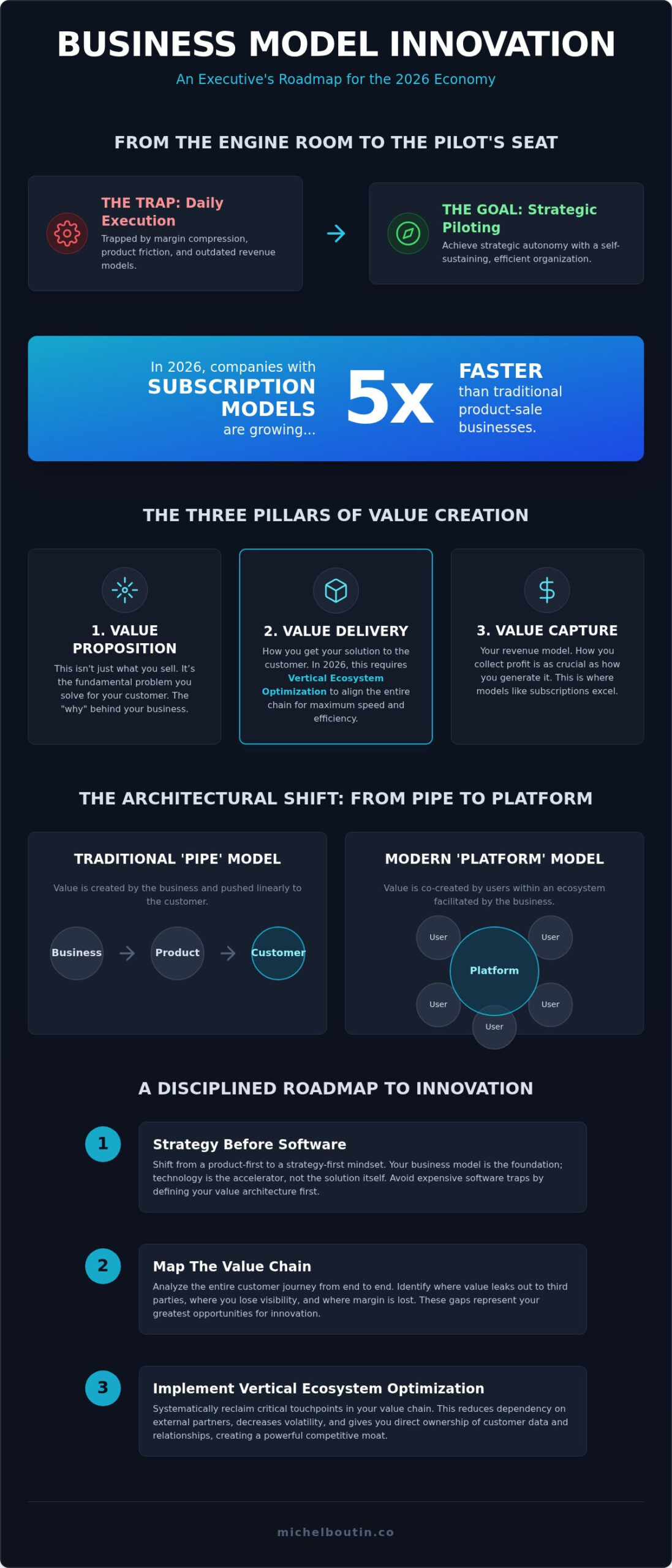
We understand that you want more than just performance; you want the serenity that comes with a self-sustaining organization. At michelboutinstudio, we’ve seen that companies with subscription models are now growing five times faster than traditional businesses. This guide promises to help you master your value architecture to drive strategic autonomy and sustainable growth. You’ll discover how to shift from daily execution to high-level piloting through Vertical Ecosystem Optimization. We’ll explore a clear roadmap to increase your profitability while building a business that operates with surgical efficiency, even when you aren’t in the room.
Key Takeaways
- Transition your organization from a product-centric approach to a strategy-first architecture to secure your competitive edge in the 2026 economy.
- Analyze industry-leading business model innovation examples to identify untapped revenue streams and more effective ways to deliver customer value.
- Follow a disciplined roadmap that prioritizes strategy before software to avoid the common trap of margin compression and operational friction.
- Apply Vertical Ecosystem Optimization to streamline your value chain and finally move from the engine room to the pilot’s seat.
- Discover how michelboutinstudio provides the external perspective needed to transform your business model into a repeatable, efficient system.
What Is Business Model Innovation In The 2026 Economy?
Business model innovation is not a minor adjustment to your marketing plan or a simple software update. It is the fundamental redesign of how you create, deliver, and capture value. While incremental improvements focus on doing the same things slightly better, Business Model Innovation focuses on doing different things that make the old ways obsolete. In 2026, the distinction is clear. If you are only optimizing existing processes, you are merely managing a slow decline. To thrive, you must rethink your entire value architecture.
The 2026 economy demands a shift from product-first to strategy-first thinking. We see many leaders stuck in the execution phase because they’ve built their business around a specific product rather than a core customer strategy. When the market shifts, the product becomes a liability. By studying successful business model innovation examples, it becomes evident that the most resilient companies are those that prioritize their strategic position over their current inventory. At michelboutinstudio, we believe this innovation is the essential precursor to any effective digital transformation.
The Three Pillars Of Value Creation
To redesign your model, you must address three specific areas. First is your Value Proposition. This isn’t just what you sell, but the actual problem you solve for the customer. Second is Value Delivery. In 2026, this involves Vertical Ecosystem Optimization, ensuring every part of your supply and distribution chain is aligned for maximum speed. Many business model innovation examples in the retail sector highlight how this optimization reduces dependency on third-party logistics. Finally, there is Value Capture. This is your revenue model. With subscription models now growing five times faster than traditional sales in Australia, how you collect profit is as important as how you generate it.
Why Executives Must Lead The Innovation Process
You cannot delegate structural change to a middle manager. Moving from the engine room to the cockpit of your organization requires an executive perspective that balances long-term vision with operational reality. Innovation acts as your primary tool for risk mitigation. By diversifying how you capture value, you protect the business from volatile market swings. This process requires a psychological shift. You must be willing to challenge legacy systems that once brought success but now create friction. michelboutinstudio helps you bridge this gap, transforming your expertise into a reproducible method for strategic autonomy.
The Architecture Of Value: Beyond Product Development
A superior product is no longer a guarantee of market survival. We’ve seen countless examples where technical excellence was overshadowed by a rigid, outdated business model. In 2026, your product development strategy must be inextricably linked to your value architecture. Without this alignment, you’re simply building faster engines for a ship that’s heading in the wrong direction. You must ask yourself: is your product serving the model, or is the model struggling to support the product?
Consider the fundamental shift from ‘Pipe’ to ‘Platform’ models. Traditional ‘pipes’ push value linearly from the business to the customer. Platforms, however, create ecosystems where users create value for each other. For many Australian businesses, this shift represents one of the most potent business model innovation examples. It moves you away from being a mere supplier and positions you as the indispensable infrastructure of your industry. This transition requires deep operational optimisation before any technology is even considered. You can’t scale a platform on a foundation of inefficient manual processes.
Vertical Ecosystem Optimization
Vertical Ecosystem Optimization means taking command of the customer journey from end to end. It’s about identifying where value leaks out to third parties and reclaiming those touchpoints. By integrating vertically, you reduce your dependency on external market fluctuations and volatile shipping costs. This isn’t just about owning the supply chain; it’s about owning the data and the relationship. Start by mapping your current journey. Where do you lose visibility? Where do you lose margin? These gaps are your greatest opportunities for structural innovation. If you want to explore how these systems apply to your specific industry, you might consider reaching out to discuss your strategic roadmap with a partner who understands these complexities.
Digital Transformation As An Enabler
Digital transformation is the engine of your new model, but it’s never the starting point. At michelboutinstudio, we often see leaders make the mistake of digitizing a broken process. This only creates an expensive, digital mess. Instead, use digital transformation to validate new revenue streams. Use real-time data to test a subscription tier or an outcome-based billing model before a full-scale rollout. This evidence-based approach ensures that your innovation is grounded in actual customer behavior, not just executive intuition. It’s about building a business that is both agile and profoundly stable. This structural clarity allows you to lead with confidence, knowing your systems are built for the 2026 economy.
Industry-Leading Business Model Innovation Examples
Studying the right business model innovation examples reveals a common truth. Success in 2026 isn’t about the product itself, but about the relationship you build through that product. Most competitors fail because they focus on the “what.” You must focus on the “why.” By shifting from a transactional mindset to a relational one, you create a business that is both resilient and highly profitable. Beyond internal restructuring, many organizations also leverage strategic acquisitions to redefine their market presence; for instance, you can discover PP-X to see how they guide firms through this growth process. Let’s look at how leaders in retail, automotive, and finance have redesigned their value architecture to achieve this.
From Ownership To Access: The Subscription Pivot
Adobe remains one of the most powerful business model innovation examples. By moving from expensive, one-off licenses to the Creative Cloud subscription, they traded lumpy revenue for a predictable, recurring stream. In 2026, this “everything-as-a-service” reality provides a vital safety net for executives. It allows you to invest in long-term development without the constant pressure of the next big launch. Executive Takeaway: Predictability in revenue creates the mental space needed for strategic leadership.
Direct-To-Consumer (DTC) In Traditional Sectors
Automotive manufacturers are increasingly bypassing traditional dealership friction to sell directly to the driver. This shift removes the middleman and gives the brand total control over the customer experience and the resulting data. While managing a multi-location delivery network is complex, the increase in margin and brand loyalty is undeniable. You’re no longer just a manufacturer; you’re a service provider. Executive Takeaway: Removing friction from the customer journey is the fastest way to capture lost value.
The Freemium To Premium Ladder
In the financial sector, we see firms offering free, high-value budgeting tools to attract a broad audience. These tools serve as a project-based entry point. Once trust is established, the firm upsells the user into a retainer-based advisory model. This laddering approach ensures you aren’t wasting marketing spend on cold leads. You’re nurturing a relationship that pays dividends over years, not days. Executive Takeaway: Use low-barrier entry points to demonstrate your expertise and lead into long-term strategic partnerships.
At michelboutinstudio, we help you identify which of these models fits your specific ecosystem. Whether you’re in retail or financial services, the goal remains the same. You want to move from being an executer of tasks to a pilot of a high-performance system. These examples aren’t just stories; they are blueprints for your own transformation. It’s time to decide which architecture will support your growth for the next decade.
How To Implement Business Model Innovation: An Executive Roadmap
Just as businesses are optimizing their vertical ecosystems, high-income leaders are increasingly seeking similar consolidation in their personal affairs; you can check out Kotini & Kotini to see how a boutique virtual family office manages tax, wealth, and risk to provide true strategic autonomy.
Transitioning to a new value architecture often feels like changing the engines of an aircraft while in flight. The primary objection we hear from leadership teams is the perceived risk of destabilizing what already works. You must manage this fear through a structured process that prioritizes strategy before software. Buying new technology to solve a structural problem only accelerates your existing inefficiencies. True innovation requires a shift in the psychology of your leadership team. You aren’t just changing a process; you’re evolving your identity from an executer to a pilot who values strategic autonomy.
Step 1 & 2: Audit And Customer Research
Your journey begins by identifying where your current model leaks profit and where your customers experience friction. These leaks are often hidden in outdated revenue structures or inefficient distribution channels. By applying sophisticated customer research techniques, you can validate your assumptions about what your market actually values in 2026. An Innovation Audit acts as a surgical diagnostic tool to pinpoint structural weaknesses in your 2026 value architecture. This phase ensures your pivot is grounded in data rather than intuition.
Step 3 & 4: Prototyping And Ecosystem Mapping
Don’t just build a Minimum Viable Product; build a Minimum Viable Model. This allows you to test your value capture and delivery systems on a small scale before a full rollout. While looking at business model innovation examples provides inspiration, your roadmap must be tailored to your specific operational constraints. You must map your vertical ecosystem to ensure every stakeholder is aligned with the new direction. During this pivot, executive coaching plays a vital role in keeping the vision clear and preventing the team from retreating into old habits when challenges arise.
Step 5: Scaling For Strategic Autonomy
The final step is to move from ad-hoc innovation projects to a systematic engine that runs without your constant intervention. This reduces your operational load and allows the business to function with less founder-dependency. You must set new KPIs that measure value capture and margin health rather than just top-line revenue. This systematic approach transforms your organization into a self-sustaining asset. If you’re ready to stop the execution grind and start leading with surgical precision, it’s time to discuss your executive roadmap with michelboutinstudio.
Scaling Autonomy Through michelboutinstudio Advisory
Why do most structural changes fail within the first six months? It isn’t usually a lack of effort or budget. It’s a lack of perspective. When you’re deep in the daily operations of your business, identifying your own structural blind spots is nearly impossible. michelboutinstudio acts as your strategic partner, providing the external clarity required to move from the execution grind to a posture of global pilotage. We don’t offer generic templates or complex jargon. We offer a proven method to rethink your value architecture with surgical precision.
You don’t need another software dashboard to manage your stagnation. You need a strategic partner who has walked this path before. By providing an objective Executive Advisory perspective, we help you step back from the engine room to see the entire horizon. Our project-based consulting provides a clear, actionable roadmap that removes the guesswork from your transformation. We’ve analyzed hundreds of business model innovation examples to distill what actually drives sustainable growth in the 2026 economy. This evidence-based approach ensures that every change we implement is grounded in market reality and operational logic.
The michelboutinstudio Approach To Innovation
Our approach is built on over 20 years of industry experience across retail, automotive, and financial services. We prioritize pragmatic, common-sense strategies that yield rapid results. By leveraging lessons learned from successful business model innovation examples, we focus on the intersection of customer strategy and operational efficiency. We use Vertical Ecosystem Optimization as our primary differentiator. This ensures your organization captures the maximum possible value from every interaction. We don’t just help you grow; we help you build a business that runs with less founder-dependency and higher strategic autonomy.
Next Steps: From Strategy To Results
Engaging with us is a commitment to your own progression and the health of your organization. You can choose to partner with us through project-based advisory for specific pivots or retainer-based models for ongoing strategic support. The first 90 days of a business model transformation are critical. During this window, we move quickly from audit to prototype, ensuring your team sees tangible progress. We focus heavily on the psychology of change. We understand that for a new model to succeed, your leadership team must embrace a new way of thinking about value. Are you ready to stop managing the engine and start piloting the ship? The transition to strategic autonomy begins with a single, decisive step. Contact michelboutinstudio today to begin your transformation.
Take Command Of Your Strategic Future
The 2026 economy doesn’t reward those who simply work harder; it rewards those who architecture their value more effectively. You’ve seen how powerful business model innovation examples shift the focus from transactional sales to deep, recurring customer relationships. By mastering Vertical Ecosystem Optimization, you finally detach yourself from the friction of daily execution and reclaim your role as a visionary pilot.
At michelboutinstudio, we bring over 20 years of executive leadership experience to help you navigate this transition. Our fixed-fee project roadmaps provide clear deliverables, ensuring your transformation is as structured as it is impactful. Don’t let another quarter pass while you’re trapped in the engine room. It’s time to elevate your perspective and secure your strategic autonomy. Your path to a more serene and profitable leadership starts with a single decision to act.
Book a Strategic Consultation with michelboutinstudio today to design a business that thrives on efficiency and growth.
Frequently Asked Questions
What is the best business model innovation example for a small business?
Transitioning from one-off sales to a “Service-as-a-Service” model is often the most effective route. For instance, a small retail shop might launch a curated monthly subscription box. This provides predictable cash flow and deeper customer loyalty. By looking at business model innovation examples in the micro-SaaS space, small firms can adopt hyper-verticalized strategies that solve niche problems with surgical precision. This shift moves you from competing on price to competing on unique value.
How do I know if my current business model is outdated in 2026?
Your model is likely outdated if you experience consistent margin compression despite increasing your sales volume. Another red flag is finding your leadership team stuck in the engine room of daily execution instead of piloting the business. If your product development feels disconnected from actual customer needs, it’s a sign your value architecture is broken. In 2026, a healthy model should drive strategic autonomy and allow the business to run with minimal founder-dependency.
Can business model innovation work in traditional industries like retail or finance?
Structural innovation is essential in retail and finance to survive the 2026 economy. Retailers are successfully adopting circular economy models where they buy back and resell used goods to capture secondary market value. Financial firms are using freemium tools to lead customers into high-value advisory retainers. These business model innovation examples prove that even the most established sectors can find new ways to deliver and capture value by prioritizing customer strategy over legacy systems.
What is the difference between product innovation and business model innovation?
Product innovation focuses on improving the “what” you’re selling, such as adding a new feature to a piece of equipment. Business model innovation focuses on the “how” you create, deliver, and capture value. For example, selling that same equipment through a monthly subscription instead of a one-time purchase is a model shift. While a better product might gain temporary attention, a superior business model creates a sustainable competitive advantage that is much harder for competitors to replicate.
How much does it cost to implement a new business model?
The cost varies significantly based on the scale of your organization and the depth of the pivot required. It’s vital to remember that strategy should always come before software. Investing in expensive digital tools before you’ve redesigned your value architecture is a common way to waste capital. At michelboutinstudio, we focus on fixed-fee project roadmaps. This ensures you have clear deliverables and a predictable budget for your transformation without the risk of scope creep or hidden fees.
How long does it take to see results from business model innovation?
You can often see the first tangible results within a 90-day window. This period allows for an initial audit, customer research, and the launch of a Minimum Viable Model. While a full structural transformation of a large organization may take 12 to 18 months, early indicators like improved customer retention or higher margins on new service tiers appear much sooner. Speed is a byproduct of clear strategic alignment and a commitment to rapid, common-sense execution by your leadership team.
Is business model innovation the same as digital transformation?
These concepts are related but distinct. Business model innovation is the precursor that defines your strategic direction and value architecture. Digital transformation is the “how” that enables that model through technology and data. You shouldn’t digitize a broken model; you should innovate the model first and then use digital tools to scale it. At michelboutinstudio, we ensure your technology investments are always driven by a robust, future-proof strategy for the 2026 market.
Do I need a consultant to help with business model innovation?
While you can attempt this internally, an external partner provides the objective perspective needed to identify hidden structural flaws. Executives are often too close to their legacy systems to see where they create friction. michelboutinstudio acts as a strategic mentor, bringing over 20 years of experience and a reproducible method for transformation. This partnership helps you avoid common pitfalls and accelerates your journey toward operational efficiency and long-term strategic autonomy for your business.
Disclaimer
Insights shared are for informational purposes and reflect professional perspective, not specific advice. Independent advice should be sought before acting on any content.