
What if your company could finally grow faster while you actually worked less? Most leaders find themselves trapped in the daily grind of execution, watching their vision get buried under operational bottlenecks and inconsistent customer results. You know that improving business processes is the key to scaling, yet it often feels like just another task on an already overflowing plate. It’s exhausting to feel like the engine of your own company rather than its pilot. At michelboutinstudio, we understand that this friction isn’t just a management issue. It’s a barrier to your personal and professional freedom.
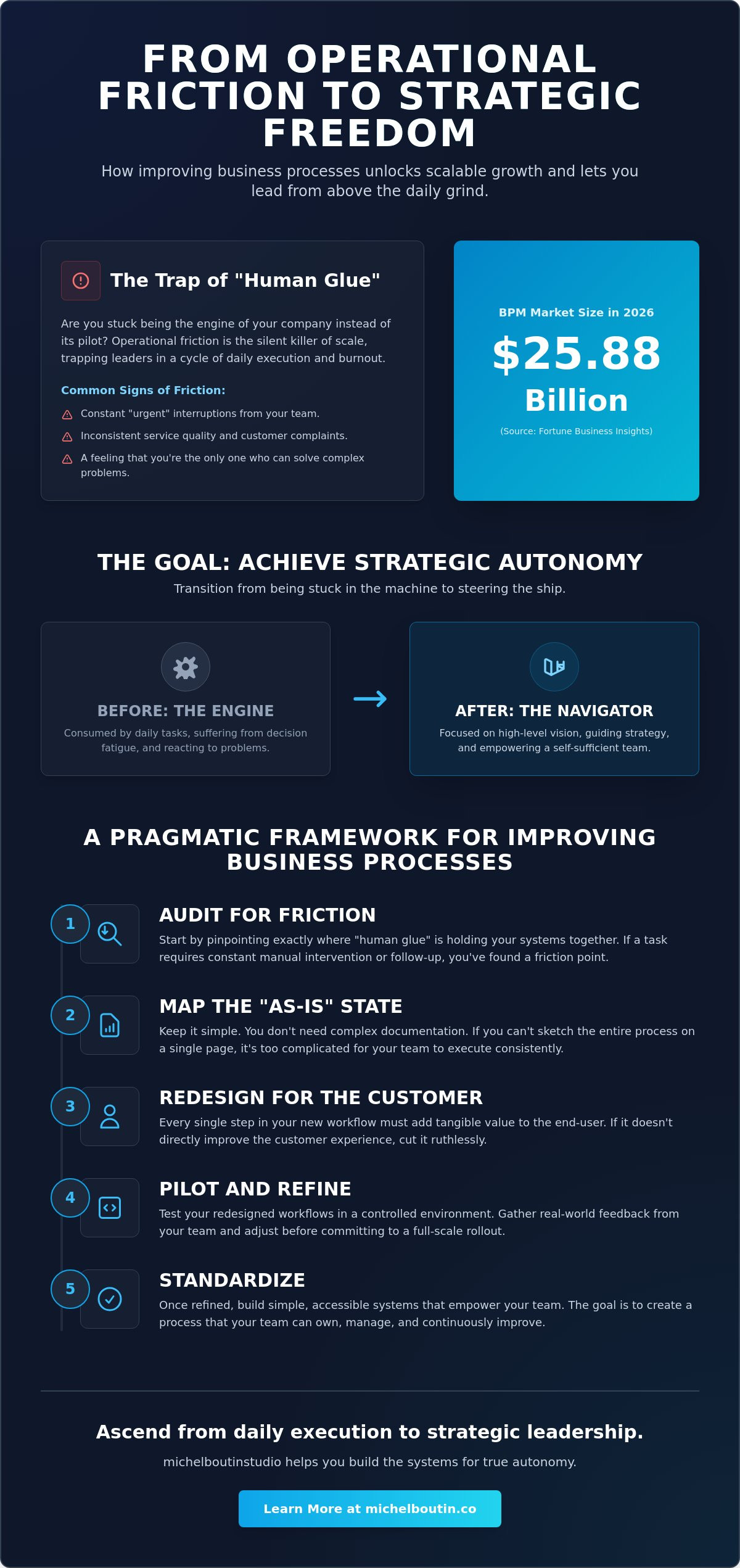
With the global Business Process Management market projected by Fortune Business Insights to reach $25.88 billion here in 2026, the tools for transformation have never been more effective. We’ll show you how to move beyond intuition and embrace evidence-based systems that run with surgical precision. You’ll discover how to transform these operational hurdles into a streamlined vertical ecosystem. This shift grants you the autonomy to lead from a strategic level. We’ll explore how integrating task-specific AI agents and unified orchestration can turn your business into a predictable, customer-centric growth machine that operates profitably without your constant intervention.
Key Takeaways
- Identify the hidden costs of “human glue” and how operational friction prevents you from reaching your true strategic vision.
- Master a pragmatic two-step framework for improving business processes that prioritizes immediate clarity over complex, heavy documentation.
- Learn why optimizing your vertical ecosystem is essential to prevent siloed improvements from creating new bottlenecks elsewhere in the organization.
- Discover how to overcome cultural resistance and secure leadership buy-in to ensure your process transformations lead to lasting change.
- Transition from the exhaustion of daily execution to the serenity of a high-level strategic advisory role with michelboutinstudio.
Table of Contents
-
Understanding The Hidden Cost Of Operational Friction In 2026
-
Ascending From Execution To Strategic Leadership With Michelboutinstudio
Understanding The Hidden Cost Of Operational Friction In 2026
Operational friction is the silent killer of scale. It’s the gap between the vision you hold for your company and the reality of daily execution. When you spend your morning unblocking a workflow that should be automated, you aren’t just losing time. You’re losing momentum. This friction is often a byproduct of outdated business process management that fails to account for the speed of the 2026 market. If your systems haven’t evolved to handle the complexity of modern digital ecosystems, they’re likely dragging you down rather than lifting you up.
Don’t mistake motion for progress. Many executives fall into the "Busy-ness Trap," where a calendar full of meetings feels like strategic advancement. It’s an illusion. If your presence is required for the business to breathe, you haven’t built a company; you’ve built a high-stress job. Improving business processes isn’t about doing things faster. It’s about building a system that achieves Strategic Autonomy. This is the state where the business operates predictably and profitably while you focus on high-level vision. You move from being the engine to being the navigator.
Common signs of operational friction in your organization include:
-
Constant "urgent" interruptions from your leadership team.
-
Customer complaints regarding inconsistent service quality.
-
A feeling that you’re the only one who can solve complex problems.
-
Growth that feels heavy and expensive rather than fluid.
The Executive Burnout Cycle
Manual intervention in low-level tasks is a slow poison. Every time you step in to fix an execution error, you consume a piece of your cognitive bandwidth. This leads to decision fatigue. By the time you need to make a pivot or innovate for 2027, your creative engine is empty. In 2026, leadership requires agility. You can’t be agile if you’re weighed down by the "human glue" holding broken systems together. Improving business processes is the only way to break this cycle and reclaim your mental energy for the work that actually moves the needle. Reclaiming this focus also allows you to prioritize family health; for those seeking expert support, you can explore Individual Therapy for Children through Balanced Minds Psychology & Wellness.
The Customer Experience Penalty
Internal bottlenecks always bleed through to the client. When your team is struggling with fragmented data or manual handovers, the customer feels the friction. It shows up as delayed responses, inconsistent service, and a fractured brand voice. These aren’t just minor inconveniences. They’re direct drivers of churn in an increasingly competitive national market. To protect your brand equity, your operations must align perfectly with a robust customer strategy. A streamlined back-end is the foundation of an exceptional front-end experience.
A Pragmatic Framework For Improving Business Processes
Improving business processes shouldn’t feel like a technical chore. It’s a strategic realignment. When executives look at What is Process Improvement?, they often find complex methodologies like Six Sigma or Lean. While these have their place, your priority in 2026 is speed and clarity. You need a framework that moves the needle today without burying your team in documentation. Efficiency is a byproduct. Autonomy is the goal.
The journey toward operational freedom follows five pragmatic steps:
-
Step 1: Audit for friction. Identify where "human glue" is currently holding your systems together. If a task requires manual data entry or constant follow-up, it’s a friction point.
-
Step 2: Map the "as-is" state. Keep it simple. If you can’t sketch the process on a single page, it’s too complex for your team to follow consistently.
-
Step 3: Redesign for the customer. Every step in your workflow must add value to the end-user. If it doesn’t, cut it.
-
Step 4: Pilot and refine. Test your new workflows in a controlled environment. Gather feedback and adjust before committing to a national rollout.
-
Step 5: Standardise. Build simple, accessible systems that empower your team to own the outcome.
Auditing For High-Impact Friction
If you turned off your phone for 48 hours, what would break? Which department would stop functioning if a specific manager went on leave? These questions reveal your single point of failure. Usually, that point is you. By identifying these bottlenecks, you can focus on operational optimisation as a true growth lever. Improving business processes starts with the courage to admit where the current structure relies too heavily on individual heroics rather than repeatable systems.
Designing For Scalability
Processes must be intuitive to be adopted. If a new hire can’t grasp a workflow in ten minutes, it won’t scale. Digital transformation plays a massive role here by automating repetitive executive tasks, but the technology must serve the strategy. Your marketing & brand strategy should be baked into every internal workflow. This ensures that as you scale, the customer experience remains consistent and high-quality. If you’re ready to move from execution to true leadership, you might want to explore how tailored advisory can accelerate this transition. At michelboutinstudio, we help you build systems that don’t just work; they thrive.
Optimising Vertical Ecosystems For Strategic Growth
True scale is never achieved in a vacuum. You must look beyond your office walls to see the full picture of your organization. A Vertical Ecosystem is the living, breathing network of your suppliers, your internal workflows, and your final customers. Most businesses fail because they treat these as separate islands. They focus on improving business processes within one department while ignoring how those changes ripple through the entire chain. Siloed improvement is a trap. It often solves a problem in one area only to create a massive bottleneck elsewhere. If your warehouse is optimized but your suppliers are lagging, your customer still receives a late package. The friction remains.
At michelboutinstudio, we advocate for a holistic view of the value chain. We don’t just look at how you work. We look at how your work connects to the world around it. This approach is essential for managing multi-location networks across the country. You need a bird’s-eye view to see where the links are weak. By synchronizing every touchpoint, you transform a collection of departments into a unified force. This is how you reclaim your time. When the ecosystem is healthy, it self-corrects. Improving business processes becomes a method of building a self-sustaining organism rather than a never-ending list of repairs.
Connecting The Value Chain
Information is the lifeblood of your ecosystem. It must move seamlessly from the first sales call to the final product delivery. If your sales team makes promises that your development team cannot keep, your ecosystem is broken. Leadership’s primary role is to maintain the integrity of this flow. In 2026, vertical integration is the foundation of high-margin profitability. It allows you to eliminate the waste and "noise" that occur during manual handovers. When every link in your chain is synchronized, you gain the clarity to see exactly where value is being created. You stop guessing and start leading.
Scaling Without Chaos
Expansion often breeds complexity, but it doesn’t have to breed chaos. If your processes only work because you are there to supervise them, you are not ready to scale. You need systems that work as perfectly in a satellite office as they do in your headquarters. This requires a deep understanding of the psychology of change. People don’t resist growth; they resist the confusion that often comes with it. This is why targeted expertise is so critical in 2026. michelboutinstudio helps you maintain a "pilot" posture during expansion. We ensure your team has the tools and the mindset to own their part of the ecosystem. You stay on the flight deck, steering the strategy, while the system handles the daily execution with precision.
Overcoming The Human Barriers To Process Transformation
"We’ve always done it this way." This is the most expensive sentence in the corporate world. In 2026, it’s a death knell. When you commit to improving business processes, you aren’t just changing software or updating spreadsheets. You’re asking people to change their habits. Resistance is natural, but it’s often rooted in fear rather than laziness. Your team might fear that a more efficient system makes their role redundant. They might worry about learning new tools while managing their current workload. If you don’t address these human elements, even the most perfect workflow will fail.
Leadership buy-in must be absolute at every level. If your middle managers see a process update as a "corporate initiative" rather than a strategic necessity, they won’t enforce it. Culture eats process for breakfast when the "why" remains a mystery. You must communicate the vision clearly. Show your team that optimization isn’t about working harder; it’s about working with more impact. At michelboutinstudio, we advocate for a "strategy before software" mindset. Adding digital tools to a broken process just creates digital clutter. Fix the logic first, then find the tool to support it.
The Psychology Of Change
Why do teams resist new systems? Usually, it’s because the change feels forced. Use conversationalist leadership to bridge this gap. Instead of issuing mandates, use factual, data-driven discussions to show where the current friction hurts the team. If they see how a new process saves them two hours of manual data entry, the resistance vanishes. Executive coaching is often the missing piece here. It prepares your leaders to handle the emotional weight of organizational shifts, ensuring they lead with calm assurance rather than frustration. For professionals in the therapeutic sector, specialized resources like Martin Hogg (Private Practice Success) provide the specific business coaching and training required to navigate these transitions successfully.
Training For Sustainability
One-off workshops are where good ideas go to die. To make improving business processes stick, you must build a culture of continuous improvement. Empower your team to be process owners. When they have the authority to suggest refinements, they become invested in the outcome. Create a feedback loop that allows workflows to evolve with the market. This keeps your systems relevant and your team engaged. If you’re struggling to move your team from resistance to ownership, reach out to michelboutinstudio for a strategic partner who understands the human side of operations.
Ascending From Execution To Strategic Leadership With Michelboutinstudio
The transition from operational chaos to strategic serenity is not a matter of luck. It is a deliberate choice to stop being the "human glue" of your organization and start being its architect. We have explored the costs of friction and the power of vertical ecosystems. Now, you must decide if you are ready to reclaim your time. Improving business processes is the vehicle that carries you from the exhaustion of daily execution to the clarity of high-level leadership. It is the difference between a business that owns you and a business that serves your vision.
At michelboutinstudio, we act as the bridge between your current bottlenecks and your future autonomy. We don’t believe in endless, open-ended consulting cycles that drain your resources without clear outcomes. Instead, we offer bespoke executive advisory through fixed-fee project engagements. This approach provides you with a defined roadmap for transformation and total financial certainty. You get a partner who understands the grit of the field and the sophistication of the boardroom. Together, we build the systems that allow you to step back without the fear of things falling apart.
The Pilot Posture
What does your day look like when your processes are truly optimized? You no longer wake up to a barrage of "urgent" Slack messages or fire-drills. Instead, you adopt a pilot posture. You spend your mornings analyzing market shifts and refining your product development strategy. You have the mental bandwidth to innovate because the engine of your business is running on a repeatable, high-performance rhythm. This is the balance we strive for. It is the intersection of peak professional performance and genuine personal peace. In 2026, this isn’t a luxury. It’s a competitive necessity.
Partnering For Growth
Reclaiming your strategic autonomy requires more than just a new piece of software. It requires a fundamental shift in how you view your role as a leader. michelboutinstudio provides the external perspective and the structural rigour needed to make this shift permanent. We help you identify the high-impact levers in your business and build the systems to pull them. If you’re tired of being stuck in the "Busy-ness Trap," it’s time to change the game. The next step isn’t to work harder. It’s to build better. Let’s transform your operational friction into a streamlined vertical ecosystem that grants you the freedom to lead.
Reclaiming Your Strategic Freedom
You’ve seen how operational friction erodes your time and how a vertical ecosystem turns chaos into a growth engine. Improving business processes isn’t just about efficiency; it’s about your quality of life as a leader. By addressing the human barriers to change and moving beyond the "Busy-ness Trap," you position yourself to lead with intention rather than reacting to fires. You’ve learned that true scale requires a system that functions predictably without your constant intervention.
At michelboutinstudio, we bring over 20 years of executive consulting experience across retail, automotive, and finance sectors. We specialize in optimizing vertical ecosystems for national scalability using a common-sense approach that puts strategy before jargon. You don’t need more complexity. You need systems that empower your vision and grant you the autonomy you’ve earned. We provide the roadmap to turn your operational hurdles into competitive advantages.
It’s time to step onto the flight deck and pilot your organization toward its full potential in 2026. Ascend to strategic leadership with michelboutinstudio. Your future of operational freedom and strategic serenity starts today. Let’s build a business that thrives on its own.
Frequently Asked Questions
What is the first step in improving business processes?
The first step is a rigorous friction audit to identify exactly where your team is acting as "human glue" for broken workflows. You must pinpoint every task that requires manual intervention to keep the wheels turning. This clarity allows you to stop reacting to fires and start building a system that functions independently. It’s about identifying the gap between your vision and your daily reality.
How do I know if my business processes are actually failing?
You know they’re failing when you experience chronic decision fatigue or inconsistent customer results as you scale. If your presence is the only thing preventing an operational collapse, your systems are fundamentally broken. Look for repetitive "busy-ness" that doesn’t result in strategic progress. Failing processes often manifest as a feeling of being stuck in execution mode rather than leading from the flight deck.
Can I improve business processes without buying expensive new software?
Absolutely. Improving business processes is primarily about logic and strategy, not just software. In fact, adding expensive new tools to a broken process often just creates digital clutter and more complexity. You should refine the workflow, eliminate waste, and ensure every step adds value first. Only then should you consider technology as an accelerant for your already efficient and well-designed system.
What is the difference between process improvement and digital transformation?
Process improvement focuses on the underlying logic and efficiency of a workflow. Digital transformation is the application of technology, like the task-specific AI agents common here in 2026, to automate that logic. You can’t successfully transform what you haven’t first improved. Strategy must always precede the software to ensure you aren’t just automating bad habits at a faster rate.
How long does it typically take to see results from process optimisation?
You’ll feel the mental relief immediately, but structural results like increased profitability and reduced churn usually manifest within 30 to 90 days. This period allows your team to move through the psychology of change and fully adopt the new systems. Consistency is the key to seeing these optimisations take root across your vertical ecosystem and achieving the autonomy you need to lead.
How do I get my team to buy into new ways of working?
You must communicate the "why" with total transparency and assurance. When teams see that improving business processes actually removes their daily frustrations and saves them hours of manual work, they become owners of the change. Use data to prove how the new way of working benefits their performance. People don’t resist growth; they resist the confusion that comes with poorly communicated shifts.
Is process improvement only for large corporations, or can start-ups benefit too?
Start-ups benefit just as much as national corporations. Building a foundation of efficient processes early prevents the "chaos of scale" that often kills many young companies. It allows a small team to punch way above their weight class by operating with the structural rigour of a much larger organisation. This early investment ensures that growth is fluid and profitable from day one.
How does michelboutinstudio approach process optimisation differently?
michelboutinstudio focuses on the intersection of organisational performance and the leader’s quality of life. We optimise entire vertical ecosystems rather than siloed departments. Our fixed-fee project engagements ensure you get a defined transformation with financial certainty. This moves you from the exhausting grind of daily execution to a posture of strategic pilot, allowing you to focus on high-level vision and innovation.
Disclaimer
Insights shared are for informational purposes and reflect professional perspective, not specific advice. Independent advice should be sought before acting on any content.