
What if your product launch strategy template connected the decisions behind the launch, not just the tasks on a timeline? When plans sit across documents and teams, customer research can get lost between insight and execution. A polished template won’t help if it doesn’t show what the evidence means, who owns each next step, or what you’ll learn once the product reaches customers.
You need a practical framework that turns customer needs into clear positioning, launch choices, responsibilities, dependencies, and measures. It should also make assumptions visible and leave room to adjust as new evidence emerges. That way, your team can move forward with shared priorities without treating the plan as fixed.
In this guide, you’ll see what to include and how to use each part to steer a real launch. We’ll connect customer evidence to decisions, map ownership and readiness across teams, and build in decision points for learning after launch. The result is a plan your team can act on, review, and adapt with confidence.
Key Takeaways
- Separate product strategy, launch strategy, the launch plan, and the campaign calendar so each guides the right decisions.
- Use a product launch strategy template to connect customer evidence and assumptions with positioning, launch choices, and clear ownership.
- Choose a format that fits how your team collaborates, tracks decisions, assigns work, and adapts the plan.
- Set measures before launch, linking each one to an objective, data source, owner, and review point.
- Use post-launch learning to adjust the plan based on customer and business outcomes, not activity alone.
What a Product Launch Strategy Template Should Actually Help You Decide
A useful product launch strategy template does more than collect dates and tasks. It connects what you know about customers to what you’ll offer, how you’ll introduce it, who needs to act, and what you’ll learn from the response. Its job is to make important decisions visible, so teams can move in the same direction instead of filling in separate documents.
Keep the core terms clear. Product strategy sets the direction for what you build and why. Launch strategy decides which audience you’re prioritising, what value you’ll communicate, and how you’ll bring the product to market. A launch plan turns that direction into owners, tasks, dependencies, and timing. A campaign calendar schedules specific communications and activities. A broader go-to-market strategy also considers how your company will reach and serve customers in relation to the market.
These pieces work together, but they aren’t interchangeable. A document can organise decisions, but it can’t make unclear customer value compelling or settle conflicting priorities by itself. The template should flex to your product, audience, business goals, and launch context. A new product entering an unfamiliar market may need more space for assumptions and customer evidence than an update for existing customers.
Product launch strategy versus a launch checklist
Strategy sets direction before you schedule activities. It clarifies who the product is for, what customer need it addresses, and which launch choices follow from that evidence. The launch plan then names owners, dependencies, and timing. A checklist helps you confirm practical readiness, such as whether customer-facing teams have current product information and know where to direct questions. Useful as it is, a checklist can’t tell you whether your positioning reflects a real customer need.
When a launch template is useful, and when it is not
Use a template to bring teams together, expose assumptions, and make readiness decisions easier to review. For example, it can show that a channel choice depends on unresolved customer feedback, or that no one owns a key hand-off. It can also make trade-offs explicit: if the team focuses on one audience first, which other audience or activity will wait? But a template can’t replace research, leadership decisions, or honest cross-team discussion. If people disagree about the audience or value, surface that debate rather than hiding it in a completed field.
A launch strategy template is a shared decision-making guide that connects customer evidence to launch choices, execution, and learning. Use it to guide a conversation, not just to complete a document. Its value lies in the choices it helps your team make and revisit as evidence changes.
Build the Product Launch Strategy on Customer and Market Evidence
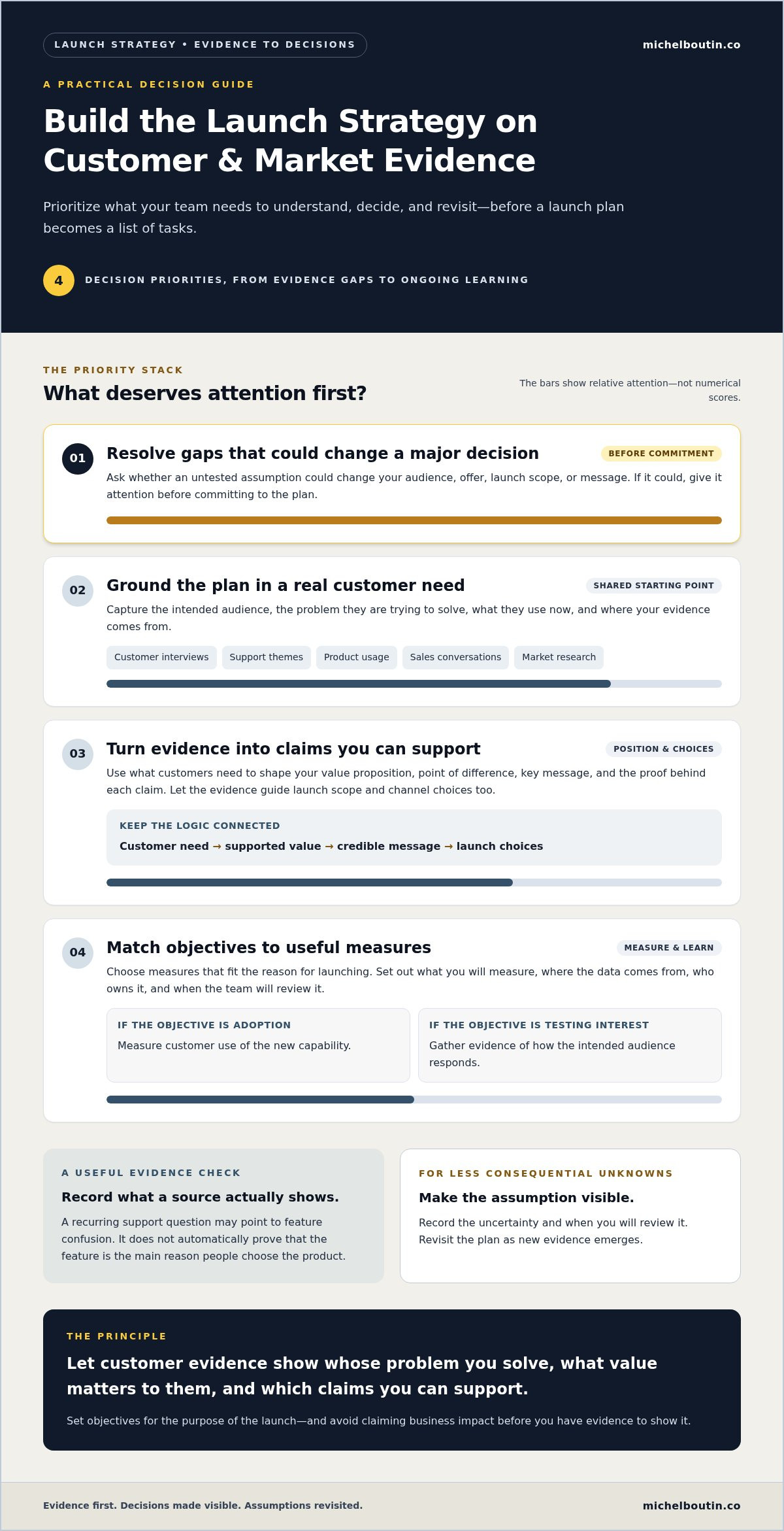
A launch decision is only as strong as the evidence behind it. Before choosing messages or channels, capture the customer problem, the audience you intend to serve, what people use now, and what you still need to find out. This gives your team a shared starting point and makes it easier to see which decisions rest on evidence and which rest on a guess.
Capture the customer, problem, and evidence
Give the product launch strategy template fields for the intended audience, the problem they’re trying to solve, their current alternatives, and the source of your evidence. Sources might include customer interviews, support themes, product usage, sales conversations, or market research. Record what each source actually shows. For instance, a recurring support question may reveal confusion about a feature, but it doesn’t automatically show that the feature is the main reason people choose the product.
Then name the gaps. If you haven’t tested whether a particular audience values a proposed feature, mark that as an assumption. Ask whether resolving it could change your audience, offer, launch scope, or message. A gap that could change a major decision deserves attention before you commit to the plan. For less consequential uncertainties, record the assumption and a point when you’ll review it.
Turn evidence into positioning and launch objectives
Translate the evidence into a value proposition, a clear point of difference, a key message, and the proof that supports each claim. For example, if customers describe difficulty completing a particular task, your message should explain how the product addresses that need. Don’t promise a broader benefit unless your evidence supports it. Use the same evidence to guide launch scope and channel choices: focus on the audience and places where you can credibly reach and serve the people you’ve prioritised.
Let customer evidence shape your positioning by showing whose problem you solve, what value matters to them, and which claims you can support.
Set objectives to match the reason for launching. You may be aiming to help existing customers adopt a new capability, introduce a product to a defined audience, or test whether a market need is strong enough to support a wider release. Choose measures that fit that purpose. For example, an adoption objective calls for a measure of customer use, while an objective to test interest needs evidence of how the intended audience responds. Avoid claiming business impact before you have evidence to show it.
For a broader view of how product decisions connect with business direction, explore product development strategy services. If aligning customer evidence with your launch choices is proving difficult, you can discuss your launch planning priorities with michelboutinstudio.
Choose a Product Launch Template Format That Fits the Work
The best product launch strategy template is the one your team can use to make and revisit decisions. Choose a format based on who needs to work with it and what they need to decide, not how polished it looks. Consider where the rationale belongs, how owners will update progress, and how decision-makers will see unresolved issues. A useful setup often pairs a detailed working template with a concise presentation for leaders who need the direction and key choices at a glance.
Working document versus spreadsheet versus presentation deck
A working document suits decisions that need context. Use it to record the rationale behind positioning, assumptions, and evidence. A spreadsheet is better for tracking owners, dependencies, timing, and measures across workstreams. A presentation deck helps teams and executives align around the main choices, but it’s rarely practical for detailed task tracking.
Campaign-specific tools can help teams build and manage a defined activity, such as a referral or prelaunch waiting-list campaign. They’re useful for campaign mechanics, but they don’t replace a broader view of the product, audience, objectives, and launch readiness.
| Format | Collaboration | Decisions and ownership | Reporting | Adaptability |
|---|---|---|---|---|
| Working document | Good for shared context and discussion | Captures rationale; owners need clear fields | Useful for qualitative updates | Easy to revise as thinking develops |
| Spreadsheet | Supports coordinated work across teams | Strong for owners, dependencies, and dates | Useful for measures and status views | Flexible, though complex sheets can be hard to maintain |
| Presentation deck | Useful for alignment and executive communication | Summarises choices; limited task detail | Highlights key measures and progress | Simple to share, less suited to frequent task updates |
| Campaign-specific tool | Focused on people running a particular campaign | Tracks campaign activities and mechanics | Reports campaign-level activity | Flexible within its tactic, narrower for overall launch planning |
When a campaign-specific template is the right tool
Use a campaign template when you’ve chosen a specific acquisition tactic and need to coordinate how it will work. A referral plan, for instance, can map participant steps, the message at each step, and campaign milestones. But first connect that tactic to the intended audience, the value offered, the launch objective, and the team’s ability to deliver. Otherwise, the mechanics can take over and the campaign risks becoming the launch plan by default.
Use This Product Launch Strategy Template From Planning to Readiness
Turn the strategy into a working sequence your team can complete and update. For each stage, capture the prompt, decision, accountable owner, contributors, due point, dependencies, and unresolved assumptions. Name a role for every owner, such as Product Lead or Customer Support Lead, so responsibility stays clear even as team members change. For growing B2B businesses that lack an in-house director to steer the launch, senior marketing leadership from budgetboosters.eu can help fulfill that role. If an item has no clear owner or depends on an unresolved decision, flag it rather than treating it as ready.
- Context: What are you launching, and why now? Record the business need and launch constraints. Decision: agreed launch purpose. Owner: Executive Sponsor.
- Customer evidence: Which audience and need are supported by evidence, and what remains uncertain? Decision: priority audience and research gaps. Owner: Customer Strategy Lead.
- Positioning: What value will you promise, and what evidence supports the message? Decision: approved positioning and proof points. Owner: Marketing Lead.
- Objectives: What should this launch achieve, and how will you assess progress? Decision: agreed objectives and measures. Owner: Business Lead.
- Launch choices: Which scope, channels, and activities best fit the audience and objectives? Decision: chosen approach and trade-offs. Owner: Product Lead.
- Readiness: What must be in place before release, and what could block it? Decision: readiness status and actions. Owner: Launch Lead.
- Learning: What responses will you review, when, and who will interpret them? Decision: review points and follow-up actions. Owner: Insights Lead.
For every decision, distinguish open from approved. Add the rationale and evidence, not just the answer. Link each positioning choice and launch message to the customer need and business objective it serves. Where brand alignment or messaging needs more attention, use this marketing and brand strategy guide as a deeper reference.
Check readiness without turning the template into paperwork
Use evidence to assess readiness, not a vague “complete” label. Product readiness might be supported by agreed release criteria; customer support by prepared guidance; sales enablement by current product information; operations by confirmed hand-offs; and communications by approved messages. Tailor the evidence to your launch. For each area, ask what a team member needs to see or do to consider it ready. Keep the review focused on issues that could affect the customer experience or delay a decision.
Track only the blockers that need action:
- Blocker: What is unresolved, and what launch decision does it affect?
- Owner: Who is accountable for moving it forward?
- Next action: What will happen, by when, and what does it depend on?
This keeps your product launch strategy template useful from planning through readiness, rather than turning it into a form to complete and forget. If you need support aligning launch choices, teams, and brand messaging, you can discuss your launch planning with michelboutinstudio.
Turn the Launch Plan Into Execution, Measurement, and Learning
A launch plan keeps working after release. Before launch, decide what you’ll measure, where the information will come from, who will review it, and when you’ll make decisions. This turns measurement into a way to guide the next step, not a report assembled after the fact. It also helps the team spot when a result is inconclusive and more evidence is needed.
Set measures that help the team make decisions
For each objective, record the measure, available baseline, target and reason for choosing it, data source, review point, and accountable owner. Use a baseline only when you have reliable data. Set targets to fit the launch purpose and evidence, rather than copying a generic benchmark that may not suit your audience or product. If you can’t measure an objective directly, note the limitation and choose a reasonable indicator that can inform the decision.
Choose measures at more than one level. Activity measures show what the team delivered, such as whether planned demonstrations took place. Customer measures reveal how people responded, such as whether they understood the offer or used a key feature. Business measures relate to the objective you set, and should be reported only when the evidence supports that conclusion. Keep these categories separate so completed activity is not mistaken for customer response or business impact.
Activity measures show what your team did; customer measures show how people responded. Keep the distinction clear in your product launch strategy template, and connect each measure to the question it helps answer.
Run a useful post-launch review
Set review moments in advance so the team can compare results with the original objectives and assumptions. Look at what the available evidence supports, what remains uncertain, and whether the launch is reaching the intended audience. Be open about limitations, such as incomplete feedback or data that doesn’t yet show a reliable pattern.
Bring customer feedback and operational experience into the same review. Did people understand the product’s value? Where did they encounter friction? Did internal hand-offs or support processes create obstacles? These questions help you distinguish a messaging issue from a product, channel, or readiness issue before deciding what to change.
Close each review with explicit decisions, owners, and next steps. You might keep the current approach, test a message with a specific audience, address a service gap, or gather more evidence before expanding the launch. Record the reason for the choice, then carry the learning into future planning.
Aligning customer strategy, product development, and execution takes more than tracking tasks. michelboutinstudio’s strategic work can help organisations connect those areas and turn launch findings into clearer priorities. For support with those decisions, you can start a conversation with michelboutinstudio.
Make Your Next Launch More Deliberate
A strong launch isn’t a document your team completes and files away. It’s a shared way to connect customer evidence with clear choices, accountable owners, and useful measures. The right product launch strategy template gives your team structure while leaving room to adapt as you learn.
Keep the plan grounded in the customer problem, tailor the format to the work, and review results against the objectives you set. Then turn what you learn into decisions and next steps. That’s how each launch can build better judgement, not just generate more activity.
michelboutinstudio brings more than 20 years of industry experience across customer strategy, product development, and marketing and brand strategy. Its strategic consulting is shaped around your business needs and objectives, helping connect customer priorities with product choices and execution.
Ready to bring your teams and launch decisions into alignment? Discuss your product launch strategy with michelboutinstudio, and take the next step with clarity and confidence.
Frequently Asked Questions
What should a product launch strategy template include?
A product launch strategy template should connect the customer problem with launch decisions and follow-up learning. Include the target audience, evidence and assumptions, positioning, launch objectives, chosen activities and channels, readiness checks, owners, dependencies, measures, and review points. Make decision status visible too, so your team can distinguish agreed choices from open questions. This helps everyone understand not only what needs to happen, but why it matters.
How do you create a product launch strategy step by step?
Start by defining the product, business context, and customer need. Gather evidence about the audience and their alternatives, then identify assumptions that could change your approach. Use what you learn to shape positioning, objectives, launch scope, and channels. Assign accountable owners and dependencies, check readiness across teams, and set measures before launch. After release, review results against your objectives and decide what to keep, change, or investigate further.
Can I use a product launch plan template for any product?
You can use the same planning framework for different products, but you shouldn’t use identical assumptions or fields without adapting them. A new product entering an unfamiliar market may need more customer research and assumption tracking. A feature for existing customers may call for a stronger focus on adoption, support, and customer communications. Tailor the audience, evidence, objectives, readiness checks, and measures to the product and launch context.
What is the difference between a product launch strategy and a launch plan?
A product launch strategy sets direction: who the product is for, what customer value it offers, and which launch choices support the business objective. A launch plan turns that direction into execution by assigning tasks, owners, dependencies, and timing. The strategy explains why the team is taking an approach; the plan clarifies who will do what and when. Your plan should follow the strategy, not stand in for it.
Should a product launch strategy template be a spreadsheet or presentation?
Choose the format based on how your team will use it. A spreadsheet works well for owners, dependencies, timelines, and measures. A presentation helps communicate decisions and align stakeholders, but it’s less suited to detailed task tracking. A working document can hold the rationale and assumptions behind decisions. Teams often pair a detailed working format with a concise presentation, keeping one for execution and the other for alignment.
How do you measure whether a product launch was successful?
Measure success against the objectives you set before launch, using relevant customer and business outcomes. For each measure, record its data source, owner, review point, and baseline or target rationale where available. Track activity, such as completed launch communications, separately from customer response, such as product use or feedback. Review the evidence and its limitations, then capture decisions and next steps. Avoid claiming an outcome unless the data supports it.
Disclaimer
Insights shared are for informational purposes and reflect professional perspective, not specific advice. Independent advice should be sought before acting on any content.