

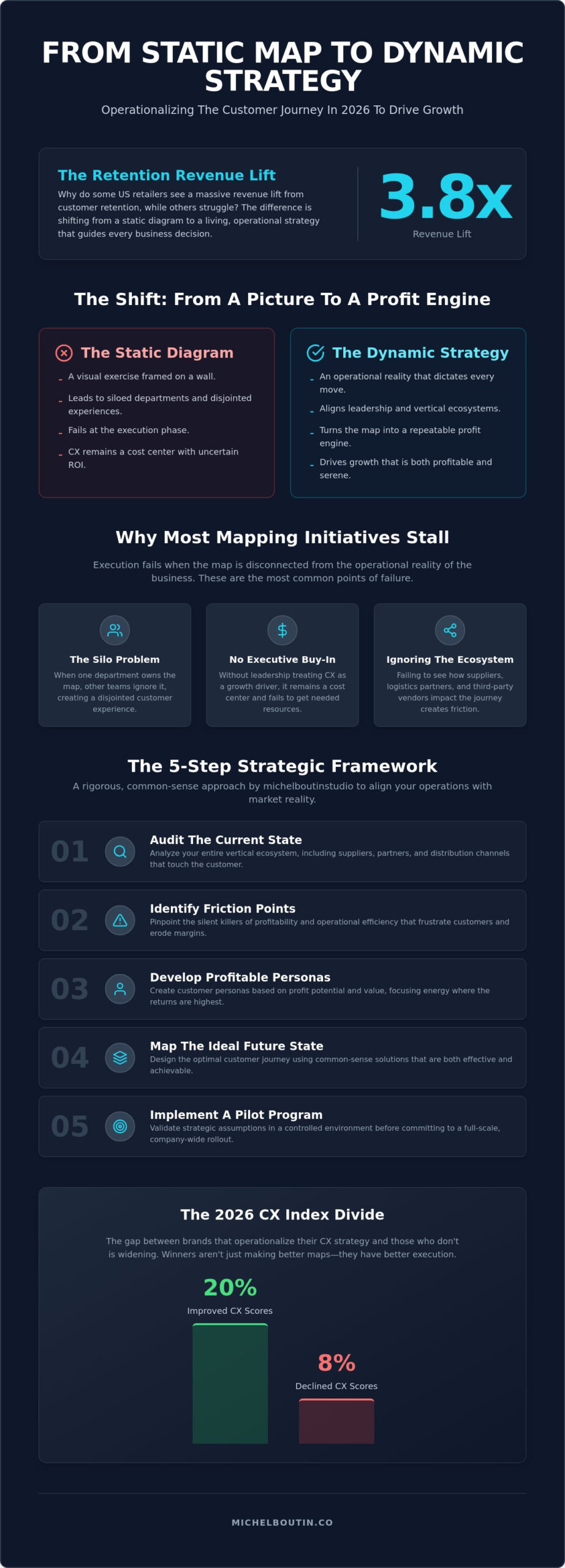
Why do some US retailers see a 3.8x revenue lift from customer retention while others watch their margins evaporate in 2026? The difference isn’t just better software. It’s the transition from a static diagram to a living customer journey mapping strategy that dictates every operational move you make. You likely feel the weight of siloed departments and the nagging uncertainty of CX ROI. It’s exhausting to manage friction when you should be driving momentum.
At michelboutinstudio, we believe a map is just a picture until it becomes an operational reality. You deserve a business that runs with precision, allowing you to move from execution to a posture of global pilotage. This guide transforms your journey mapping from a visual exercise into a powerful strategy for scale. We’ll explore the shift toward total experience and provide a clear roadmap to align your leadership with customer reality, ensuring your growth is both profitable and serene.
Key Takeaways
- Understand why a visual diagram is insufficient and how to implement a customer journey mapping strategy that serves as a functional engine for growth.
- Audit your vertical ecosystem to pinpoint where operational inefficiencies are frustrating your customers and eroding your margins.
- Move from the exhaustion of daily execution to a posture of strategic pilotage by aligning your leadership team with customer reality.
- Prioritize strategy before software to avoid the trap of expensive tools that fail to fix broken underlying processes.
- Learn how michelboutinstudio applies a common-sense approach to transform complex customer journeys into clear, repeatable paths for profitability.
Defining The Customer Journey Mapping Strategy In 2026
The Australian landscape has shifted. Customers now demand radical autonomy. They expect to move through your ecosystem without friction or forced interactions. When they hit a wall, they don’t just complain; they leave. Research shows that in 2026, 20% of global brands improved their CX Index scores while 8% declined. The winners didn’t just have better maps; they had better execution. At michelboutinstudio, we help you bridge the gap between high-level vision and the grit of daily operations. We position you as a strategic pilot rather than a manager of fires.
The Core Components Of A Strategic Framework
A framework succeeds when it aligns your long-term goals with the customer’s immediate reality. This starts with vision alignment. If your journey map doesn’t directly support your growth targets, it’s a hobby, not a strategy. You must replace internal assumptions with data-driven empathy. Effective customer journey mapping utilizes real-world research to uncover what your customers actually do, rather than what you hope they do. Finally, a robust strategy requires a feedback loop. The market moves fast. Your strategy must evolve alongside it to remain relevant and profitable.
Why Most Mapping Initiatives Stall At The Execution Phase
The most common failure is the silo problem. When marketing owns the map, the operations team often ignores it. This creates a disjointed experience where the promise doesn’t match the delivery. Without executive buy-in, CX remains a cost center. You must treat it as a primary growth driver to see real results. Many organizations also ignore their vertical ecosystem. They fail to see how suppliers, logistics partners, and third-party vendors impact the journey. At michelboutinstudio, we specialize in Vertical Ecosystem Optimization to ensure every link in your chain strengthens the customer experience. When you optimize the entire system, you unlock a level of efficiency that drives both scale and personal serenity for the leadership team.
Building The Strategic Framework: From Data To Insights
Transformation requires more than a brainstorming session. It demands a structured approach that moves from raw data to actionable clarity. A successful customer journey mapping strategy in 2026 follows a rigorous five-step framework designed to align your operations with market reality. You start by auditing the current state across your entire vertical ecosystem. This isn’t limited to your internal processes. It includes every supplier, partner, and distribution channel that touches your customer. If your logistics partner is slow, your customer journey is broken; similarly, selecting the right transaction infrastructure through PaySelect ensures your payment process doesn’t become a friction point.
Research Techniques That Deliver Factual Clarity
Surveys often provide a filtered version of the truth. In 2026, we’ve seen that direct observation and stakeholder interviews yield far more reliable insights. People’s actions rarely match their survey responses. You can explore our specific customer research techniques to understand how we uncover these hidden behaviors. Balancing quantitative data with qualitative insights is the key to factual clarity. For those seeking a foundational definition of these elements, IBM’s guide to customer journey mapping offers a solid starting point for understanding the core components of a map.
Identifying The ‘Moments Of Truth’ In Your Business
Every business has high-impact touchpoints where a customer decides to stay or walk away. These are your Moments of Truth. Prioritize improvements here based on your overall business transformation goals. By understanding the psychology of change, you can influence customer behavior naturally without relying on aggressive sales tactics. This isn’t about manipulation; it’s about removing the obstacles that prevent a seamless experience. When you master these moments, you move from managing transactions to piloting a growth engine. If you’re looking to refine these touchpoints, reach out to michelboutinstudio for a strategic consultation.
Aligning Leadership And Vertical Ecosystems For Success
Success in 2026 belongs to the leaders who stop managing tasks and start piloting systems. When your leadership team remains stuck in the weeds of daily execution, the customer experience inevitably suffers from inconsistency. A high-level customer journey mapping strategy requires you to step back. You need to see the entire horizon of your vertical ecosystem. This isn’t just about your internal staff; it’s about every partner and supplier that contributes to the final result.
Optimizing these vertical ecosystems ensures that the end-to-end journey remains seamless. If you manage a multi-location network across Australia, consistency is your biggest challenge. Without alignment at the top, one branch delivers excellence while another creates frustration. Leadership development is the bridge that closes this gap. It empowers your team to own the customer reality at every touchpoint. This creates a culture where high performance and personal serenity coexist.
Breaking Down Silos Through Executive Advisory
Silos are the primary enemy of a unified journey. When departments compete for resources instead of collaborating on the customer experience, the strategy stalls. We use executive advisory to create cross-functional accountability. This transition isn’t always easy. It requires a shift in mindset that many leaders find challenging. Our executive coaching helps you manage this transition with calm assurance. You move from a cost-center mentality to seeing CX as a primary driver of scale and personal autonomy.
The Vertical Ecosystem Advantage
Your customer doesn’t care whose logo is on the delivery truck. They only care if the product arrives on time and in perfect condition. This means your suppliers and logistics partners are integral parts of your customer’s journey. Strategies for optimizing the entire value chain are essential for reducing friction outside of your direct control. By following Harvard Business School’s process for journey mapping, you can identify where these external partners impact your brand reputation. At michelboutinstudio, we refine these connections. We turn your vertical ecosystem into a competitive advantage that competitors cannot easily replicate. When the entire chain is optimized, your business gains the momentum it needs to thrive without your constant intervention.
Operational Optimisation: Turning The Map Into A Profit Engine
Software doesn’t solve structural problems. It only accelerates them. By 2026, the market is saturated with platforms promising to automate your customer experience. Yet, without a sound customer journey mapping strategy, you are simply automating chaos. We see this often: an executive invests in a high-end CRM, but their team still works in silos. The result is a digital layer that masks deep operational inefficiency. You must prioritize strategy before software to ensure your investments actually yield a return. Transformation isn’t a project; it’s a posture you adopt to stay ahead.
Mapping your journey reveals the leaks in your profit engine. Every time a customer has to repeat their information or wait for a department hand-off, you lose money. These friction points aren’t just annoying; they’re expensive. By identifying these redundancies, you can streamline your vertical ecosystem and reallocate resources where they drive growth. This is how you bridge the gap between what your brand promises and what your operations actually deliver. For businesses in the mortgage sector, utilizing specialized support from Orchestrate can help eliminate these operational leaks during the title and settlement phases. When your systems match your message, you build a foundation for scale that doesn’t require your constant, hands-on intervention.
Efficiency As A Customer Experience Feature
Efficiency is more than an internal metric. It’s a customer experience feature. When your internal systems work flawlessly, the customer feels it through a sense of ease and speed. They move through the path to purchase without effort. This is where operational optimisation becomes your greatest competitive advantage. You aren’t just making things faster; you’re making them better. Digital transformation should always serve the customer first, rather than just checking a box for the IT department. US retailers who mastered this alignment in early 2026 saw a 3.8x revenue lift from customer retention and enrichment. The same logic applies to the Australian market: simplicity wins.
Measuring ROI: The Executive Dashboard
Stop relying on Net Promoter Scores alone. In 2026, savvy executives demand harder data to justify their initiatives. Your dashboard should track customer lifetime value (CLV) and churn reduction. These are the hard business metrics that prove the financial impact of your journey strategy. A well-executed map reduces the cost of acquisition and increases the value of every existing relationship. It transforms CX from a vague concept into a measurable profit engine. If you’re ready to stop guessing and start piloting your business with precision, contact us at michelboutinstudio to discuss your operational roadmap.
Navigating Transformation With michelboutinstudio
True transformation is rarely a solo endeavor. It requires a partner who understands the friction of the field and the vision of the boardroom. At michelboutinstudio, we provide that bridge. We don’t offer generic templates or academic theories. We deliver a customer journey mapping strategy rooted in over 20 years of industry experience. Our expertise in managing multi-location networks across Australia allows us to see the operational hurdles others miss. We focus on Vertical Ecosystem Optimization; ensuring every part of your business works in harmony to drive scale.
You have a choice in how we work together. Some organizations require a project-based approach to solve a specific, immediate bottleneck. This is ideal for rapid, common-sense results that stabilize a volatile touchpoint. Others prefer a retainer-based advisory to ensure long-term alignment and continuous improvement. Both paths lead to the same result: a business that operates with precision and a leader who regains their personal autonomy. You move from the exhaustion of execution to the serenity of global pilotage. This isn’t just about performance; it’s about your quality of life as a leader.
Our Strategic Approach To Customer Experience
We begin with a deep audit. This isn’t a surface-level review. We map your entire vertical ecosystem to find the hidden leaks in your profit engine and identify where silos are creating customer frustration. From there, we develop a clear roadmap for both digital and operational transformation. This plan is pragmatic. It focuses on what needs to change and how to change it without breaking what already works. We provide continuous support through executive advisory and coaching; ensuring your team stays aligned with the new reality and remains accountable for the end-to-end journey.
Next Steps For Your Business In 2026
The landscape of 2026 rewards the agile and punishes the stagnant. How does your current strategy hold up against today’s market benchmarks? If you feel the weight of departmental silos or the frustration of inconsistent experiences, now is the time to act. Stepping back to pilot your business toward growth is a strategic necessity. You deserve a structure that functions effectively without your constant intervention. It’s time to transform your operational reality and claim the high-level performance your organization is capable of. Contact michelboutinstudio today for a strategic consultation and begin your journey toward a more profitable, autonomous future.
Piloting Your Organization Toward Strategic Autonomy
The transition from visualizing a map to executing a customer journey mapping strategy is the defining factor for growth in 2026. You now understand that high-level performance requires more than just new software. It demands a rigorous alignment of your leadership and a complete optimization of your vertical ecosystem. By removing operational friction and bridging the gap between your brand promise and reality, you secure both profitability and personal serenity.
At michelboutinstudio, we bring over 20 years of executive consulting expertise to help you navigate this transformation. As specialists in Vertical Ecosystem Optimization, we have a proven track record in the Australian retail and financial sectors. We don’t just provide a plan; we provide the path to strategic autonomy. Are you ready to step back from the daily execution and start piloting your business with precision?
Achieve Strategic Autonomy With michelboutinstudio
Your future of scalable growth and operational clarity starts today. Take the first step toward a more autonomous and profitable reality.
Frequently Asked Questions
What is the difference between a customer journey map and a journey strategy?
A customer journey map is a static visual tool, while a journey strategy is the operational framework that drives business decisions. The map illustrates the path your customer takes today. The strategy defines how you will optimize that path to increase profitability and scale. Without a strategy, your map is just an artifact that fails to trigger meaningful change within your vertical ecosystem.
How long does it typically take to develop a comprehensive journey mapping strategy?
A comprehensive customer journey mapping strategy generally takes between eight and twelve weeks to develop. This timeline includes the initial audit, stakeholder interviews, and the development of a future-state roadmap. Taking this time ensures your strategy is rooted in factual clarity rather than internal assumptions. It allows you to validate your pilot program before committing to a full-scale operational rollout.
Who in the organization should own the customer journey mapping process?
Executive leadership must own the process to ensure cross-functional accountability. While marketing or customer success teams often manage the day-to-day data, the CEO or COO must drive the strategic alignment. This top-down approach is essential for breaking through departmental silos. When leadership owns the journey, the organization moves from managing tasks to piloting a unified growth engine.
Vertical ecosystem optimization ensures that every partner, supplier, and distributor aligns with your brand promise. Your customer journey doesn’t end at your warehouse doors; it continues through delivery and support. If a third-party partner creates friction, your brand suffers the consequences. By optimizing the entire ecosystem, you remove obstacles outside your direct control and create a seamless end-to-end experience for the user.
What are the most common mistakes executives make when mapping customer journeys?
The most frequent mistake is treating the map as a finished product rather than a living strategy. Executives often fail to involve every department, which leaves operational gaps. Another common error is letting expensive software dictate the process before the underlying strategy is clear. You can’t automate a broken journey; you must fix the process first to see a real return on your investment.
How do you measure the financial return on a journey mapping strategy?
You measure the financial return by tracking hard business metrics like Customer Lifetime Value (CLV) and churn reduction. A successful customer journey mapping strategy reduces the cost of acquisition by improving retention and enrichment. In 2026, global brands that focused on total experience saw significant gains in their CX Index scores. These improvements translate directly into higher margins and a more predictable revenue stream for your organization.
Why does michelboutinstudio emphasize strategy before software?
Software only amplifies your existing operational reality; it doesn’t solve structural problems. At michelboutinstudio, we’ve seen many leaders waste capital on tools that their teams aren’t ready to use. We prioritize strategy to ensure your processes are optimized and your leadership is aligned first. Once you have a clear roadmap, you can select the digital tools that actually serve your customers and your growth goals.
Disclaimer
Insights shared are for informational purposes and reflect professional perspective, not specific advice. Independent advice should be sought before acting on any content.