

What if your improvement programme is making work more complicated without making life better for customers? An operational excellence framework should connect the customer promise to leadership decisions and the work teams do every day. Without that link, improvement efforts can drift from strategic priorities, leaving teams unsure which measures and methods fit the problem.
A practical approach doesn’t mean adding another layer of process or adopting every popular method. Start by defining what better performance means for your customers and organisation. Then build repeatable practices around it. This gives people clearer priorities and helps your business improve without relying on short-lived initiatives.
This guide shows you how to shape a framework around your operating context. You’ll connect customer value with strategy, choose improvement methods for the challenge at hand, and use measures that support sound decisions. You’ll also see how leadership, team involvement and everyday practices help changes stick. michelboutinstudio connects operational optimisation with broader business goals, helping you shape a stronger operation around your priorities.
Key Takeaways
- Build your operational excellence framework around the customer value your organisation aims to create, not a borrowed template.
- Connect leadership, people, processes and performance learning so each element reinforces the others.
- Choose Lean, Six Sigma or Agile according to the work challenge, rather than treating one method as a universal answer.
- Start with a focused area: define outcomes, map the work, identify friction, test changes and embed what works.
- Shape operational choices around your organisation’s goals, drawing on customer strategy, digital transformation and leadership where relevant.
What an Operational Excellence Framework Should Deliver for Customers
A useful framework links the value you promise customers to the work that delivers it, the decisions that shape that work and the learning that helps you improve. It provides a consistent way to turn strategy into daily practice. Start with why customers choose you and the experience you intend to provide, not with a popular model.
An operational excellence framework is a repeatable way to organise work and decisions so your organisation can deliver customer value consistently and learn how to improve. This definition keeps the focus on outcomes, not activity for its own sake. A process may be faster on paper, but if it makes the customer experience less reliable, it hasn’t strengthened your promise.
Operational excellence is often discussed alongside approaches such as Lean and Six Sigma. The Operational Excellence Wikipedia article offers a broader introduction to the concept and related frameworks. Treat any model as a source of ideas, not a substitute for deciding what value means in your organisation.
How to Define Operational Excellence in Your Organisation
Begin with the customer outcomes that matter most. Is your promise dependable delivery, consistent quality, a timely response or a clear experience at every touchpoint? Choose outcomes that reflect how your organisation creates value, then connect them to strategic priorities. Your definition should help teams make everyday trade-offs, not sit apart from the work.
For example, if responsiveness matters, trace how requests move between teams and where decisions wait. If consistency is central, examine handoffs and the guidance people use. A closer understanding of customer strategy and strategic growth can help clarify which customer needs should shape those operating choices.
Why Efficiency Alone Is Not Operational Excellence
Efficiency is useful, but a local gain can shift effort or create friction elsewhere. A team might finish its task sooner by passing incomplete information to another team. The first step looks faster, but the full customer journey may become slower or less predictable. Measure performance across the work that delivers the outcome, not only within individual tasks.
Durable performance also depends on people knowing who can make decisions, having the support to do their work well and being able to learn from recurring problems. If a new process relies on constant workarounds, the underlying design needs attention. Build the ability to spot issues, respond clearly and improve the work as conditions change.
Put the customer promise into practical terms. Name the outcomes, identify the decisions and work that influence them, and agree how you’ll recognise when delivery is falling short. This gives teams a shared reference point for improvement. It also helps leaders distinguish a lasting change in how the organisation operates from a short-term efficiency project that may not serve customers better.
The Core Elements of an Operational Excellence Framework
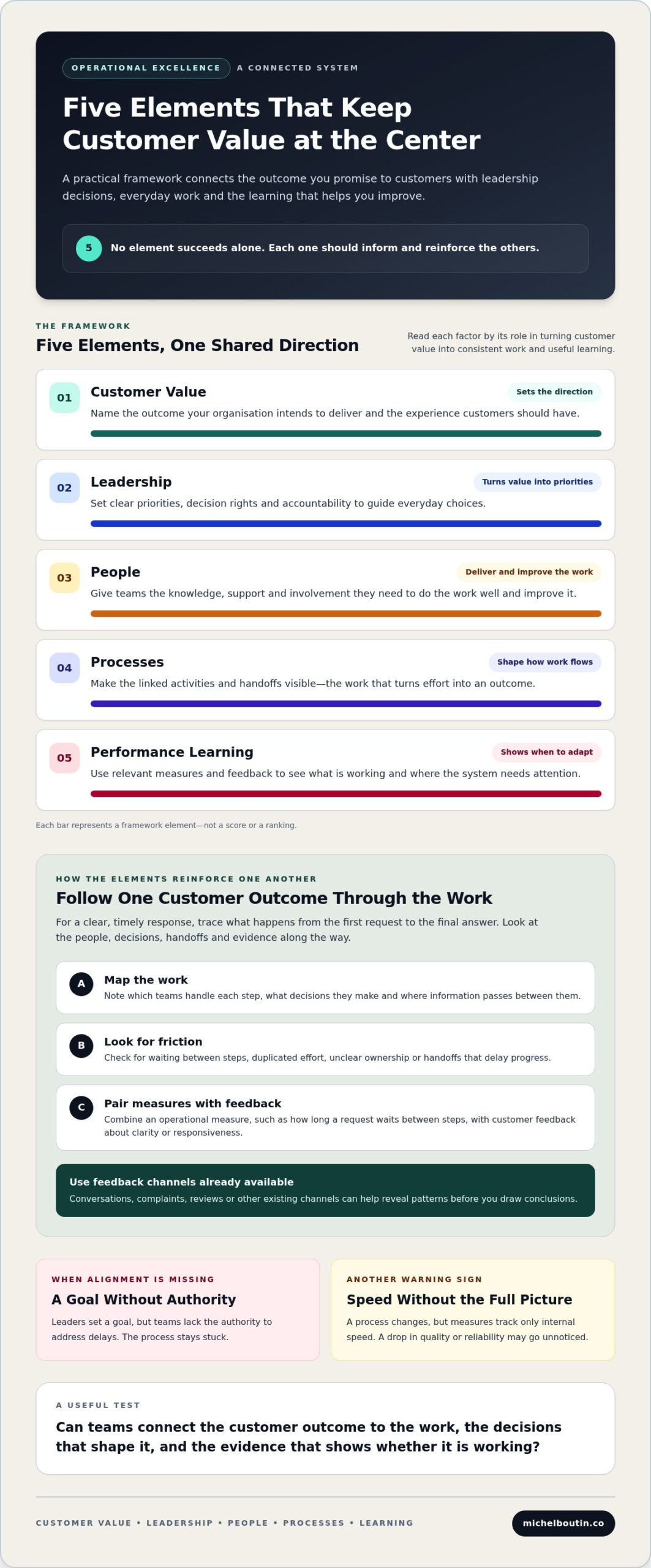
A strong operational excellence framework is a connected system, not a set of boxes to tick. Its elements are customer value, leadership, people, processes and performance learning. Each has a distinct role, but none succeeds alone. Customer value sets the direction. Leadership turns it into priorities. People carry out and improve the work. Processes shape how work flows, while performance learning shows whether the system is delivering as intended.
- Customer value: The outcome your organisation intends to deliver and the experience it wants customers to have.
- Leadership: Clear priorities, decision rights and accountability to guide everyday choices.
- People: The knowledge, support and involvement teams need to deliver and improve the work.
- Processes: The linked activities and handoffs that turn effort into an outcome.
- Performance learning: Useful measures and feedback that reveal what is working and where to adapt.
Operational excellence depends on leadership, processes, people and feedback working in alignment, so teams can deliver customer value and learn from the results. If leaders set a goal but teams lack the authority to address delays, the process stays stuck. If a process changes but measures track only internal speed, you may miss a drop in quality or reliability. The elements need to inform one another.
Connect Customer Value to Processes and Decisions
Choose one customer outcome and trace the work behind it. If customers value a clear, timely response, map what happens from the first request to the final answer. Note which teams handle each step, what decisions they make and where information passes between them. This can reveal handoffs that delay progress, duplicated effort or unclear ownership.
Then decide what evidence would show whether the process supports that outcome. Pair an operational measure, such as how long a request waits between steps, with customer feedback about clarity or responsiveness. Feedback might come from conversations, complaints, reviews or other channels already available to your organisation. Look for patterns before drawing conclusions. The GOV.UK Service Standard offers a public example of guidance that puts user needs at the centre of service design and delivery.
Build Leadership, People, and Learning into the Framework
Leaders make the framework usable. They explain what matters, clarify who can make which decisions and give frontline teams a way to raise concerns. People closest to the work often spot friction first. Give them room to suggest a small change, observe what happens and share what they learn.
When a process produces an unwanted outcome, examine the conditions and steps that shaped it before assigning blame. Was information missing? Did an approval hold up the work? Could two teams have understood ownership differently? Treating these questions as learning helps you adjust the process and strengthen shared accountability. These considerations can also help frame a discussion of your operational priorities with michelboutinstudio.
Operational Excellence Frameworks and Methods: What Each Is For
An operational excellence framework sets the broader direction: what the organisation wants operations to achieve and how improvement connects to its goals. Methods are approaches teams use to examine and improve specific parts of the work. Keep the distinction clear. The framework defines the organisation-wide aim; methods provide ways to pursue it.
Lean, Six Sigma and Agile can each support operational improvement, but they address different challenges. They aren’t competing versions of the same solution.
| Method | Useful focus | Consider it when |
|---|---|---|
| Lean | Flow, waste and handoffs | Work is delayed, repeated or includes steps that don’t contribute to the intended outcome. |
| Six Sigma | Variation and quality | Results differ more than expected and you need structured analysis to understand why. |
| Agile | Iterative work and changing priorities | Teams need to adapt plans as they learn, particularly where requirements may shift. |
Other terms describe different things. The Shingo Model is a named model that emphasises principles and organisational culture. Kaikaku refers to step-change redesign rather than gradual adjustment. These ideas may inform your approach to change, but neither removes the need to define the intended customer and business outcomes first.
Match the Improvement Method to the Problem
Start with evidence about the work, not a preferred tool. If a process stalls at handoffs or contains unnecessary steps, use Lean thinking to examine flow and waste. If the same process produces inconsistent quality, structured analysis associated with Six Sigma can help identify sources of variation. Where priorities shift and work benefits from short cycles of planning and review, Agile practices may fit. Choose a method for the diagnosed problem, then assess whether it helps deliver the intended outcome.
Why No Single Method Fits Every Organisation
The right choice depends on customer expectations, the type of work, operational constraints and team readiness. A tightly controlled, repeatable process presents different improvement needs from work where requirements evolve. Before adopting a method, clarify who will lead it, what problem it should solve and how you’ll assess its value. Without purpose and ownership, new terminology can add meetings and effort without improving the work.
Digital change also needs to fit the operating strategy. A new tool or system won’t resolve unclear responsibilities or a poorly designed process by itself. Consider how technology affects people, decisions and the customer experience, and connect it to the outcomes your organisation is pursuing. This strategic guide to digital transformation explores how executives can approach that connection.
Use a simple selection test: name the customer outcome, describe the friction in the work, then choose an approach suited to that friction. Keep the method in service of the framework, not the other way around. This makes improvement practical and helps teams understand why a change matters.
How to Put an Operational Excellence Framework into Practice
Turn your operational excellence framework into a focused cycle of action, not an organisation-wide redesign. Choose a service, workflow or team where improvement supports a clear business priority. A focused starting area gives you room to understand the work, involve the people who do it and learn before extending changes elsewhere.
Diagnose the Operating Challenge Before Choosing an Intervention
Begin with the customer outcome you want and the business priority it supports. Then follow the work from start to finish. Include roles, handoffs, approvals and the information people use. Separate what you can observe, such as a request waiting for approval, from assumptions about why it waits. This helps you target the source of friction rather than applying a familiar fix too early.
- Define outcomes. State the customer experience you want and the operational result that supports it. Keep both in view as you assess possible changes.
- Map the work. Outline the steps, roles, handoffs and decisions in the selected workflow. Capture how the work happens in practice, not only how a procedure says it should happen.
- Diagnose friction. Look for repeated work, delays, unclear ownership or missing information. Check these observations with the people involved before deciding what causes them.
Test, Learn, and Embed Improvements
Once the challenge is clearer, choose a manageable change and explain its purpose. Name who will lead the test and who needs to be involved. Before it begins, agree how you’ll review customer experience alongside operational performance. If a change speeds up one step but makes service less reliable, that matters. Reviewing both helps you understand the trade-offs and adjust thoughtfully.
- Prioritise. Select a change that addresses the diagnosed friction and supports the intended outcome. Consider its effect on connected teams, not just the starting point.
- Test. Explain the reason for the change, clarify responsibilities and try it in the focused area. Give affected teams a clear way to share what they notice.
- Review. Compare what happens with the outcomes you set. Consider customer feedback and service quality alongside measures of flow, rework or delays that fit the process.
- Embed. Document the useful practice, update guidance where needed and make ownership clear. Revisit the change as customer needs, team feedback or operating conditions shift.
Keep the learning loop open. If the test doesn’t produce the intended result, treat that as information about the process, not a reason to assign blame. Refine the change or revisit your diagnosis, then share what the team learns so improvement becomes part of ordinary work. A discussion of your operational priorities can help connect these steps to your organisation’s goals.
How michelboutinstudio Can Help Shape Your Operational Excellence Framework
A framework should fit the organisation that will use it. michelboutinstudio works collaboratively with leaders to shape operational optimisation around their goals, customer priorities and operating context. Rather than applying a generic template, the work connects practical operating choices with the wider direction of the business.
An operational challenge can touch several parts of an organisation at once. A process change, for example, may affect customer experience, team responsibilities and digital systems. Depending on the challenge, michelboutinstudio can bring together operational optimisation, customer strategy, digital transformation and leadership perspectives to help leaders assess those relationships and set a coherent direction.
Tailor the Framework to Your Industry and Operating Context
Industry shapes how value is delivered and where operational friction may appear. michelboutinstudio works with organisations in financial services, industrial services and goods, and services, marketing and hospitality. A useful framework reflects the work, customer expectations and strategic priorities of that specific context.
- Financial services: Digital Transformation for Banks and Challenger Brands can be considered alongside Customer-Centric Innovation, so digital and operational choices support the experience the organisation intends to deliver.
- Industrial organisations: Industrial Services Optimization can connect with Materials Sourcing and Supply Chain Optimization and Sales and Distribution Efficiency. This helps leaders consider how work across functions supports customers and operating priorities.
- Services and hospitality: Service Re-Imagining and Customer Experience Innovation, Hospitality Innovation, and Data-Driven Growth and Market Positioning can inform decisions about how a service is designed, delivered and improved.
These examples aren’t a fixed formula. Your organisation’s customer promise, business model and operating conditions determine which priorities deserve attention. A useful framework makes those choices visible and links them to the way teams work.
Turn Strategic Direction into Collaborative Action
michelboutinstudio works closely with clients to develop tailored solutions, focusing on measurable and sustainable improvement. That means translating strategic intent into practical operating choices: clarifying priorities, bringing relevant perspectives together and shaping measures that help leaders assess progress. The collaborative approach gives the people responsible for the work a chance to contribute their understanding of day-to-day realities.
Michel Boutin brings over 20 years of industry experience to this work. That experience informs the strategic perspective, while the framework is tailored to each client’s goals and challenges. The aim is to strengthen alignment between what the organisation sets out to achieve and how it operates, without assuming one method or structure suits every business.
To explore how your operating priorities connect with customer strategy, leadership or digital change, reach out to michelboutinstudio and start a conversation.
Make Your Next Operating Decision Count
Your next step doesn’t need to be a sweeping transformation. Choose one important business priority and ask whether the way work is organised helps you deliver on it. The answer can reveal where clearer ownership, better coordination or a change in direction would make a practical difference.
A useful operational excellence framework gives you a steady way to make those decisions as your organisation grows. Keep the customer promise in view, involve the people closest to the work and make space to adjust when experience shows that a choice isn’t working as intended. Progress comes from building better ways of operating into how your organisation leads and learns, not from adding complexity for its own sake.
You don’t have to solve every operating challenge at once. Start with the priority that matters most, then build from what you learn. Start a conversation with michelboutinstudio about the operational priorities you want to move forward.
Frequently Asked Questions
What Is an Operational Excellence Framework?
An operational excellence framework is a repeatable way to organise work and decisions so an organisation can deliver customer value consistently and learn how to improve. To put it into practice, record a proposed change’s scope, accountable owner, affected teams, dependencies and review point before work begins. This makes it easier to see who needs to be involved and how the change will be managed. Keep the reference simple enough to use in planning and decision-making.
Is Operational Excellence the Same as Operational Efficiency?
No. Efficiency looks at how resources and processes are used, while operational excellence also asks whether the organisation delivers what customers value and supports its strategic aims. A team might shorten a task by removing a review, for instance, but if errors then reach customers, the change may weaken overall performance. Consider the effect across the whole service, not only the speed or effort of one step.
Can a Small or Growing Business Use an Operational Excellence Framework?
How Do You Measure Operational Excellence?
Measure the outcomes your organisation has chosen to improve, using indicators that reflect both customer experience and the work behind it. For a service team, that could mean considering whether customers receive clear responses alongside how often requests need to be handled again. Review measures together and use them to prompt investigation or decisions. A metric is useful when it helps explain what to do next, not simply when it fills a report.
What Happens if an Operational Excellence Programme Doesn’t Deliver Lasting Change?
Reassess how the change fits the organisation’s priorities and daily pressures. For instance, a new handover process may be understood in a workshop but difficult to follow during busy periods. Ask affected teams what gets in the way, whether responsibility is clear and whether the review process makes the change visible. You may need to narrow the scope or adjust the approach. Treat weak adoption as evidence to learn from, not a reason to blame people.
Does Operational Excellence Require Automation or AI?
No. Start by identifying the work problem and the outcome you want, then decide whether technology has a useful role. If staff repeatedly transfer the same information, first establish why the duplication occurs and whether the process itself can be simplified. Automation or AI-driven tools may suit some challenges, but they won’t resolve unclear decisions or unsuitable workflows on their own. Choose technology to support a defined need, not as a goal by itself.
Disclaimer
Insights shared are for informational purposes and reflect professional perspective, not specific advice. Independent advice should be sought before acting on any content.