
Leadership team alignment is not a psychological state; it is a structural byproduct of a shared customer strategy and operational rigor. You’ve likely felt the weight of internal silos slowing down your best ideas. It’s exhausting to watch strategic initiatives stall at the execution phase while your executive stress climbs due to a lack of operational autonomy. In the fast-paced market of 2026, these bottlenecks are no longer just inconveniences; they are direct threats to your competitive edge.
We believe you deserve a unified executive front that moves with precision and purpose. At michelboutinstudio, we show you how to transform executive friction into a cohesive strategic engine that drives profitability and operational serenity. You’re about to learn the specific best practices that lead to clearer delegation and sharper strategic focus. We will preview the structural shifts needed to move from daily execution to a posture of high-level pilotage, ensuring your organization achieves its full potential while you regain your personal balance.
Key Takeaways
- Define the core of leadership team alignment as the synchronization of vision, strategy, and execution to eliminate decision-making delays and internal friction.
- Discover the michelboutinstudio framework of Shared Vision, Unified Strategy, and Disciplined Execution to create a common vocabulary for success across your entire organization.
- Learn how to dismantle the silos between departments like marketing and operations, transforming executive friction into a cohesive strategic engine that drives profitability.
- Access a practical executive checklist and workshop roadmap to assess your current standing and move toward operational serenity and clearer delegation.
- Shift your focus from daily execution to global strategic pilotage, leveraging the unbiased advisory of michelboutinstudio to scale your collective impact in 2026.
Understanding Leadership Team Alignment In Modern Business
True leadership team alignment is not just about getting along in the boardroom. It is the surgical synchronization of your vision, your strategy, and your daily execution. When these three elements move in unison, your organization functions as a single, powerful unit. Without this harmony, you’re simply a group of high-performing individuals pulling in different directions. Are you leading a team, or just managing a collection of departments?
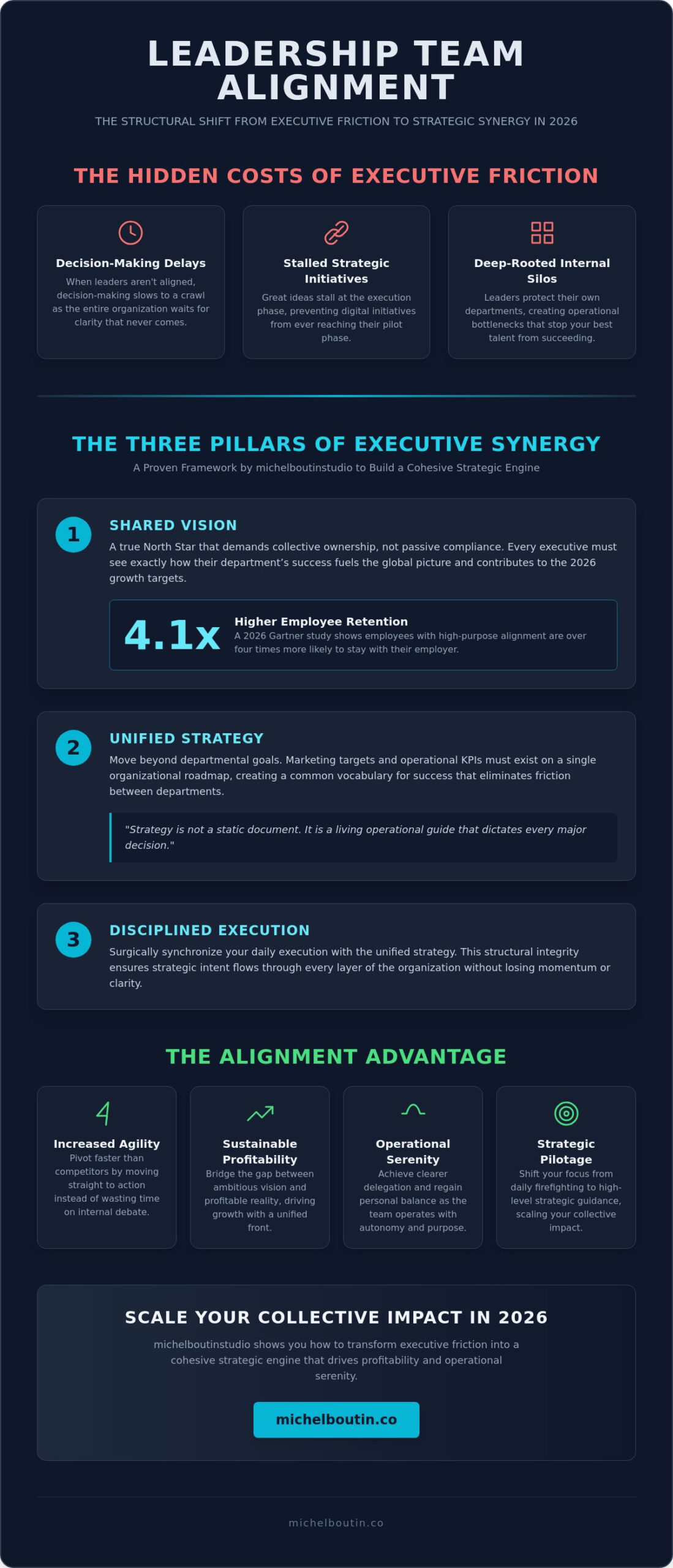
In 2026, the cost of misalignment has reached a breaking point. Rapid digital transformation means that even a minor delay in decision-making can result in a significant lag in market positioning. If your executive team isn’t perfectly calibrated, your digital initiatives will stall before they even reach the pilot phase. This friction is especially visible in multi-location networks, where a lack of cohesion at the top translates into operational chaos across every site you manage. Understanding Leadership Team Alignment is no longer a luxury; it’s the baseline for survival.
We must distinguish between polite agreement and strategic commitment. Polite agreement is what happens when executives nod during a meeting but return to their offices to protect their own silos. Strategic commitment is different. It means every leader has skin in the game and shares the same definition of success. It’s the difference between a team that follows orders and a team that owns the outcome.
The Hidden Costs Of Executive Friction
When your top-tier leaders aren’t aligned, the entire organization feels the tremor. Decision-making slows to a crawl as departments wait for clarity that never comes. This lag doesn’t just frustrate your staff; it actively erodes your annual growth targets. Silos at the top create operational bottlenecks that stop your best talent from doing their jobs. Perhaps the heaviest cost is the psychological toll on you. Are you spending your days on high-level strategy, or are you stuck in execution-level firefighting because your team can’t function without your intervention?
Managing this psychological toll is essential for sustained performance, and professional support through Mindbender Counseling can help leaders navigate the personal stress associated with organizational misalignment.
Alignment As A Competitive Advantage
A unified team possesses the agility to pivot faster than any competitor. When market shifts occur, an aligned executive front doesn’t waste time on internal debate; they move straight to action. Strategic alignment is the bridge between your most ambitious vision and a profitable reality. This synergy creates a level of long-term business resilience that allows you to scale with confidence. At michelboutinstudio, we view this leadership team alignment as the foundation for your personal serenity and your company’s enduring success.
The Three Pillars Of Executive Synergy
Leadership is not a solo performance. It is a collective discipline. At michelboutinstudio, we utilize a proven framework to anchor your team: Shared Vision, Unified Strategy, and Disciplined Execution. This structure moves your leaders away from the weeds of daily tasks and into a posture of global pilotage. When you establish a common vocabulary for success, you eliminate the friction that usually exists between departments like marketing and finance. Achieving deep leadership team alignment requires more than a shared office; it requires a shared language.
This structural integrity is essential for vertical ecosystem optimization. It ensures that your strategic intent flows downward through every layer of the organization without losing momentum. Without these pillars, even the most talented executives will eventually drift into conflicting priorities.
Pillar 1: Establishing A Shared Vision
A true North Star does more than look good on a wall. It must resonate across every sector, whether you operate in retail, automotive, or finance. The CEO’s role is to articulate a vision that demands collective ownership rather than passive compliance. According to a 2026 Gartner study, employees with high-purpose alignment are 4.1 times more likely to stay with their employer. This starts at the top. Every executive must see exactly how their department’s success fuels the global picture. Do your leaders know how their specific KPIs contribute to the 2026 growth targets?
Pillar 2: Building A Unified Strategy
Move beyond departmental goals. Your marketing targets and your operational KPIs must exist on a single organizational roadmap. At michelboutinstudio, we emphasize project-based strategic consulting to define clear, non-negotiable deliverables. Strategy is not a static document hidden in a drawer. It is a living operational guide that dictates every major decision. It provides the clarity needed to say no to distractions. If your strategy doesn’t simplify your decision-making process, it isn’t doing its job.
Pillar 3: Disciplined Execution And Accountability
Execution requires systems, not micromanagement. You need high-level reviews that focus on outcomes rather than a list of activities. Many leaders find that retainer-based executive advisory is the most effective way to maintain long-term alignment. It provides an outside perspective that keeps the team focused on the horizon. When accountability is built into the system, you gain the serenity of knowing that the engine is running even when you aren’t in the room. If you are ready to move from friction to flow, you might consider how a tailored strategic advisory session can reset your team’s trajectory.
Overcoming The Friction Of Executive Silos
Many leaders still dismiss leadership team alignment as a “soft” skill. They are wrong. Misalignment is a structural failure with a measurable impact on your bottom line. It manifests as wasted budget, duplicated efforts, and missed market windows. When your marketing team builds a promise that your operations cannot fulfill, your brand equity evaporates. You don’t need more meetings; you need a shared customer strategy that forces these disparate functions to speak the same language.
Breaking down the barriers between marketing, product development, and operations requires a return to common-sense business strategies. Internal politics usually thrive in the absence of clear, objective goals. At michelboutinstudio, we strip away the noise. By grounding your executive decisions in the reality of your business ecosystem, you replace complex power struggles with a streamlined focus on growth. Have you noticed how much faster your organization moves when everyone stops protecting their turf and starts protecting the vision?
Reframing Conflict As Strategic Tension
Alignment does not mean constant agreement. In fact, a team that always agrees is likely a team that isn’t innovating. We teach you to reframe conflict as strategic tension. This is about fostering healthy debate that sharpens your final decisions. The key is to distinguish between personal friction and professional disagreement. When discussions get heated, pivot back to data-driven customer insights. Objective data acts as a neutral arbiter, allowing your team to settle disputes based on what actually drives value for the business rather than who has the loudest voice.
The Role Of The Customer In Uniting Teams
The customer is the ultimate unifying force for any executive team. When you prioritize the customer experience (CX), internal silos begin to crumble naturally. In 2026, corporate profitability is inextricably linked to a leadership team’s ability to execute a unified customer strategy, as fragmented brand experiences now lead to near-instantaneous market share loss. This is why integrating product development strategy services with your overarching brand vision is essential. It ensures that your innovation pipeline isn’t just a collection of cool ideas, but a strategic engine designed to meet specific market needs.
Moving From Conflict To Strategic Collaboration
Conflict in the boardroom is often just misdirected energy. When your executives clash, they aren’t necessarily fighting each other; they’re fighting the friction caused by a lack of clarity. True leadership team alignment turns this friction into a cohesive force. To move forward, you must transition from execution-heavy roles to a posture of strategic leadership. This shift requires you to stop working in the business and start working on the systems that drive it. It’s about moving from the cockpit of a single department to the control tower of the entire organization.
Scaling your operations in 2026 demands more than just effort; it requires targeted expertise. As your network grows, particularly across multi-location hubs, the complexity of maintaining a unified front increases. Without a structured approach to collaboration, your strategic intent will dilute as it moves down the chain of command. You must build a culture where collaboration is the default, not an after-thought.
Conducting An Alignment Audit
Before you can fix the drift, you must measure it. We recommend a rapid audit to reveal hidden misalignments. Start by asking your team these critical questions:
- Does every executive define our 2026 success metrics in the exact same way?
- Is the flow of information between our regional hubs and the central office seamless or filtered?
- Which “execution traps” are currently preventing you from focusing on high-level strategy?
An execution trap occurs when a senior leader spends more than 30% of their time on tasks that should be delegated. Identifying these bottlenecks is the first step toward reclaiming your operational serenity. If your data is inconsistent across different locations, your alignment is already compromised.
Designing Workshops For Rapid Impact
Discussion without a deadline is just a distraction. A successful alignment workshop must move from diagnosis to a concrete action plan in a single day. At michelboutinstudio, we believe in the power of external facilitation. A neutral, strategic perspective prevents internal biases from clouding the outcome. It allows every team member to speak freely without the weight of hierarchy. By the end of the session, you should have three immediate KPIs that the entire team owns collectively. These aren’t departmental goals; they are shared commitments to the organization’s future. If you are ready to stop the cycle of boardroom friction, you can book a strategic alignment workshop to reset your team’s trajectory today.
Scaling Collective Impact With michelboutinstudio
Achieving sustainable growth requires more than just a brilliant idea; it demands a flawlessly synchronized executive engine. You don’t need a consultant who merely hands over a report and disappears. You need a partner who understands the weight of your role and the complexity of your ecosystem. At michelboutinstudio, we act as that strategic partner, helping you bridge the gap between high-level ambition and operational reality. We focus on performance, but we never ignore your need for personal serenity.
The benefit of an independent consulting studio lies in its unbiased perspective. Internal teams are often too close to the politics of the boardroom to see the structural cracks. We provide a surgical look at your organization, integrating marketing, product development, and leadership into a single, cohesive growth engine. This holistic approach ensures that your leadership team alignment isn’t just a temporary state achieved during a retreat, but a permanent feature of your business model. It’s time to reclaim your focus through structured operational optimization.
Executive Advisory For Long-Term Success
Alignment is not a one-time event; it is a discipline that must be maintained. This is why many high-level leaders choose ongoing, retainer-based support. It provides the consistency needed to keep the team focused on the horizon while navigating the inevitable storms of the business cycle. At michelboutinstudio, we provide a mentor perspective that goes beyond traditional coaching. We don’t just talk about leadership; we help you implement common-sense, actionable strategies that lead directly to increased profitability. You gain a trusted advisor who is as committed to your results as you are.
Transforming Your Leadership Posture
The transition from executional fatigue to global pilotage is the most significant leap a leader can make. Are you tired of being the person who has to solve every operational hiccup? By refining your systems and your team’s synergy, you move into a posture of high-level oversight. This isn’t just about business metrics; it’s about your quality of life. The modern Australian leader deserves the autonomy to step back from the weeds without fearing that the engine will stall. Achieving this balance often involves managing the personal pressures that accompany such roles; for instance, Tracy Kimberg offers expert guidance on maintaining relationship health and emotional resilience during demanding career shifts.
True success is measured by the strength of the systems you leave in place. When your leadership team is perfectly aligned, your organization gains the resilience to scale without your constant intervention. You deserve a structure that supports your ambition and your well-being simultaneously. If you are ready to stop managing friction and start leading a legacy, your next step is clear. Book a strategic consultation with michelboutinstudio to begin your transformation today.
RECLAIMING STRATEGIC SERENITY THROUGH COLLECTIVE IMPACT
You’ve seen that true leadership team alignment is not a soft skill; it is a structural necessity for the 2026 business environment. By anchoring your executive synergy in a shared vision and a unified customer strategy, you eliminate the friction that stalls growth. This transformation allows you to shift from the exhaustion of daily execution to a posture of global pilotage. You regain your time while your organization gains a resilient engine for profitability. It’s about building a system that functions with precision even when you aren’t in the room.
With over 20 years of executive experience, michelboutinstudio operates as a dynamic consulting studio designed for rapid, common-sense results. Whether you lead in the retail, automotive, or financial sectors, our expertise helps you bridge the gap between vision and reality. We understand the unique pressures of scaling multi-location networks and the need for a mentor who speaks the language of high-level strategy. Your path to operational serenity and collective impact starts today. Don’t let another quarter pass in a cycle of boardroom friction.
Partner with michelboutinstudio to align your team and drive profitable growth. Your journey toward an autonomous, high-performing executive front is just one conversation away.
Frequently Asked Questions
What is the primary cause of leadership team misalignment in 2026?
The primary cause is the sheer speed of digital transformation combined with a lack of a unified customer strategy. Executives often retreat into their own departmental silos to manage rapid change, which creates conflicting priorities. Without a shared framework, your leaders end up protecting their own turf rather than moving the entire organization toward its 2026 growth targets.
How long does it typically take to align a senior executive team?
Initial structural alignment can be established during an intensive one-day workshop, but full operational integration usually takes three to six months. This period allows your team to move past polite agreement and into a state of strategic commitment. It’s about building new habits of global pilotage that replace old, execution-heavy routines.
Can leadership alignment be achieved without external consulting?
While internal efforts are valuable, achieving deep leadership team alignment is difficult without a neutral, strategic perspective. Internal leaders often have blind spots or are too entangled in boardroom politics to challenge the status quo effectively. A partner like michelboutinstudio provides the unbiased advisory needed to dismantle silos and install a reproducible method for collaboration.
What is the difference between team building and leadership team alignment?
Team building focuses on interpersonal rapport and trust, while alignment is a structural byproduct of shared strategy and operational rigor. You can have a team that gets along personally but remains strategically fragmented. Alignment ensures that every executive decision is synchronized with the vision, strategy, and execution of the business engine.
How does customer strategy impact executive team synergy?
A shared customer strategy serves as the ultimate arbiter for internal disputes. When your leaders focus on the customer experience rather than departmental KPIs, silos begin to crumble naturally. This shift in perspective ensures that every function, from marketing to product development, is pulling in the same direction to drive profitability.
Is leadership team alignment relevant for startups as well as established firms?
It is essential for both, though the stakes differ. Startups need alignment to scale their collective impact without descending into chaos. Established firms require it to maintain agility and pivot faster than their competitors. In the fast-paced market of 2026, even a small gap in alignment can stall a startup’s momentum or cause an established firm to lose significant market share.
What role does the CEO play in maintaining alignment over the long term?
The CEO acts as the primary architect of the vision and the guardian of the alignment process. Their job is to articulate a North Star that demands collective ownership and to ensure that the team stays focused on high-level strategy. They must also identify when the team is slipping back into execution-level firefighting and steer them back toward global pilotage.
How do you measure the ROI of a leadership alignment initiative?
You measure ROI through accelerated decision-making, reduced operational friction, and the successful completion of strategic initiatives that previously stalled. When your leadership team alignment is high, you see a direct impact on your bottom line through increased efficiency. You also gain personal ROI in the form of operational serenity and more time to focus on long-term business resilience.
Disclaimer
Insights shared are for informational purposes and reflect professional perspective, not specific advice. Independent advice should be sought before acting on any content.